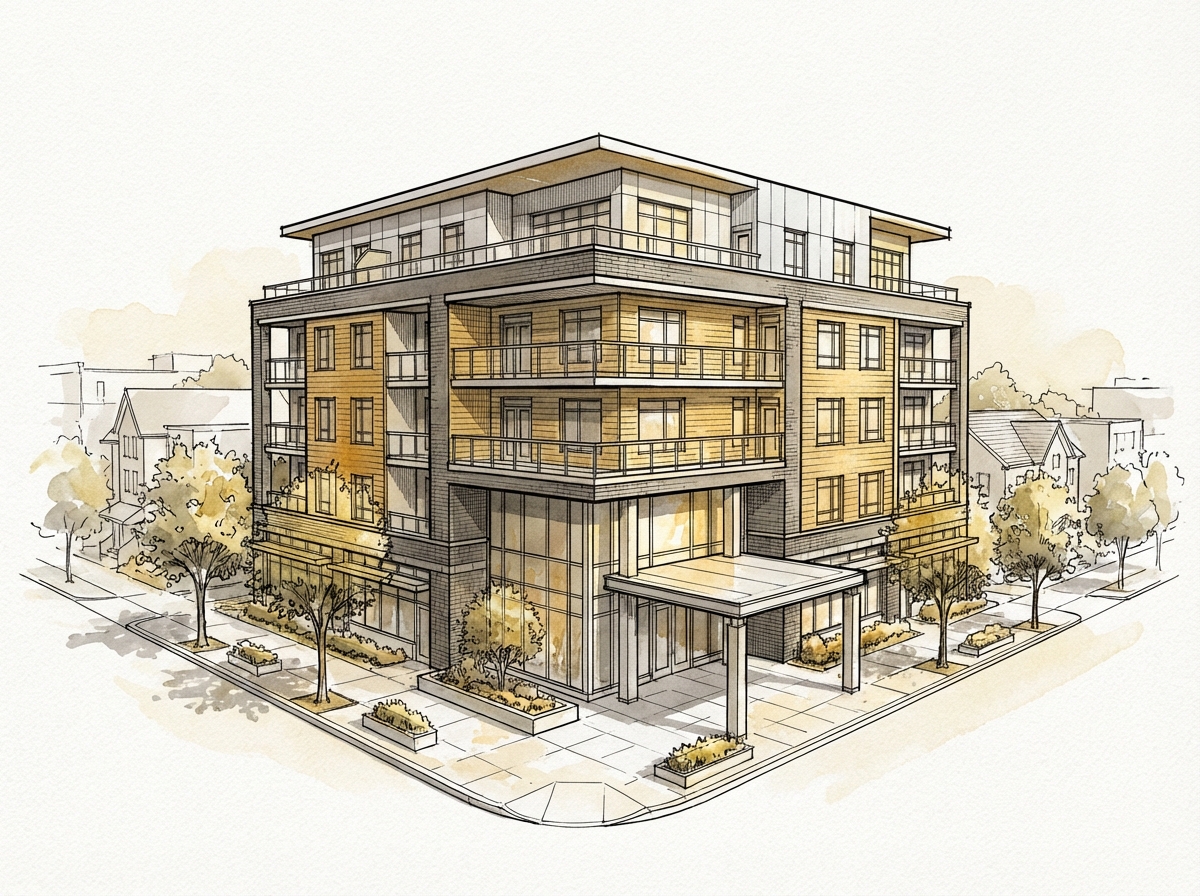
12-24 unit apartment buildings for sophisticated developers seeking institutional-quality urban infill projects with partnership opportunities.
✓
Economies of Scale
Per-unit costs decrease with larger buildings as fixed costs (design, permitting, project management) spread across more units. Shared systems (elevators, mechanical, common areas) become cost-effective.
✓
CMHC MLI Select Optimization
Larger unit counts maximize the benefits of CMHC's affordable housing programs, with potential for 95% LTC financing, 50-year amortization, and significant interest rate reductions.
✓
Institutional Quality Asset
Buildings at this scale meet institutional investor criteria, providing future exit options including sale to REITs, pension funds, or other institutional buyers.
✓
Professional Management Efficiency
Scale justifies dedicated on-site management or professional property management, improving tenant experience and operational efficiency.
✓
Amenity Package Viability
Unit count supports common amenities such as fitness rooms, parcel lockers, bike storage, and outdoor spaces that smaller buildings cannot economically provide.
Things to Consider
Important factors before you build.
Capital Requirements
Even with CMHC financing, equity requirements range from $500K to $1.5M+. Most individual investors lack the capital for projects at this scale.
Development Complexity
Elevator requirements, enhanced fire safety systems, and accessibility standards increase design and construction complexity significantly.
Approval Timeline
Development agreements and enhanced review processes can extend approval timelines to 6-12 months or longer, increasing carrying costs and project risk.
Operational Overhead
Common areas, elevators, and amenities require ongoing maintenance budgets. Professional property management is typically required.
Market Timing Risk
Longer development timelines (22-30 months) expose projects to market cycle risk. Rental market conditions at completion may differ from project inception.
Frequently Asked Questions
Does Helio build mid-size apartment buildings?
Selectively. Mid-size apartments (12-24 units) are beyond our typical project scope, but we engage with qualified opportunities through partnership models. We look for experienced developers with appropriate capital, major urban sites with strong fundamentals, and projects where our design-build expertise adds clear value. Contact us to discuss partnership possibilities for significant development sites.
What equity is required for a mid-size apartment project?
Even with CMHC MLI Select financing (up to 95% LTC for qualifying projects), expect to contribute $500K to $1.5M+ in equity depending on project size and CMHC qualification level. A typical 18-unit project at $6.5M total cost with 90% CMHC financing requires approximately $650K equity, plus reserves. Partnership structures can help qualified developers access larger projects.
Why is CMHC MLI Select essential for mid-size apartments?
At this project scale, conventional financing terms (75-80% LTV, 25-year amortization) result in marginal or negative cash flow. CMHC MLI Select transforms project economics through higher leverage (up to 95% LTC), extended amortization (up to 50 years), and below-market rates. The program requires meeting affordability, energy efficiency, and accessibility criteria, but these requirements align with best practices for institutional-quality development.
How long does a mid-size apartment project take from concept to occupancy?
Expect 22-30 months from site identification to full occupancy. The timeline includes 3-6 months for site selection and feasibility, 6-12 months for design and approvals (longer if development agreements are required), 12 months for construction, and 4-8 months for lease-up. Complex sites or development agreements can extend timelines significantly.
What makes a site suitable for a mid-size apartment building?
Ideal sites are 15,000+ sqft in HR-1 or HR-2 zones, with access to transit and urban amenities. Corner lots or through-lots provide design flexibility. Sites should have adequate municipal services and minimal environmental or heritage constraints. We evaluate sites based on zoning alignment, neighborhood context, access and parking, and development potential relative to existing or emerging area character.
Compare Building Types
Explore similar building types to find the right fit for your lot and budget.
Explore Mid-Size Apartment Building development opportunities across Nova Scotia. Each location page includes local rental data, zoning details, and a personalized feasibility snapshot.