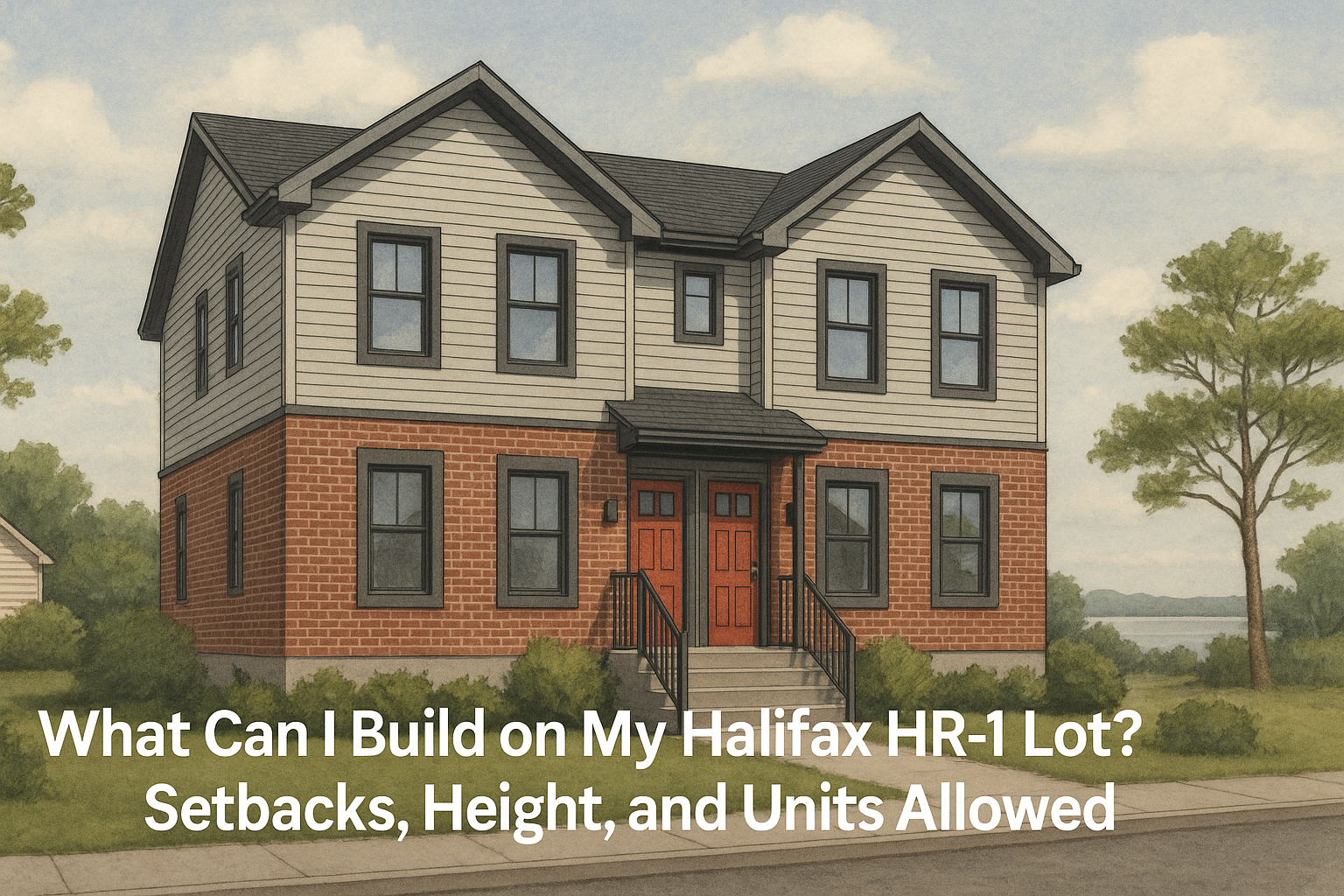
What Can I Build on My Halifax HR‑1 Lot? Setbacks, Height, and Units Allowed
If you own property in Halifax's Regional Centre, HR-1 zoning could let you build more than just a single-family home. This zoning, introduced in 2021 as part of the Halifax Centre Plan, allows for multi-unit housing like duplexes, triplexes, fourplexes, and even small apartment buildings. The number of units depends on lot size, setbacks, height restrictions, and parking requirements - not a fixed cap.
Key points:
- Building Types: Duplexes, triplexes, townhouses, fourplexes, and small apartment buildings.
- Unit Limits: No fixed cap; typically 6–8 units on a 15m-wide lot, more for larger lots.
- Height Rules: Multi-storey buildings allowed, with limits near residential zones.
- Setbacks: Govern how close buildings can be to property lines, stricter near residential zones.
- Parking/Outdoor Space: Each unit usually requires parking, and outdoor areas must meet liveability standards.
To maximize your lot's potential, consider Halifax's planning tools or consult city staff. For smooth construction, an integrated design-build approach avoids delays and cost overruns.
Building Types and Unit Limits on HR-1 Lots
What You Can Build on HR-1 Land
Halifax's updated HR-1 zoning rules aim to address housing shortages by allowing a variety of building types. These include fourplexes, small four-storey apartment buildings, townhouses (either stacked or side-by-side), duplexes, and triplexes, offering flexibility to suit different lot sizes and investment strategies.
Townhouses are a great option for wider lots, as they can accommodate multiple attached units. On the other hand, duplexes and triplexes are ideal for narrower lots where larger buildings might not meet setback requirements.
Let’s take a closer look at how unit limits are determined based on design and regulatory guidelines.
Maximum Number of Units Allowed
HR-1 zoning doesn’t impose a fixed cap on the number of units. Instead, the allowable unit count is shaped by factors like building form, setbacks, height restrictions, and parking requirements. For example, a standard 15-metre-wide lot can typically support 6–8 units, while larger lots might allow for 10–12 units.
The practical limits often come down to parking and outdoor space. Generally, each unit requires a parking spot, and there must be sufficient outdoor areas for residents. These requirements help balance density with liveability, ensuring developments remain functional and community-oriented.
Lot coverage rules also play a role. Buildings can only occupy a certain percentage of the lot, leaving room for parking, landscaping, and setbacks. Naturally, larger lots can handle more units, while smaller ones are restricted by their physical size rather than zoning rules.
This flexible approach to density sets the stage for a new way of thinking about urban design, as explained in the next section on updated density standards.
How Density Rules Have Changed
Under the old bylaws, there were strict limits on the number of units per property. HR-1 zoning takes a different approach, relying on performance-based standards that focus on efficient design rather than arbitrary caps. As long as your project meets height limits, setback requirements, and parking provisions, there’s no set maximum for unit count.
Building form standards are now the priority. For example, an 8-unit building that respects all design and setback rules is seen as more desirable than a poorly planned 4-unit structure that disregards neighbourhood integration or overuses lot space.
This shift is particularly beneficial for owners of larger or irregular lots. Properties like corner lots, deep parcels, or wider areas can now support developments that better reflect their size and potential. Instead of being held back by outdated unit limits, these lots can accommodate designs that align with their context.
The new rules also promote better-quality construction. Developers are incentivized to meet comprehensive building standards rather than just staying under a unit cap. This leads to thoughtfully designed buildings that enhance neighbourhoods while addressing the growing demand for rental housing.
Setback and Height Rules for HR-1 Properties
Required Setbacks from Property Lines
In Halifax's HR-1 zones, setback rules dictate how close buildings can be to property lines. For lots neighbouring Established Residential (ER) zones, these rules are more stringent to preserve the character of nearby neighbourhoods. At the same time, height restrictions play a key role in shaping the overall design of HR-1 developments.
Height Limits for Buildings
HR-1 zoning allows for multi-storey buildings, provided they adhere to standard height limits. However, when a building exceeds 20 metres in height and is next to an ER zone, any portion above 20 metres must be recessed by 3.0 metres [2].
A clear example of these height rules in action is the redevelopment of the Gray Arena [1]. Situated near an ER zone, the project was limited to seven storeys, or roughly 21 metres, to ensure compliance with HR-1 zoning guidelines.
| Requirement | Standard HR-1 | HR-1 Adjacent to ER | Impact |
|---|---|---|---|
| Stepback for portions over 20m high adjoining ER | Not specified | 3.0 metres [2] | Reduces upper floor area |
Other Factors That Affect Building Size
HALIFAX Home Owners May Have Just Won THE LOTTERY : Halifax Proposed Zoning Changes January 2024
sbb-itb-16b8a48
How to Follow Halifax Planning Rules
Navigating Halifax's HR-1 planning rules can seem daunting, but there are digital tools and consultation services available to make the process easier. The Halifax Regional Municipality provides several platforms to help ensure your project aligns with local zoning requirements.
Tools to Check Your Lot's Rules
Halifax Property Online is a great starting point. This tool allows you to access details like property boundaries, zoning designations, PDF zoning maps, and land use restrictions. It even includes aerial photography for a more comprehensive view of your lot[5].
For broader municipal data, ExploreHRM is another resource worth exploring. It offers an accessible online service that serves as a backup for quick access to municipal information[3][4].
If you need official documentation of your property's zoning status, ViewPoint, Halifax's online municipal portal, is the go-to platform. It provides interactive maps and zoning certificates, which are particularly useful for confirming zoning compliance[5]. Additionally, the Nova Scotia Geomatics Centre adds a provincial layer to your research, offering information on land use, environmental overlays, infrastructure, and property ownership. This is especially helpful for understanding how provincial regulations might intersect with your HR-1 development plans[5].
When these tools aren’t enough, consulting directly with planning staff can provide the clarity you need for more complex scenarios.
Getting Help from City Planning Staff
For a more tailored approach, reaching out to Halifax planning staff can make a big difference. They can help interpret local maps and bylaws in the context of your specific property. The Halifax Regional Municipality Planning Office provides personalized guidance, which is especially useful if your lot has unique features or irregular boundaries[5].
"Municipal planning offices often offer free consultations with zoning officers who can clarify complex rules and explain how they apply to your property." – casascotia.com [5]
These consultations go beyond what online tools can offer, providing site-specific insights and strategies to address potential challenges early on. Planning staff can also suggest ways to make the most of your lot while staying fully compliant with regulations.
If you have questions or want to book a consultation, Halifax's 311 service connects you directly with the relevant planning staff. This ensures you receive accurate and current information about your property and any updates to HR-1 regulations.
Getting the Most from Your HR-1 Lot
Understanding HR-1 zoning rules is only the beginning. The real challenge comes when it’s time to turn those rules into reality. What you can build on paper doesn’t always translate smoothly into an actual construction project. The approach you choose for building can make the difference between a profitable investment and an expensive headache. This is where the debate between traditional and integrated construction methods comes into play.
Problems with Standard Construction Methods
Traditional construction methods can create a tangled mess of complications, even for the most promising HR-1 projects. When you hire separate companies for design, engineering, and construction, you’re essentially piecing together a team of independent contractors who may never have worked together before - and that’s where the trouble starts.
Coordinating architects, engineers, and contractors often leads to miscommunication, design changes, and disputes. This fragmented setup puts you in charge of juggling six or more companies, each with its own schedule and priorities. The result? Delays, rework, and a lot of frustration.
Cost overruns of 30–60% are common with traditional methods. For example, if the electrician shows up before the plumber has finished, or if the engineer’s specs don’t align with the architect’s drawings, someone has to pay for the extra work. And that someone is usually you.
Delays are another major issue. What starts as an 8-month project can stretch to 18 months or longer. Every delay eats into your potential rental income. If your fourplex could generate $7,800 in monthly rent, a 10-month delay means $78,000 in lost revenue.
On top of that, traditional methods can feel chaotic. You’ll be signing multiple contracts, each with different penalty clauses, warranty terms, and accountability standards. When something goes wrong, figuring out who’s responsible can feel more like solving a legal puzzle than making a phone call. This is where integrated design-build offers a smarter alternative.
Why Integrated Design-Build Works Better
Integrated design-build simplifies the entire process by combining design, engineering, and construction under one roof. Instead of managing multiple contractors, you work with a single team that handles every phase of the project.
This approach offers single accountability - one contract, one warranty, and one point of contact. You’ll avoid disputes, and fixed pricing ensures there are no unpleasant budget surprises. Timelines are guaranteed, turning your construction schedule into a binding commitment. From day one, the design team collaborates directly with the construction crew, eliminating the miscommunications that often lead to delays and extra costs.
The process is systematic and predictable. Advanced scheduling tools coordinate every trade and delivery, ensuring work flows smoothly without the bottlenecks that typically drag out traditional projects.
How Helio Urban Development Can Help
Helio Urban Development takes the integrated design-build approach to the next level, offering tailored solutions for HR-1 projects. As the only company in the region specializing in 4+ unit rental properties, they’ve solved the three biggest challenges property owners face.
In August 2025, Helio’s integrated model saved property owners an average of $47,000 per project. Their fixed-price construction costs $160,000 per unit, with a guaranteed 6-month timeline backed by delay penalties.
Currently, Helio has 31 units under construction across Nova Scotia, with plans for 131 more. They’ve achieved zero cost overruns on all projects, proving that predictable, efficient construction is achievable when design and build teams work hand-in-hand.
The company’s leadership brings valuable expertise to HR-1 development. Lloyd Liu, a Yale MBA and former Merrill Lynch investment banker, personally reviews every quote, leveraging his experience from managing over $30 million in construction projects. Yuan He, a data scientist from the University of Pennsylvania, developed the scheduling system that cuts typical 12–18 month timelines down to just 6 months.
Helio’s construction package is designed to deliver quality and value. It includes ductless heat pumps, triple-pane windows, quartz countertops, engineered hardwood flooring, and high-end fixtures. Property owners can expect rental income of $1,950–$2,100 per unit, translating to annual returns of 12–20%.
For those looking to maximize financing, Helio offers CMHC MLI Select construction at $200,000 per unit. These energy-efficient builds qualify for 95% financing with 50-year amortization, making it possible to achieve positive cash flow from day one with minimal upfront capital.
Summary and Next Steps
HR-1 zoning presents a great opportunity for Halifax property owners to turn their land into rental income. However, understanding the regulations is just the first step - success lies in how efficiently and profitably you can bring your vision to life.
What HR-1 Zoning Lets You Build
Under HR-1 zoning, a single-family lot can be transformed into a multi-unit rental property, with the potential to build up to 14 residential units. This zoning allows for a range of building types, including duplexes, triplexes, fourplexes, and even larger multi-unit structures.
Height restrictions typically range from 2.5 to 3 storeys, depending on your lot and neighbourhood. Setback rules ensure the building fits well within the streetscape while maximizing the usable area. These guidelines give property owners room to plan strategically.
For instance, a thoughtfully designed fourplex on an HR-1 lot could bring in rental income of $7,800 to $8,400 per month. Over the course of a year, this could translate to returns between 12% and 20% - provided the project is planned and executed with care.
Tips for Property Owners
To make the most of your lot’s potential, here are some key steps to follow:
- Start with a site feasibility assessment. This will help you understand your lot's dimensions, setbacks, and density limits, avoiding surprises down the line.
- Consult with Halifax Regional Municipality planning staff. While online tools can provide a solid starting point, speaking directly with a planner can uncover specific details or considerations that might impact your project.
- Be strategic about your construction process. Traditional construction methods often lead to delays and cost overruns, cutting into your rental income.
An integrated design-build approach can help avoid these common issues. By combining all aspects of the project - design, construction, and management - under a single team, you benefit from fixed pricing, guaranteed timelines, and one point of accountability. For example, Helio Urban Development offers a streamlined design-build model with fixed costs and a 6-month completion timeline.
Think of your HR-1 project as a long-term investment. Partnering with experts who understand both the regulatory environment and the financial side of rental property development can help you fully realize your lot’s earning potential.
FAQs
How many units can I build on an HR-1 lot in Halifax?
In Halifax, HR-1 zoning permits the construction of multi-unit residential buildings, allowing for a maximum density of up to 14 units per lot. However, the actual number of units you can build on a specific lot isn't set in stone. It depends on several factors, including the size of the lot, setback requirements, and height restrictions.
If you're looking to make the most of your property, it’s crucial to dive into the zoning regulations and ensure your plans align with municipal guidelines. Working with a professional builder who has experience with HR-1 zoning can simplify the process and help you navigate the details to maximize your lot’s potential.
What are the benefits of using an integrated design-build approach for my HR-1 property in Halifax?
An integrated design-build approach streamlines your HR-1 project by merging the design and construction phases into one cohesive process. This eliminates many common issues like delays, miscommunication, and surprise expenses since a single team oversees every step from start to finish.
With one unified team handling the project, you’ll enjoy clear accountability, quicker progress, and predictable costs. This method keeps your project aligned with Halifax's zoning regulations, allowing you to make the most of your HR-1 lot with efficiency and ease.
What are the key zoning rules for building on an HR-1 lot in Halifax, including setbacks and height limits?
To develop on an HR-1 zoned lot in Halifax, you’ll need to meet specific zoning requirements, particularly around height, setbacks, and density. For instance, buildings can’t exceed four storeys or 14 metres in height. Front setbacks must fall between 3 and 6 metres, while side and rear setbacks depend on the lot’s location. If your property borders an established residential zone, a 6-metre setback is typically required.
You’ll also need to factor in Floor Area Ratio (FAR), lot coverage, parking spaces, and landscaping standards. These guidelines are meant to balance new developments with the area’s character while making the most of the property’s potential. Getting familiar with these rules early on can streamline your project and ensure compliance.