The Complete Guide to Nova Scotia Zoning for Multi-Unit Construction
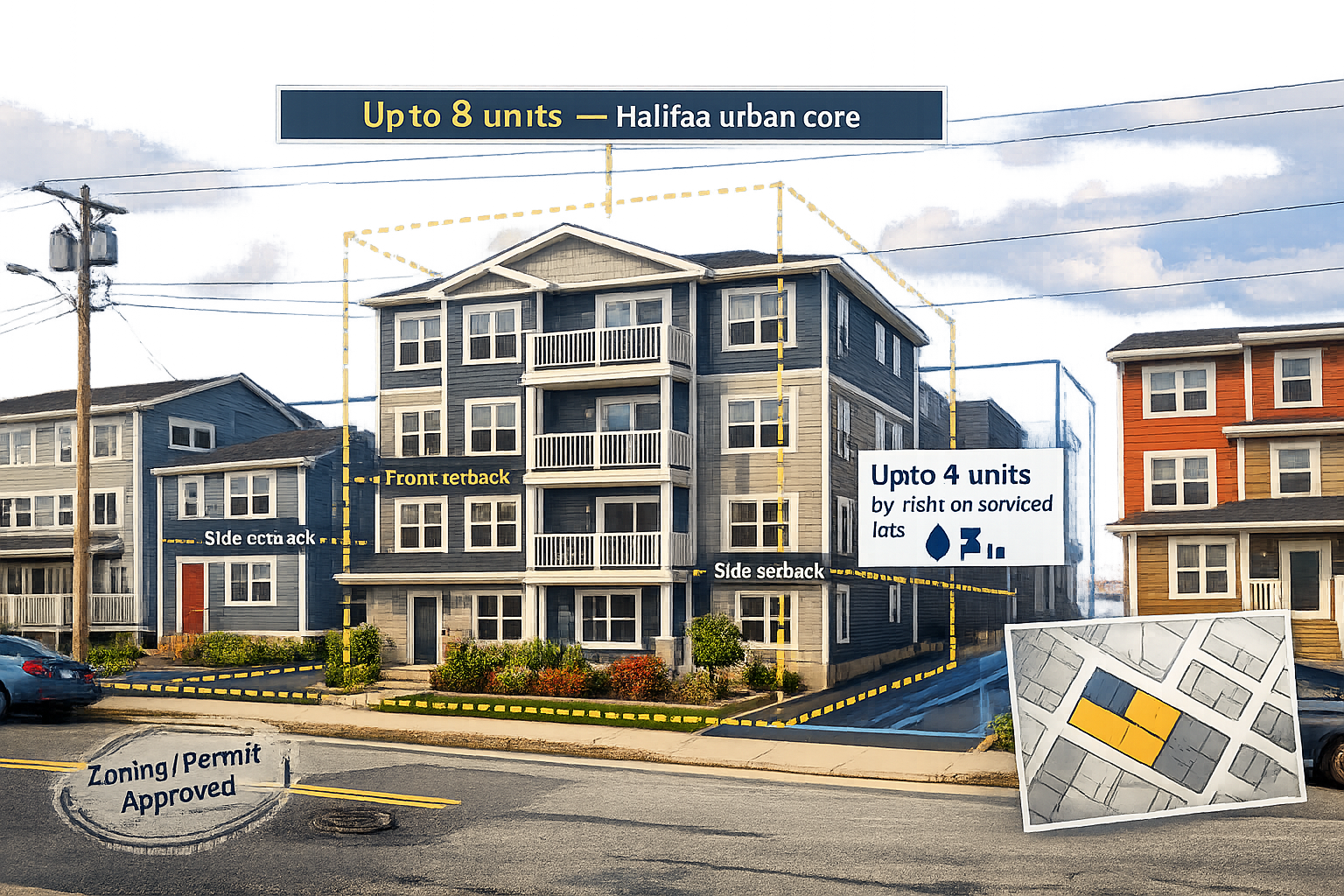
If you're thinking about building a fourplex, sixplex, or eightplex in Nova Scotia, the first question is simple: does your land qualify? Zoning rules decide what you can build, how many units you can include, and whether you’ll need to rezone. For example, as of January 2024, Halifax allows up to four units on serviced lots and up to eight units in the urban core without rezoning. This change can save you months of delays, but only if your lot meets the requirements.
This guide breaks down Nova Scotia’s zoning categories, explains where you can build multi-units as-of-right, and covers setbacks, density, and permits. By the end, you’ll know exactly what steps to take - whether you’re planning a fourplex in Halifax or an eightplex in Kings County.
Nova Scotia Zoning Categories and Multi-Unit Building Permissions Guide
How neighbourhood zoning changes will help housing demand
sbb-itb-16b8a48
Main Zoning Categories for Multi-Unit Buildings
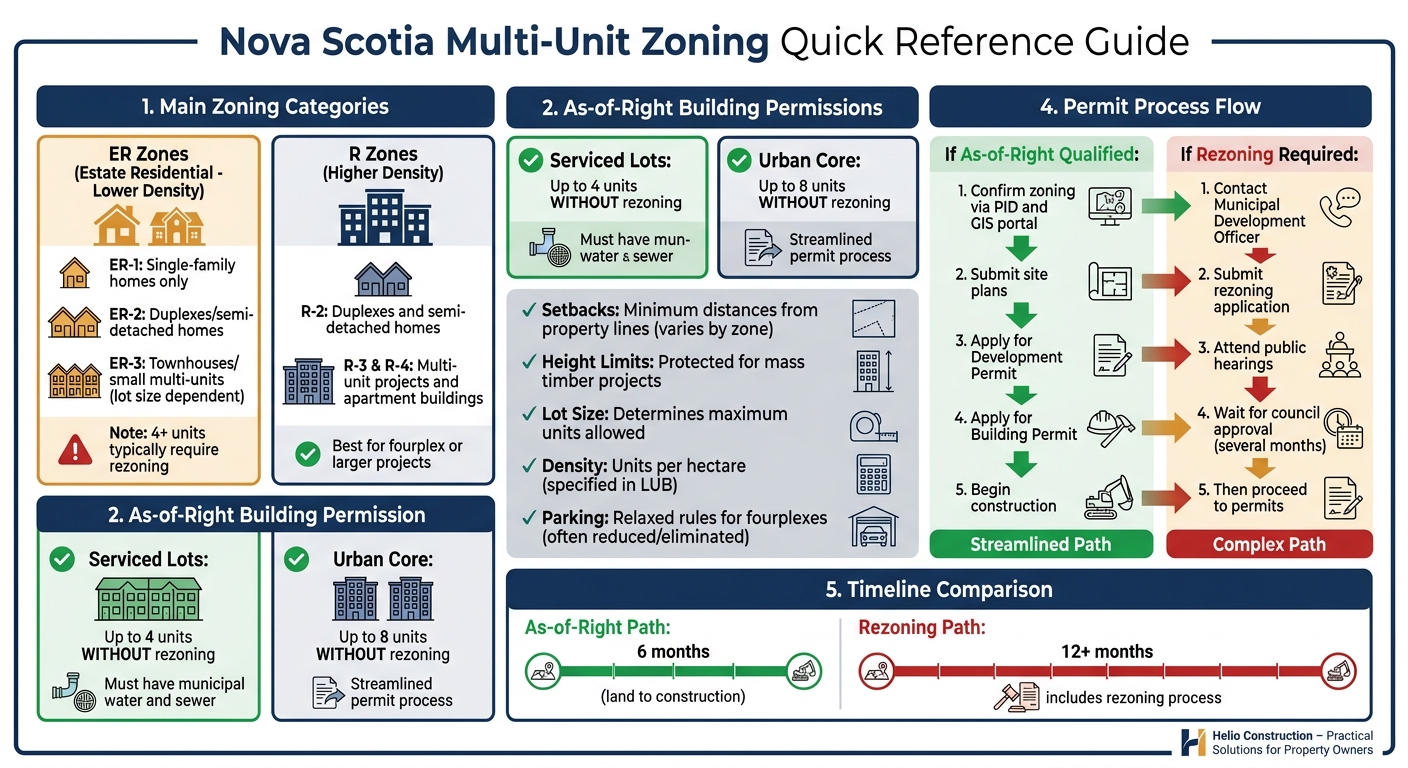
In Nova Scotia, municipalities generally follow a similar zoning framework. The primary zones relevant for multi-unit construction include the ER zones (ER-1, ER-2, ER-3) and the R zones (R-2, R-3, R-4). Each zone outlines specific rules about the number of units allowed and overall density, making it essential to understand these details before purchasing land or starting a project. Let’s start with the ER zones commonly found in Halifax and nearby areas.
ER-1, ER-2, and ER-3 Residential Zones
The "ER" (Estate Residential) zones are prevalent in Halifax and surrounding municipalities. These zones are generally lower density and aim to maintain the character of existing neighbourhoods.
- ER-1: Typically limited to single-family homes.
- ER-2: Allows duplexes or semi-detached homes.
- ER-3: Permits slightly higher density, such as townhouses or small multi-unit buildings, depending on lot size and available services.
However, ER zones are not ideal for larger projects. For instance, buildings with 4 or more units usually aren’t allowed without rezoning. If you’re looking at properties in ER-1 or ER-2 zones but planning a larger build, you’ll likely need to rezone to R-3 or R-4. This process can be time-consuming and doesn’t guarantee approval. We’ll discuss rezoning challenges for ER zones later on.
R-2, R-3, and R-4 Zones
For higher-density projects, the R zones offer more flexibility:
- R-2 (Two-Unit Residential): Permits duplexes and semi-detached homes but restricts larger buildings like fourplexes unless rezoning is approved.
- R-3 and R-4: These zones are designed for higher-density residential use, accommodating multi-unit projects, including apartment buildings.
Some municipalities include specific conditions in R-3 and R-4 zones to ensure long-term rental housing remains available [1].
Key takeaway for property owners: If your goal is to build a fourplex or larger, focus on properties already zoned as R-3 or R-4. This approach minimizes the risk of rezoning delays and aligns better with your project timeline. Choosing the right zoning from the start can save significant time and avoid unnecessary hurdles.
As-of-Right Building Permissions
Understanding zoning categories is key, but as-of-right development takes things a step further, offering a straightforward route for multi-unit construction. With as-of-right (or by-right) development, property owners can build projects that align with existing zoning by-laws without needing rezoning, public hearings, or council approvals. If your project complies with the Nova Scotia Building Code and local land-use rules, you can directly apply for a building permit, skipping the drawn-out rezoning process altogether.
Which Zones Allow 4+ Unit Buildings As-of-Right
In Halifax, serviced lots - those connected to municipal water and sewer systems - permit up to 4 units to be built by-right. For properties within Halifax's urban core, the allowance increases to up to 8 units per lot. Starting January 2024, these updated rules remove the need for rezoning for anything beyond single detached homes.
For example, if you’re planning a fourplex on a serviced lot in Halifax, you can avoid the rezoning process entirely. Instead, you’ll focus on submitting your site plans, architectural drawings, and engineering reports directly to the municipality. The same applies to building an eightplex in the urban core, making the process more predictable and efficient.
Benefits of As-of-Right Zoning
The primary advantage of as-of-right zoning is certainty. As Casa Scotia explains:
"A development agreement is a negotiated contract between you and the municipality... traditional rezoning can take several months without guarantee of approval" [1].
With as-of-right development, meeting the technical requirements ensures approval, eliminating the need for political negotiations or extended community hearings.
This streamlined approach reduces delays, lowers legal and consulting fees, and speeds up the transition from land acquisition to generating rental income. For property owners partnering with design-build firms, this can significantly cut project timelines, making it easier to move from planning to completion.
Setbacks, Lot Size, and Density Requirements
When planning your development, legal parameters are just the beginning. The physical constraints of your site - like setbacks, lot size, and density limits - can significantly shape your project's design. Getting these calculations right early on can save you from expensive redesigns later.
Setback and Height Limits
Setbacks define how far structures must be from property lines, and these rules differ depending on your municipality and zoning. In Halifax, January 2024 updates have eased setback rules for higher-density projects, but specifics still depend on your zoning overlay. For instance, swimming pools and their equipment must be at least 1.22 metres (4 feet) from side or rear property lines[2]. Detached garages cannot be placed in front yards and have reduced setback requirements for side and rear yards.
Height limits, especially for mass timber projects, are protected under provincial rules to prevent density reductions. This means local caps won’t reduce your unit count. In Halifax's urban core, these regulations give you more room to maximize your lot’s potential without sacrificing density[3].
To avoid issues, check setback distances early using your municipality’s GIS portal. If your design slightly exceeds setback limits, you might resolve it through a variance application with the local development officer, sidestepping the need for a full rezoning process[1].
Calculating Lot Size and Permitted Density
Your lot’s size and zoning dictate how many units you can build. In Halifax, serviced lots allow up to 4 units by-right, while urban core lots permit up to 8 units without additional approvals[1]. Beyond these by-right limits, density depends on your Land Use Bylaw (LUB). Multi-unit residential developments may be permitted outright, conditional, or require a development agreement.
Start by locating your property’s PID through your tax assessment and confirming your zoning using GIS tools like HRM Online Maps[1]. For zones like R-3 and R-4, which cater to multi-unit and higher-density buildings, the LUB specifies frontage, lot area, and maximum units per hectare. If your project doesn’t align with these rules, you’ll need a development agreement. This process involves public hearings and council approval, so it’s best to factor in the added time and complexity[1].
Rezoning and Building Permits
Once you've confirmed your lot's dimensions and density, the next step is navigating the approval process. Depending on your property's zoning and the scale of your project, you might need to rezone before applying for permits. Knowing when rezoning applies - and how to handle permits - can save you both time and money. Let's break it down.
When Rezoning is Required
Rezoning is necessary when your proposed multi-unit project doesn't match your property's current zoning classification. To determine this, reach out to your Municipal Development Officer and review the local Land Use By-Law. For instance, if your lot is zoned for single-family homes but you plan to build a fourplex, you'll need to apply for a zoning amendment. This process involves submitting an application, attending public hearings, and waiting for council approval.
Key update for Halifax property owners: Starting January 2024, Halifax's zoning reforms remove the need for rezoning on serviced lots for up to 4 units, or up to 8 units in the urban core. If your project fits these limits, you can skip rezoning and go straight to applying for permits. However, if you're outside Halifax or exceed these thresholds, you'll still need to go through the rezoning process. This change simplifies the process for many projects, helping you avoid unnecessary delays.
How to Secure Building Permits
Once rezoning is complete (if required), you can move forward with obtaining permits. Construction projects typically need two types of permits:
- Development Permit: This confirms your project aligns with the Land Use By-Law, including rules on setbacks, density, and land use.
- Building Permit: After the Development Permit is approved, this ensures your construction complies with the National Building Code.
For example, in the Municipality of Yarmouth, a Building Permit is mandatory for any structure over 20 square metres (215 square feet). Even non-structural repairs or alterations valued at $5,000 or more may require a Building Permit in some areas.
Before drafting site plans, request a property survey to confirm property lines and setbacks. If you're converting a non-residential building for residential use, you'll also need a "Change of Use" permit - even if no structural changes are involved. Keep in mind that permit timelines can vary depending on the municipality, so plan accordingly.
Real Project Examples
Building on the zoning categories and permit processes discussed earlier, these examples highlight how zoning rules translate into actual development projects. Theoretical guidelines often meet practical hurdles, and these cases from Halifax and Kings County show how zoning changes and municipal requirements impact multi-unit developments in Nova Scotia.
Example: Fourplex in Halifax
Since January 2024, Halifax Regional Municipality has simplified the process for building a fourplex on serviced lots with municipal water and sewer access. These lots now qualify as-of-right, meaning property owners can bypass rezoning. The process is straightforward: submit site plans that meet setback and lot coverage rules, confirm the lot can support the building, and move directly to the Development Permit stage.
This shift cuts down the time from buying land to applying for permits, provided the lot is already serviced and meets basic size requirements. A key change is the relaxed parking rules - secondary or backyard suites no longer require parking spaces, and many fourplexes can reduce or skip parking altogether. Additionally, each unit gets its own civic address during permitting, making tenant management and property administration simpler[4].
Example: Eightplex Rezoning in Kings County
While Halifax has streamlined processes, rural areas like Kings County present different challenges. Building an eightplex here still requires rezoning, as larger multi-unit projects often exceed lower-density residential zoning limits. Rezoning involves applying through the Municipal Development Officer, submitting detailed site plans, and navigating public hearings and council approvals.
To succeed, the project must meet strict requirements under the Building Code, including setbacks, density limits, and proof of infrastructure capacity. Septic systems are a common hurdle in rural areas. If the land’s natural capacity falls short, engineered septic solutions may be required, adding both cost and time to the process. These steps illustrate how rural zoning rules can significantly impact project timelines and budgets.
How to Evaluate Your Property
Checking Your Property's Zoning Status
The first step is finding your Property Identification Number (PID). You can locate it on your tax assessment or by visiting the PVSC website. Once you have your PID, head to your municipality's GIS portal - Halifax property owners, for instance, can use HRM Online Maps. From there, download the Land Use Bylaw (LUB) to confirm your property's zoning and whether it allows multi-unit development as-of-right [1].
What this means for property owners:
If your property is zoned as R‑3, R‑4, C‑1, C‑2, or MU, you're likely in the clear for multi-unit development without additional approvals. However, R‑1 or R‑2 zones usually require rezoning or a development agreement to proceed.
Once you’ve confirmed your zoning, you can start planning the next steps for your project.
What to Do Next
If your zoning doesn’t allow as-of-right multi-unit development, reach out to municipal planning staff. They can guide you on applying for a development agreement or requesting a variance for smaller issues like setbacks [1].
Next, dive into the specifics of your municipality’s LUB to understand setback, density, and lot coverage requirements. This will help you figure out if your lot is large enough to support the number of units you want to build. For instance, if you're in Halifax and planning a fourplex on serviced land, the as-of-right process can fast-track you to site planning and permit applications. On the other hand, larger projects or rural properties may require more time for rezoning, engineered septic systems, or infrastructure upgrades. Take the example of an eightplex in Kings County - these additional steps can extend your timeline significantly.
Conclusion
Nova Scotia's zoning rules are the backbone of successful multi-unit developments. The introduction of by-right permissions - allowing up to four units on serviced lots and up to eight units in Halifax's urban core without needing rezoning - has expanded what property owners can build. To make the most of these changes, you need to know your property's zoning designation, confirm municipal water and sewer servicing, and understand the setback and density rules outlined in your municipality's Land Use Bylaw.
For property owners, the difference between a six-month build and a year-long rezoning process often comes down to by-right qualification. Properties zoned for multi-unit use (commonly R-3, R-4, or MU in serviced areas) provide the most straightforward path to construction. In contrast, properties in lower-density residential zones may require additional steps like development agreements or variances.
To move forward, start by locating your PID and checking your zoning through your municipality's GIS portal. If your lot qualifies for multi-unit by-right development, you can jump straight to site planning and permitting. If not, consult with municipal planning staff to explore your options. Since January 2024, the regulations have offered more flexibility, but understanding the specific requirements remains essential.
Across the province - from Halifax to Kings County to Lunenburg - each municipality’s Land Use Bylaws dictate lot coverage, height, and density limits. Being familiar with these rules can save you months of delays and significant costs. Whether you're planning a fourplex on a serviced Halifax lot or rezoning for an eightplex in a rural area, confirming your zoning status is the critical first step to turning your property into a profitable rental development.
FAQs
How do I know if my lot is “serviced” and qualifies for by-right units?
A lot is classified as “serviced” if it has access to municipal water and sewer systems. In Halifax, these serviced lots can accommodate up to four units without requiring rezoning. To verify this, review your lot's zoning designation and service status using municipal resources or by reaching out to the local planning office. Additionally, ensure the lot complies with zoning requirements such as setbacks, minimum lot size, and height restrictions to qualify for by-right development.
What’s the difference between a variance and a rezoning?
Rezoning and variance requests serve different purposes when it comes to land use regulations.
Rezoning involves changing the zoning classification of a property to permit different or expanded types of development. This process is more involved, requiring a formal application, public consultations, and municipal approval. It can take several months to complete.
On the other hand, a variance allows for a specific exception to existing zoning rules - such as setbacks or height restrictions - without altering the overall zoning category. Variances are generally quicker and less demanding to secure compared to rezoning.
What documents do I need before applying for a Development Permit and Building Permit?
To get Development and Building Permits in Nova Scotia, make sure you have the following:
- Site plans and drawings: These should detail the layout, setbacks, lot coverage, building height, and parking arrangements.
- Zoning confirmation: Ensure the intended use aligns with municipal zoning regulations.
- Site-specific details: Include information like lot size, required setbacks, and any heritage or environmental considerations that might apply.
- Completed application forms: Obtain these from your local municipal office.
Since requirements can differ between municipalities, it's a good idea to consult your local planning department for a precise list of what’s needed.