Nova Scotia Construction Costs 2026: What Property Owners Are Actually Paying
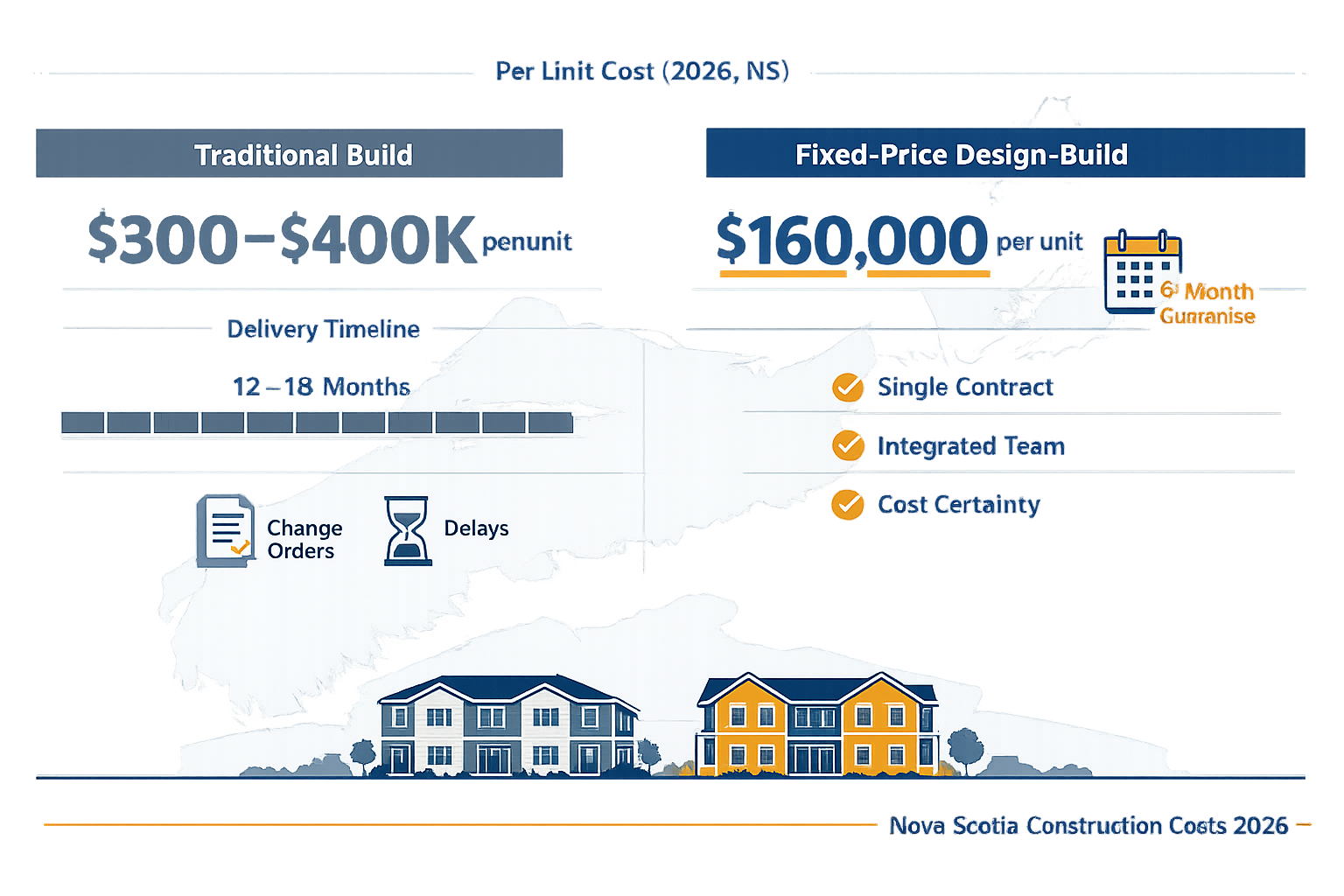
If you're planning to build a rental property in Nova Scotia this year, you're likely wondering: how much will it actually cost? In 2026, constructing a typical 4-unit rental building in the province will set you back between $1.2 million and $1.6 million, or $300,000 to $400,000 per unit. However, using a fixed-price, integrated design-build approach like Helio Urban Development’s, you could cut that to $160,000 per unit, or $640,000 for a fourplex.
This article breaks down the numbers so you can make informed decisions. We'll cover per-unit costs, regional price differences, and how fixed-price contracts can shield you from rising labour and material costs. Whether you're building in Halifax or a rural area, you'll leave with a clear understanding of what you'll pay and how to budget effectively.
Nova Scotia Construction Costs 2026: Build New vs Buy Existing Fourplex Comparison
New Construction in Halifax Part One. How Much Does It Cost? How to Select a Builder?
sbb-itb-16b8a48
Per-Unit Costs for 4+ Unit Rental Properties
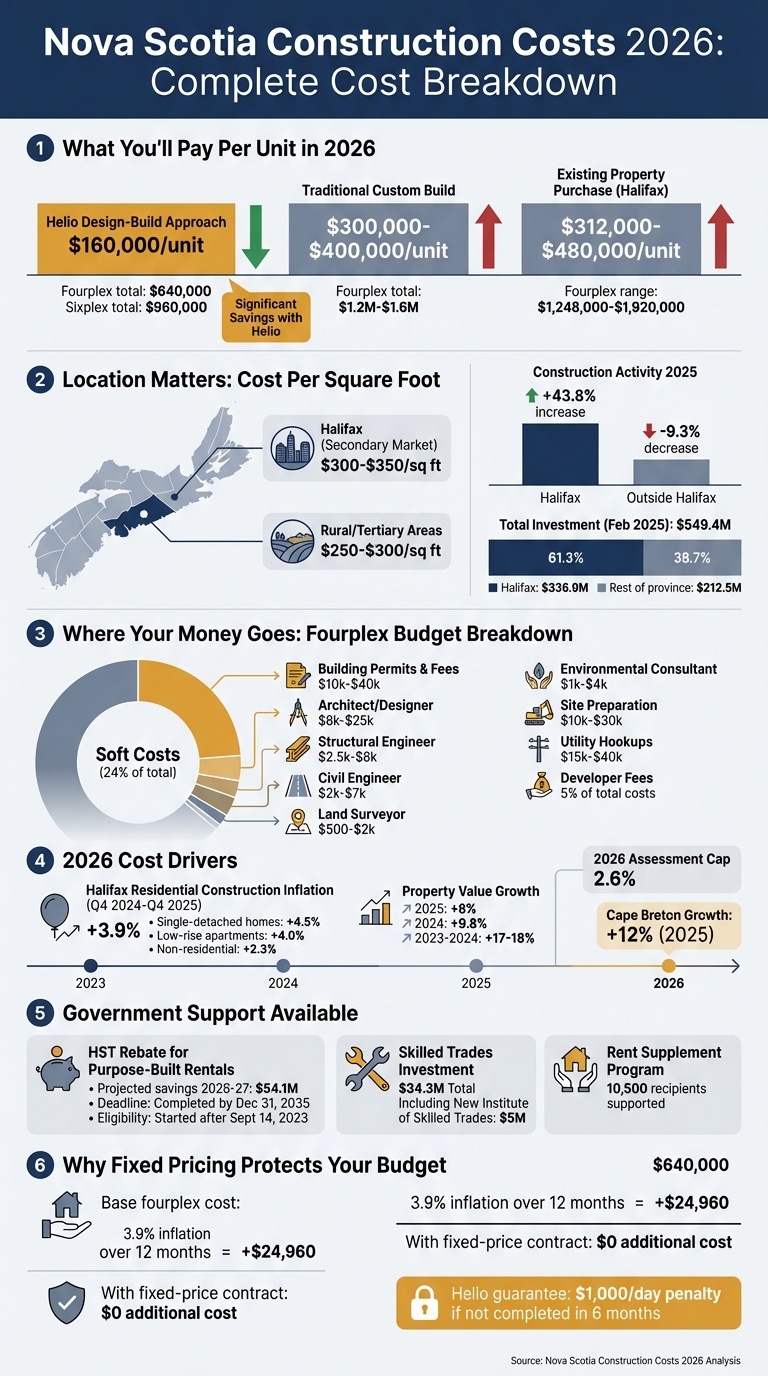
By 2026, property owners in Nova Scotia constructing multi-unit rental properties will encounter varying costs per unit depending on their chosen construction method. Helio Urban Development, using an integrated design-build approach with standardized plans and fixed pricing, achieves per-unit costs of approximately $160,000 for fourplexes and sixplexes. For instance, a fourplex built through this model costs about $640,000 in total, while a sixplex comes in around $960,000. On the other hand, traditional custom-build methods, often relying on cost-plus contracts, result in much higher per-unit costs. For comparison, buying an existing four-unit property in Halifax currently ranges between $1,248,000 and $1,920,000, translating to $312,000 to $480,000 per unit. This stark contrast underscores the immediate equity advantage of building new with a fixed-price, integrated approach.
Regional factors also play a key role in influencing these costs. In secondary markets like Halifax, new construction typically costs between $300 and $350 per square foot [3]. Meanwhile, in tertiary or rural areas, costs drop to $250 to $300 per square foot [3]. However, lower labour expenses in these areas can be offset by higher transportation costs and longer permit approval times.
Standardized designs further minimize the impact of building size on per-unit costs, a distinct advantage of the integrated design-build model. This approach spreads fixed expenses - such as permits, site preparation, and professional fees - across multiple units, unlike traditional custom builds, where these costs are concentrated on fewer units, driving up the per-unit price.
What Goes Into the Total Cost: Materials, Labour, Permits, and Fees
Breaking down costs helps you compare quotes and pinpoint potential overruns. For multi-unit rental properties in Nova Scotia, total development costs fall into three main categories: materials and finishes, labour, and soft costs (like permits, professional fees, and development charges). Helio simplifies this process by bundling everything into a fixed-price contract, which includes architectural drawings, engineering specs, permit applications, and construction. This approach protects property owners from unexpected market shifts and cost overruns[7].
Materials and Finishes
Material costs depend on the level of finishes you choose, but fixed-price contracts now include these expenses, shielding owners from price jumps. In Nova Scotia, inflation in residential construction is a reality. For instance, Halifax saw residential building costs rise by 3.9% from Q4 2024 to Q4 2025, compared to a 2.3% increase for non-residential projects[1]. Without a fixed-price agreement, this inflation could significantly impact your project. For example, a 3.9% rise in material costs over a 12-month build could add $24,960 to a $640,000 fourplex budget.
Let’s move on to how labour costs add to the overall project expenses.
Labour Costs in 2026
Labour shortages are one of the biggest challenges for construction projects in Nova Scotia, alongside land availability and financing. As Rob Lough, Broker/Owner at Century 21 Optimum Realty, puts it:
No housing supply discussion is complete without addressing the labour gap... training today's apprentices means more capacity to build tomorrow's homes.
The provincial government has allocated $34.3 million to expand skilled trades, including $5 million for a new Institute of Skilled Trades[8]. While these efforts are a step forward, the current labour shortage continues to push up costs and delay timelines. Inflation and supply chain disruptions compound this issue. For example, a single school project in Springhill saw its budget balloon by $8 million, reaching $30 million[9]. Public Works Minister Kim Masland highlighted the challenge:
We've always dealt with supply issues, with cost demands... Now we're seeing inflation at unprecedented times.
Labour shortages don’t just strain budgets - they can also add months to your project timeline.
Now, let’s look at soft costs and how they influence your overall budget.
Permits, Development Fees, and Professional Services
Soft costs - such as permit fees, architectural services, and construction loan interest - typically account for around 24% of total development costs[3]. Here’s what you can expect for a fourplex in Nova Scotia:
| Service/Fee Category | Estimated Cost Range |
|---|---|
| Building Permits & Fees | $10,000 – $40,000 |
| Architect / Designer | $8,000 – $25,000 |
| Structural Engineer | $2,500 – $8,000 |
| Civil Engineer | $2,000 – $7,000 |
| Land Surveyor | $500 – $2,000 |
| Environmental Consultant | $1,000 – $4,000 |
| Site Preparation | $10,000 – $30,000 |
| Utility Hookups | $15,000 – $40,000 |
Urban areas like Halifax tend to have higher costs due to stricter building codes and elevated labour rates. On the other hand, rural areas might offer savings on permit fees but could face increased transportation and delivery costs for materials[5]. Developer fees usually amount to 5% of the combined soft and hard costs[3]. In a design-build model, services like architectural drawings, engineering specs, and permit applications are included in the total project price[7]. This eliminates the hassle of coordinating multiple professionals and reduces the risk of unexpected overruns.
Halifax HRM vs Other Nova Scotia Regions: Cost Differences
In 2025, Halifax saw a sharp 43.8% jump in construction activity compared to the previous year, while areas outside the city experienced a decline of 9.3%. This contrast highlights disparities in demand, labour supply, and access to materials [2]. Residential construction costs in Halifax also climbed by 3.9% between Q4 2024 and Q4 2025, with single-detached homes seeing the highest increase at 4.5% [1]. For property owners, building in Halifax often comes with higher upfront expenses due to elevated labour costs and stricter regulations. On the other hand, rural projects may offer savings on land and permit fees, though these are often offset by higher transportation costs and potential delays. These regional differences directly shape the financial landscape of your project.
Why Location Affects Your Budget
The cost variations across Nova Scotia primarily arise from differences in labour availability and municipal fee structures. Halifax’s construction boom has drawn skilled trades to the city, reducing delays compared to rural areas where a smaller labour pool can slow projects. As Jeff Caddell, Director at Property Valuation Services Corp, explains:
It appears, just based on those trends that we're seeing, that there is more of a demand for lower-priced homes outside of those urban areas [4].
This trend has led many property owners to explore duplexes and multi-unit developments in regions like Cape Breton. In 2025, residential property values in Cape Breton rose by 12%, surpassing the provincial average growth of 8% [4].
Halifax suppliers, benefiting from higher demand, maintain larger inventories and offer more frequent deliveries, which helps avoid delays. In contrast, material deliveries to rural areas may take longer and cost more. Additionally, Halifax’s complex zoning regulations drive up permit fees and development charges. Smaller municipalities may charge less for permits, but their approval processes can be slower. By February 2025, total construction investment in Nova Scotia hit $549.4 million, with $336.9 million concentrated in Halifax and $212.5 million in the rest of the province [2].
What's Driving 2026 Construction Costs: Labour, Materials, and Market Trends
Labour shortages remain a major factor shaping construction budgets in 2026. Nova Scotia's 2026–27 provincial budget allocates $34.3 million to grow the skilled trades workforce, with $5 million set aside for a new Institute of Skilled Trades [8]. As Rob Lough, Broker/Owner at Century 21 Optimum Realty, aptly puts it:
No housing supply discussion is complete without addressing the labour gap [8].
The shift from single-family homes to multi-unit developments has intensified competition for skilled workers [4]. This demand is reshaping project priorities, with multi-unit construction taking centre stage as developers face ongoing labour constraints.
On the cost front, there are signs of stabilization. Residential property values increased by 8% in 2025, a slower pace compared to 9.8% in 2024 and the sharp 17–18% growth seen in 2023–2024. For 2026, the residential assessment cap is set at 2.6%, aligning with current inflation rates [4]. Material costs have levelled off as supply chains recover, but labour expenses continue to rise due to the persistent skills gap.
While training investments show promise for long-term workforce stability, they won't deliver immediate relief. Property owners can take advantage of the provincial HST rebate for purpose-built rentals - available for projects completed by 2035 - to help counterbalance rising labour costs [8]. This rebate, alongside other financial strategies, provides a practical way to manage the evolving construction landscape.
Building New vs Buying Existing: Total Project Costs Compared
Property owners face a critical choice: should they build new or purchase an existing property? The decision hinges on factors like total project costs, financing options, and long-term returns. In Nova Scotia's 2026 market, this choice has become more balanced, thanks to tax incentives for new construction and the potentially higher upkeep costs tied to older buildings. Let’s break down the numbers and considerations.
Fourplex Example: Build vs Buy
Take the example of a fourplex. Helio Urban Development offers a fixed construction cost of $160,000 per unit, bringing the total construction cost to about $640,000 (excluding land costs). On the other hand, buying an existing fourplex in a comparable location often comes at a premium, making new construction a more cost-effective option.
New builds also benefit from tax rebates. The HST and federal GST rebates can significantly lower the effective cost of construction. As Rob Lough, Broker/Owner at Century 21 Optimum Realty, explains:
This [HST rebate] is arguably the single most impactful measure in the budget for real estate investors [8].
For property owners, these rebates can make a substantial difference in project affordability.
Existing properties, however, come with hidden costs. Nova Scotia’s 2026 provincial assessment cap is set at 2.6%, shielding current owners from sharp tax hikes. But this cap resets to full market value when a property is sold [4]. For instance, if you buy a property at its full market price, the reassessment could lead to significantly higher property taxes. In contrast, new builds are assessed at market value from the start, offering more predictable tax planning over the long term.
Return on Investment Over Time
Beyond initial costs, new construction offers better financial returns over time. Maintenance expenses for new builds are typically minimal during the first 10 years, whereas older properties often require immediate upgrades or repairs. This alone can save property owners thousands in early capital expenditures.
Modern construction standards also improve energy efficiency, cutting utility bills and making units more attractive to renters. Additionally, Nova Scotia’s expanded rent supplement program now supports 10,500 recipients, offering landlords government-backed rental income and reduced default risks [8]. As Jeff Caddell, Director at Property Valuation Services Corporation, notes:
We're seeing more of a focused demand for homes, those smaller-type homes, semi-detached townhouses, duplexes, multi-unit [4].
Construction costs for low-rise apartments in Halifax rose by only 4.0% in 2025 [1], meaning the equity gains from building new continue to outpace the modest increases in labour and material costs.
For property owners: In 2026, building new provides a competitive edge. Upfront costs are on par with buying existing properties, but the long-term advantages - tax savings, lower maintenance, and energy-efficient designs - make new construction a smarter choice. Plus, the HST rebate for projects completed by 2035 adds urgency for those considering this route.
How Helio Urban Development Delivers $160K Per Unit with Fixed Pricing
Helio Urban Development's pricing of $160,000 per unit is a standout figure in Nova Scotia's 2026 construction market. This price isn’t achieved by compromising on materials or cutting corners. Instead, it's the result of an integrated design-build approach that simplifies the process and eliminates the layers of markups typical in traditional builds. This method ensures predictable costs and smooth project coordination.
What Integrated Design-Build Means
In the traditional construction model, you’re juggling multiple contracts - architects, engineers, contractors - each adding their own markup and increasing the risk of delays. Helio flips this model on its head by combining all disciplines under one contract. From the start, architects, engineers, construction crews, and project managers collaborate, allowing cost-saving strategies to be baked into the design phase [3]. Helio also takes care of permit acquisition, cutting down on administrative bottlenecks and keeping soft costs in check.
Why Fixed-Price Contracts Eliminate Cost Overruns
Helio’s fixed-price contracts build on the integrated design-build model by locking in costs upfront, shielding property owners from market volatility. This is especially important in 2026, where unpredictability in labour and material costs can wreak havoc on budgets. For example, copper prices shot up 36% year-over-year in early 2026 [10], and ongoing labour shortages in Nova Scotia have driven wages higher. Traditional cost-plus contracts leave owners vulnerable to these fluctuations.
With Helio, the total price is set before construction begins. You’ll know exactly what you’re paying, no matter how the market shifts. Plus, the contract includes a $1,000-per-day penalty if Helio fails to meet the guaranteed 6-month timeline, aligning their priorities with yours. Helio absorbs the risks of material price increases and labour shortages, not you.
For property owners: In a market where Halifax construction costs rose 3.9% from Q4 2024 to Q4 2025 [1], locking in a fixed price now can safeguard your budget against further hikes. Combine this with the provincial HST rebate for new purpose-built rental projects [8], and Helio’s $160,000 per unit pricing becomes a smart financial move. It’s a compelling case for building new rather than buying existing properties.
What Property Owners Should Know Before Building in 2026
As you plan to build a multi-unit rental property in Nova Scotia in 2026, there are several key factors to keep in mind. Construction costs have been anything but stable - Halifax alone saw a 3.9% price increase from Q4 2024 to Q4 2025, and utilities, demolition, and plumbing costs remain under pressure [1]. This volatility makes careful budgeting and cost management essential.
One major advantage for property owners in 2026 is the provincial HST rebate for purpose-built rental projects. This rebate is projected to save developers $54.1 million in 2026–27 and applies to projects started after September 14, 2023, that are completed by December 31, 2035 [8]. When combined with federal GST/HST rental rebates, it can significantly reduce your soft costs, making your project more financially viable.
Speaking of soft costs, plan for these to take up about 24% of your total project budget [3]. This includes permits, architectural fees, and legal expenses. For instance, permit fees for a fourplex can range from $10,000 to $40,000 [5]. While these costs are unavoidable, using an integrated design-build model can simplify the process by bundling these expenses into one contract. This approach not only reduces administrative headaches but also eliminates unnecessary markup layers.
Labour shortages remain a challenge despite a $34.3 million investment in skilled trades [8]. To protect your budget from rising wages and material costs, securing a fixed-price contract is critical. The integrated design-build method can also shift the risk of cost increases from you to the builder, giving you more financial certainty. Additionally, financing tools like CMHC MLI Select, which require as little as a 5% down payment [6], can help you maintain liquidity and lock in your costs early.
Property owners who take advantage of these rebates, fixed-price contracts, and favourable financing options in 2026 will be in a strong position to develop rental properties that generate consistent cash flow. Acting decisively now can help you navigate cost pressures and set the foundation for a successful project.
FAQs
Does $160,000 per unit include land and site work?
The $160,000 per unit cost in Halifax includes design, construction, and finishing services. However, it’s unclear if this figure accounts for land and site work. These additional elements could significantly influence the overall budget, depending on the location and condition of the property.
How do I qualify for the Nova Scotia HST rebate for new rentals?
For detailed and current information on qualifying for the Nova Scotia HST rebate on new rental properties, it's best to consult official sources such as the Nova Scotia government or the Canada Revenue Agency (CRA). These agencies provide the most accurate and up-to-date guidelines regarding HST rebates for rental properties.
What affects construction costs most between Halifax HRM and rural builds?
The main cost difference between Halifax HRM and rural areas boils down to higher expenses in the city. In Halifax, labour tends to command higher wages, materials often come with steeper price tags, and permits can be more expensive. On the other hand, rural areas typically see reduced costs in these same categories, making them more budget-friendly for many projects.