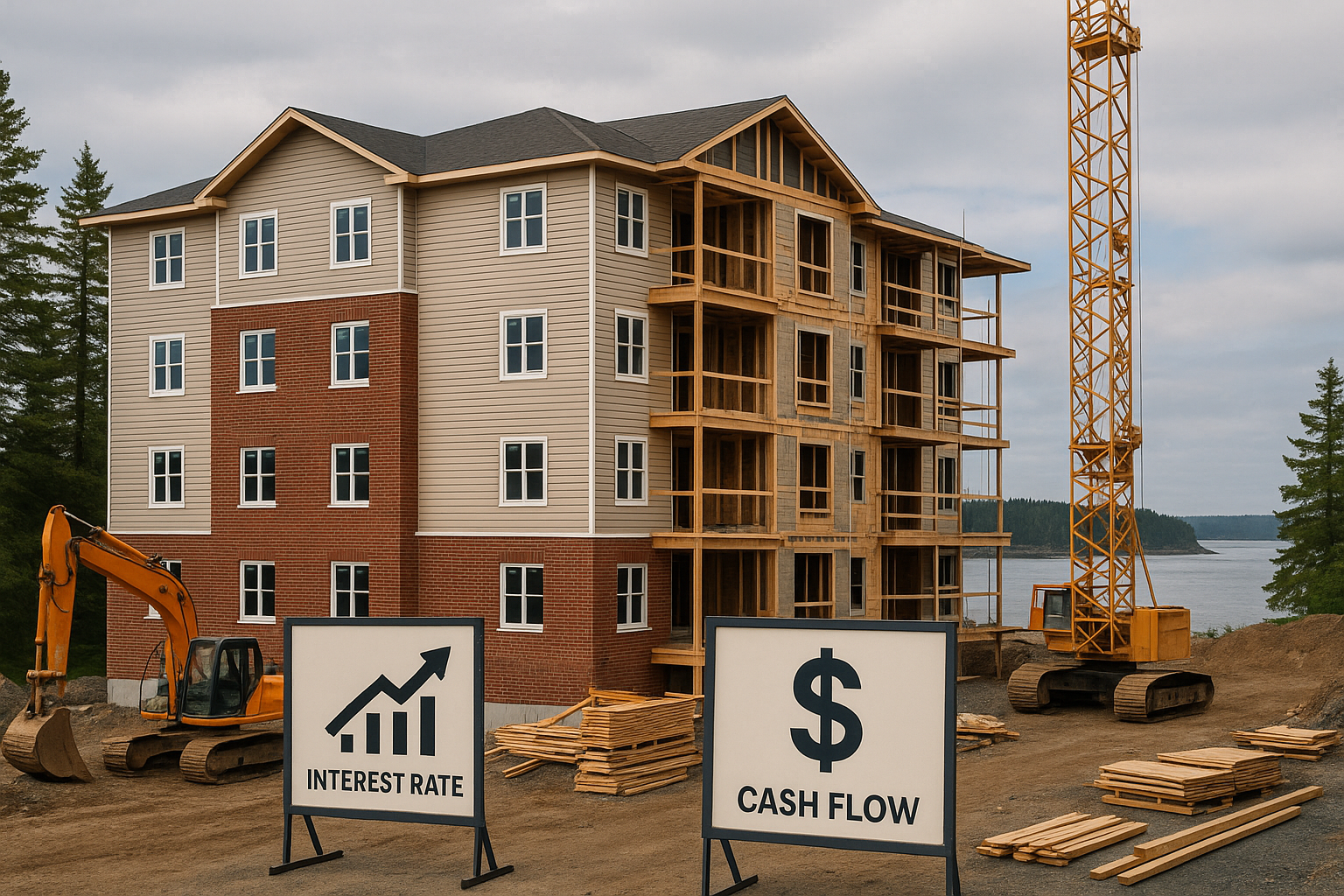
How Interest Rate Changes Impact Your Nova Scotia Build: DSCR, Cash Needed, and Sensitivity
Interest rate changes can make or break your multi-unit rental project in Nova Scotia. A small increase in rates can raise borrowing costs, tighten lender requirements, and cut into your returns. Here's what you need to know:
- Debt Service Coverage Ratio (DSCR): Higher rates increase mortgage payments, lowering DSCR. A drop below 1.25 can lead to stricter terms or loan rejection.
- Cash Requirements: Rising rates mean lenders may demand larger down payments and reserves, increasing upfront costs.
- Project Sensitivity: Even a 0.5% rate hike can reduce annual cash flow by thousands and delay profitability.
To minimize risks, consider fixed-rate loans, CMHC MLI Select financing, and fixed-price construction contracts. These strategies can help keep your project financially stable despite rate fluctuations.
Top economist reveals a scary truth for mortgage rates
How Interest Rates Impact Multi-Unit Construction in Nova Scotia
Changes in interest rates can ripple through financing and cash flow, potentially affecting whether a construction project remains viable. Let’s examine how shifts in variable rates can influence the costs tied to construction loans.
How Interest Rates Affect Construction Financing
When the Bank of Canada changes its policy rates, the cost of borrowing for variable construction loans often shifts as well. Higher rates can lead to increased monthly interest payments, even with minor adjustments. For instance, a small rate hike could significantly raise carrying costs for your project. To manage the heightened risk, lenders may tighten their requirements - this could mean asking for a stronger debt service coverage ratio (DSCR), bigger down payments, or even adjustments to the project’s scope.
Additionally, as funds are drawn during construction, they accrue interest at the prevailing rates. This can drive up the total financing costs over time, adding pressure to project budgets and timelines.
Nova Scotia Interest Rate Trends and Construction Impact
While Nova Scotia’s construction financing landscape often mirrors national trends, local factors add extra layers of complexity. The province’s steady rental demand and shifting market conditions mean that even modest rate increases can upset project economics. In response, local lenders may revise their lending terms, adjusting DSCR requirements or loan-to-cost ratios. These changes can force property developers to reconsider their financing strategies or adapt project timelines to align with evolving market realities.
Debt Service Coverage Ratio (DSCR): What You Need to Know
When it comes to financing, especially during times of rate fluctuations, understanding the Debt Service Coverage Ratio (DSCR) is crucial. It’s a key metric lenders use to evaluate whether your property generates enough income to cover its mortgage payments. A strong DSCR is often the difference between securing financing and facing rejection.
What is DSCR and Why Lenders Care About It
The DSCR measures how well your rental income can cover your debt obligations. It’s calculated by dividing your net operating income (NOI) by your annual debt service (the total of your yearly mortgage payments).
For multi-unit construction projects in Nova Scotia, most lenders require a DSCR between 1.20 and 1.25. This means your rental income must exceed your mortgage payments by 20-25%. If interest rates rise, your debt service increases while rental income remains steady, leading to a lower DSCR. A declining ratio signals higher risk, prompting lenders to either reject your application or demand a larger down payment to offset the risk.
How to Calculate DSCR: Step-by-Step Example
Let’s break this down with an example of a 4-unit rental property in Halifax:
- Rental Income: Each unit rents for $1,800 monthly, generating $86,400 annually in gross rental income.
-
Expenses: Subtract operating costs, including:
- Property taxes: $4,200
- Insurance: $2,400
- Maintenance: $4,320
- Vacancy allowance: $4,320
After expenses, your net operating income (NOI) is $71,160.
- Debt Service: Assume a $600,000 mortgage at a 5.0% interest rate over 25 years. Your monthly payment is $3,488, or $41,856 annually.
-
DSCR Calculation: Divide your NOI by your annual debt service:
$71,160 ÷ $41,856 = 1.70.
This DSCR comfortably exceeds the minimum requirements, giving you a solid safety margin.
Now, let’s see what happens if interest rates increase. At 5.5%, your monthly payment rises to $3,639, or $43,668 annually. The new DSCR becomes:
$71,160 ÷ $43,668 = 1.63.
While this is still above most lenders’ thresholds, the drop illustrates how rate hikes can impact your financing eligibility.
DSCR at Different Interest Rates
Interest rate changes can significantly affect your DSCR, which in turn influences loan terms and approval chances. Here’s how the same 4-unit property performs under various rate scenarios:
| Interest Rate | Monthly Payment | Annual Debt Service | DSCR | Lender Assessment |
|---|---|---|---|---|
| 4.5% | $3,340 | $40,080 | 1.78 | Excellent - Strong approval |
| 5.0% | $3,488 | $41,856 | 1.70 | Good - Standard approval |
| 5.5% | $3,639 | $43,668 | 1.63 | Acceptable - May require higher down payment |
| 6.0% | $3,792 | $45,504 | 1.56 | Marginal - Stricter lending terms |
A 1.5% increase in rates reduces the DSCR from 1.78 to 1.56. While still above the minimum threshold, this decline could lead to tighter lending conditions, such as requiring larger equity contributions or personal guarantees.
Properties with DSCRs below 1.25 often face significant hurdles. Lenders may demand down payments exceeding 25% or reject the loan outright. For this reason, many investors aim to maintain a higher DSCR buffer to safeguard against rate changes and ensure smoother financing.
With this understanding of DSCR sensitivity, let’s explore how cash requirements shift under varying financing conditions.
Cash Requirements for Construction Financing
When interest rates rise, they bring along higher upfront cash requirements for construction financing. This happens because lenders tighten their loan-to-cost (LTC) and loan-to-value (LTV) ratios, meaning you’ll need to put more equity into the project. Additionally, reserve funds to cover several months of debt service tend to increase, and interest accrual during construction becomes more significant. These changes in lending criteria can directly impact how much cash you need to have on hand.
How Interest Rates Impact LTC and LTV Ratios
Higher interest rates push lenders to adjust their terms to manage risk. One of the key adjustments is lowering LTC and LTV ratios, which shifts more financial responsibility to you as the borrower. This means you’ll need to contribute more cash upfront. On top of that, reserve funds to cover debt service for several months may be higher, and the overall cost of interest during the construction phase will rise.
How Helio Urban Development Reduces Cash Flow Risk
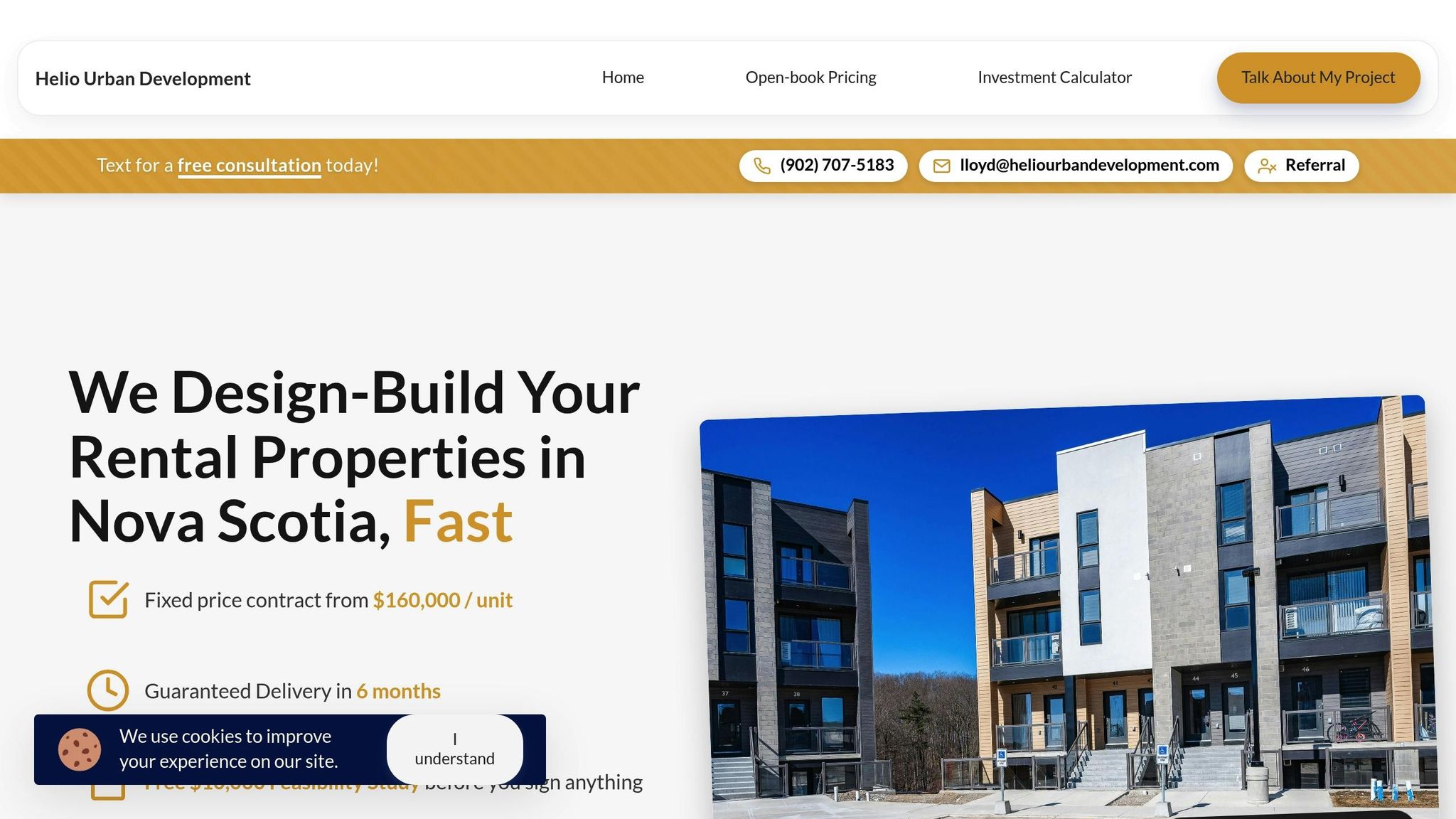
Addressing these increased cash demands can be challenging, but Helio Urban Development offers a way to ease the pressure. Their integrated builder approach eliminates the inefficiencies of fragmented contractor management, which often causes delays, cost overruns, and extended interest accrual. Instead, Helio’s fixed-price model and six-month construction guarantee lock in costs and reduce the time it takes to complete the project, cutting down on interest accrual.
By sticking to a strict timeline, Helio ensures that property owners can start earning rental income as planned, which helps offset financing costs. This streamlined approach not only lowers cash flow risks but also makes financing more manageable.
For those opting for CMHC MLI Select financing, Helio’s integrated model offers even greater advantages. With pre-coordinated specifications, complete documentation, and energy efficiency compliance, property owners can access up to 95% financing with as little as a 5% down payment. This significantly reduces the upfront cash required compared to traditional financing options, making it a smart choice for many developers.
sbb-itb-16b8a48
Sensitivity Analysis: Measuring ROI and Risk When Rates Change
What is Sensitivity Analysis and Why Use It
Sensitivity analysis is a financial tool that evaluates how changes in a single variable - like interest rates - can impact your return on investment (ROI), cash flow, and time to positive cash flow. For multi-unit developments in Nova Scotia, it acts as a financial stress test. By simulating rate increases of 0.25%, 0.5%, and 1%, you can gauge how these shifts affect your project's financial health.
Skipping this step can leave property owners exposed to unexpected financial challenges. For example, a project that seemed profitable with a 4.5% interest rate could struggle to break even if rates climb to 5.5%. This is particularly critical because construction loans often span 6-12 months, during which permanent financing rates can change. Modelling these potential rate increases ensures you’re prepared for their impact on ROI and cash flow. Let’s explore a practical example to illustrate this.
Example: How a 0.5% Rate Increase Changes ROI
To see how a rate hike can influence finances, consider a 4-unit build in Halifax with a total project cost of $1.2 million. Each unit rents for $2,200 per month, generating a gross rental income of $8,800 monthly or $105,600 annually. With a 75% loan-to-cost ratio, you’d borrow $900,000 and contribute $300,000 in equity.
At a 4.5% interest rate, your annual debt service would be around $56,160. Subtracting operating expenses of $31,680 (30% of gross income), your net operating income comes to $73,920. This leaves you with $17,760 in annual cash flow, translating to a 5.9% cash-on-cash return on your $300,000 investment.
Now, if rates increase to 5.0%, your annual debt service rises to $59,400, an extra $3,240 per year. As a result, your cash flow drops to $14,520, and your cash-on-cash return slips to 4.8%. That 0.5% rate increase cuts your annual cash flow by $3,240 and reduces ROI by over 1 percentage point.
The impact doesn’t stop there. At 4.5%, your project achieves positive cash flow in the first month after stabilization. But at 5.0%, it could take 2-3 more months of rent increases to hit the same cash flow levels, delaying your path to profitability.
Risk Tables: Comparing Outcomes at Different Rates
Examining multiple rate scenarios provides a clearer picture of potential outcomes and helps you prepare for shifting market conditions. The table below compares how various interest rates affect the same Halifax 4-unit project:
| Interest Rate | Annual Debt Service | Annual Cash Flow | Cash-on-Cash Return | Monthly Break-Even Rent |
|---|---|---|---|---|
| 4.0% | $52,920 | $21,000 | 7.0% | $2,077/unit |
| 4.5% | $56,160 | $17,760 | 5.9% | $2,138/unit |
| 5.0% | $59,400 | $14,520 | 4.8% | $2,200/unit |
| 5.5% | $62,640 | $11,280 | 3.8% | $2,261/unit |
| 6.0% | $65,880 | $8,040 | 2.7% | $2,323/unit |
This table highlights a few key takeaways. For every 0.5% increase in interest rates, annual cash flow drops by about $3,240, and cash-on-cash returns decline by roughly 1.1 percentage points. Additionally, the break-even rent per unit rises by approximately $62 with each rate increase.
At a 6.0% interest rate, the project still produces positive cash flow, but the returns are minimal. A 2.7% cash-on-cash return is barely better than what a high-interest savings account offers, without the headaches of property management.
The analysis also demonstrates the opportunity cost of rising rates. If rates climb from 4.0% to 6.0% during your construction period, you lose $12,960 in annual cash flow compared to your original projections. Over a 10-year period, that’s $129,600 in reduced returns - almost half of your initial equity investment.
This data helps establish decision thresholds. For instance, you might decide that returns below 4.0% make the project unviable, prompting a reassessment if rates exceed 5.25%. Alternatively, you could identify the rent levels needed to maintain target returns, guiding you to locations with stronger rental growth potential.
Ultimately, sensitivity analysis ensures that every aspect of your project - from DSCR to upfront cash needs - remains financially sound.
How to Protect Against Interest Rate Risk in Your Nova Scotia Build
Understanding how interest rate changes impact your project is just the first step - you also need a plan to manage those risks. Property owners who take steps to address interest rate fluctuations can keep their projects on track and maintain expected returns, even when market conditions shift. Here are three practical strategies to safeguard your build from rising rates.
Lock in Fixed-Rate Construction Loans
In Nova Scotia, many construction loans come with variable interest rates tied to benchmark rates. This means that if rates rise during your build, your borrowing costs could increase significantly once the loan converts to permanent financing. Opting for a fixed-rate construction loan can help you lock in your interest rate from the start, ensuring predictable costs throughout the project. While fixed-rate loans might cost slightly more upfront, they provide peace of mind by eliminating uncertainty.
Not all lenders offer fixed-rate construction loans, so it’s worth shopping around. Local credit unions and private lenders in Nova Scotia may have more flexible options compared to traditional banks. The best time to negotiate is before construction begins, as this is when you typically have the most leverage. If fixed-rate loans aren’t available, you could explore alternatives like CMHC MLI Select, which helps reduce upfront risks.
Use CMHC MLI Select for Higher Financing
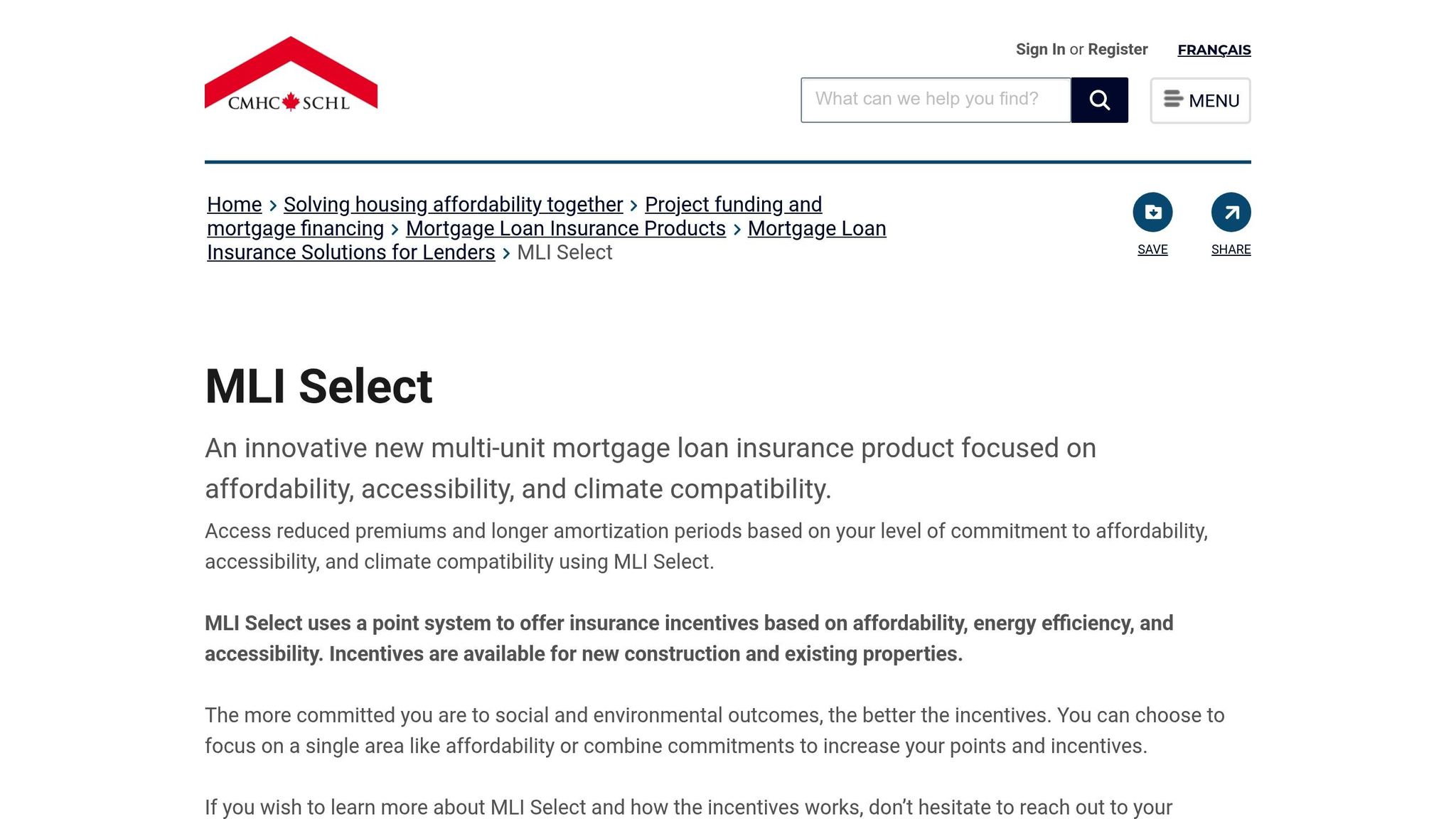
The CMHC MLI Select program allows eligible multi-unit rental property projects to secure financing of up to 95% of the property’s value. This significantly lowers the amount of cash you need to invest upfront, which can help ease the pressure on your returns if interest rates rise later on. Traditional construction loans often require a larger equity contribution, but MLI Select offers a way to maintain liquidity while still moving forward with your build.
To qualify, projects must meet specific energy efficiency requirements. The application process can take longer due to the need for detailed energy modelling and CMHC approval, so it’s important to plan ahead. Partnering with builders experienced in energy-efficient construction can help streamline this process and improve your chances of approval.
Choose Integrated Builders for Fixed-Price Contracts
Managing costs during construction is another way to protect against the impact of rising rates. Traditional building methods often lead to budget overruns, with actual costs exceeding initial estimates by as much as 30–60%. This could force you to secure additional financing at higher borrowing rates, creating further financial strain.
Integrated design-build firms offer a solution by providing fixed-price contracts that include financial penalties for delays. For example, Helio Urban Development guarantees six-month project completion at a fixed price of $160,000 per unit, with penalties of up to $1,000 per day for delays. This approach ensures budget certainty and reduces the risk of unexpected costs.
Conclusion: Get Ready for Interest Rate Changes in Your Nova Scotia Build
Interest rate changes play a big role in shaping project finances, influencing metrics like the DSCR, cash requirements, and sensitivity to market shifts. Property owners in Nova Scotia need to grasp these impacts to better prepare for potential rate adjustments. By diving into financial metrics and conducting sensitivity analyses, you can anticipate how rate changes might affect your project and make informed decisions to safeguard your investment.
But it’s not just about crunching numbers - your choice of construction method can also make or break your project. Traditional construction approaches often come with fragmented processes, leading to higher risks of budget overruns and delays. Imagine planning for an eight-month project only to see it stretch to 18 months due to coordination issues among multiple contractors. These delays can leave you more vulnerable to rising interest rates and additional financing needs.
An integrated design-build solution, like the one offered by Helio Urban Development, tackles these challenges head-on. With fixed-price construction set at $160,000 per unit and a six-month completion timeline, they provide a clear path to predictable outcomes. Plus, their $1,000 daily delay penalty ensures accountability and keeps timelines on track. This streamlined approach helps reduce the risks tied to fluctuating interest rates and prolonged construction schedules.
When you pair a fixed-price construction model with CMHC MLI Select financing, you create a strong buffer against interest rate volatility. This combination allows you to manage financial risks effectively while targeting monthly rents of $1,950–$2,100 per unit and aiming for annual returns between 12% and 20%.
FAQs
How can I manage the effects of rising interest rates on my multi-unit rental construction project in Nova Scotia?
Rising interest rates can throw a wrench into your construction project's financial plans, but there are ways to navigate these hurdles and keep things on track.
First, keep a close eye on mortgage and construction loan rates in Nova Scotia. Even a small rate hike can have a big impact on your overall costs. You might want to look into financing options like construction loans or CMHC-insured loans. These options often come with lower rates and longer amortization periods, which can help ease cash flow pressures.
It's also crucial to dig into your project's financial details. Metrics like the Debt Service Coverage Ratio (DSCR) and the cash needed for financing can give you a clearer picture of how your project might be affected by rising rates. By evaluating these numbers early, you can spot potential risks and tweak your strategy to stay profitable.
What are the advantages of using CMHC MLI Select financing for developing a rental property?
Canada Mortgage and Housing Corporation's (CMHC) MLI Select financing comes with some standout perks for rental property developers. These include loan-to-value ratios as high as 95%, amortization periods stretching up to 50 years, and access to interest rates below prime. On top of that, it offers lower mortgage insurance premiums, which can significantly cut project costs.
This program aims to simplify and reduce the cost of financing, particularly for multi-unit rental developments. It’s a way to improve financial viability while supporting better long-term profitability for property owners.
How does a design-build approach reduce financial risks from delays and interest rate changes?
When you opt for a design-build approach, you’re essentially placing both the design and construction responsibilities into the hands of a single, accountable team. This setup not only simplifies communication but also reduces the chances of errors and missteps. The result? A more seamless process that helps keep your project on track, avoiding costly delays or missed deadlines.
This method also speeds up the project timeline, which can be a big deal when trying to dodge rising interest rates or other financial curveballs. With quicker delivery and tighter cost management, you’re far less likely to face unexpected surprises. It’s a straightforward way to achieve more predictable results, offering property owners a sense of control and peace of mind.