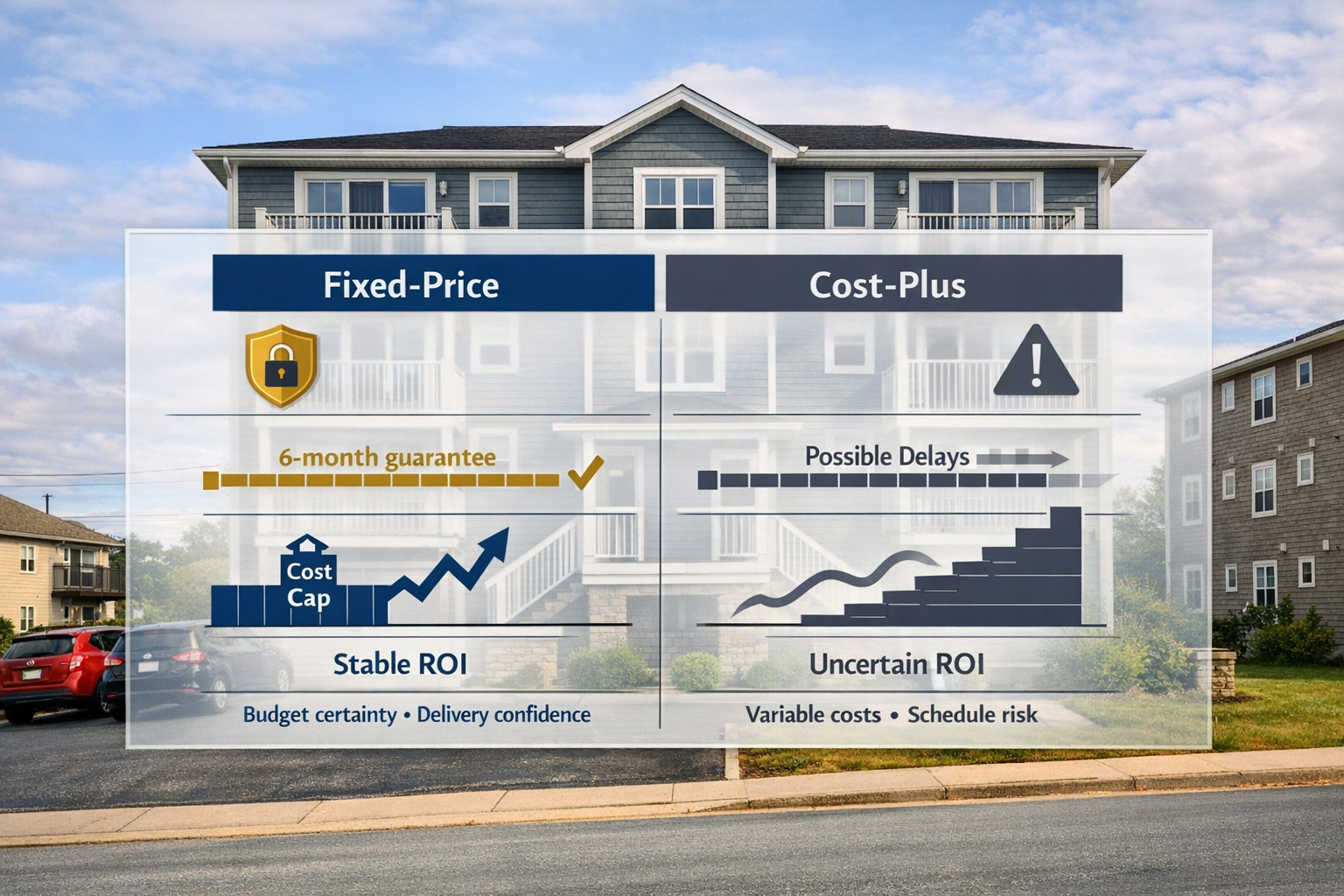
Fixed Price vs. Cost-Plus Construction: Which Model Protects Your Investment?
When you're building a rental property in Nova Scotia - whether it's a fourplex in Halifax or a duplex in Dartmouth - one of the biggest decisions you'll make is choosing between a fixed price or cost-plus contract. This choice directly impacts your budget, timeline, and financial risk. For example, a fixed price contract might lock in your cost at $640,000, while a cost-plus contract could leave you paying $700,000 or more if material prices spike or delays occur.
This article breaks down how each contract type affects your investment, so you can decide which model aligns with your goals.
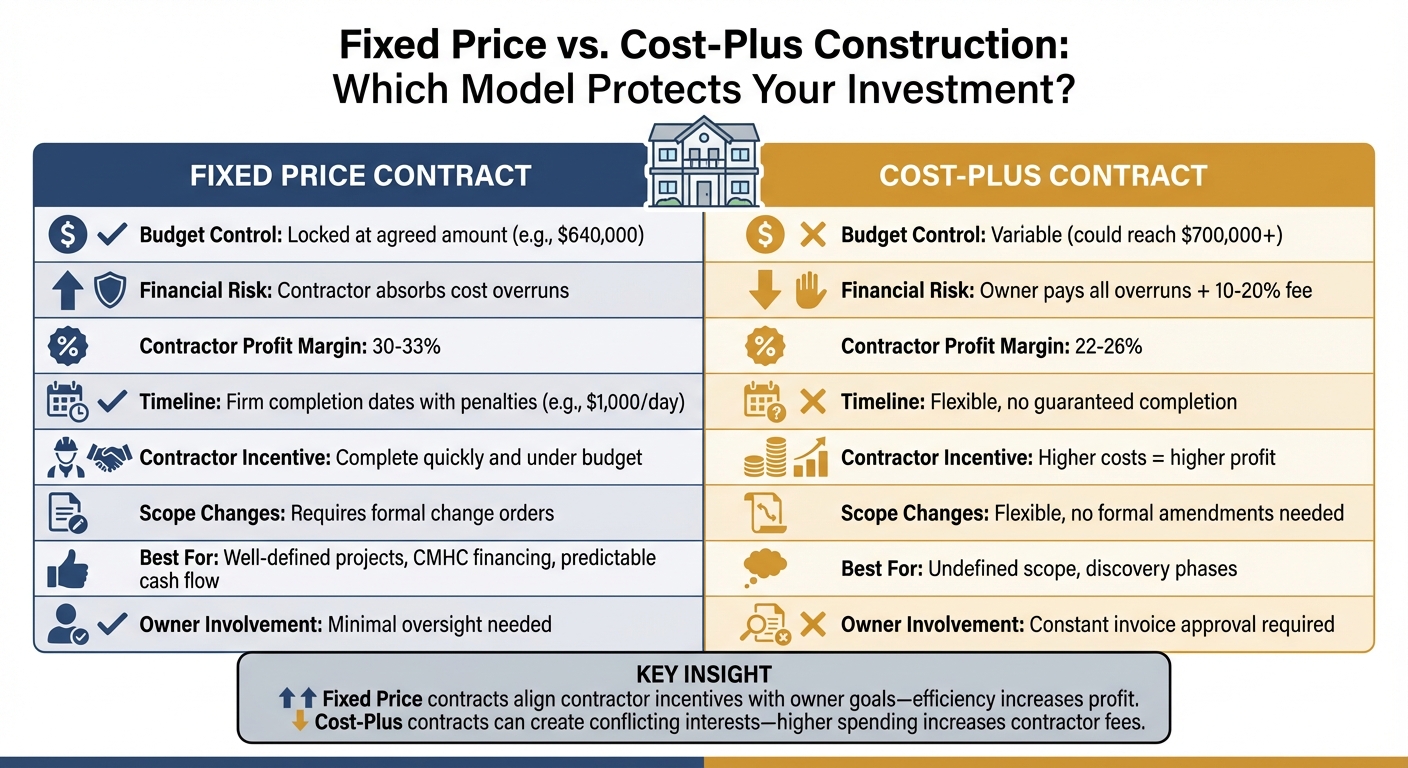
Fixed Price vs Cost-Plus Construction Contracts Comparison for Nova Scotia Rental Properties
How do you decide between a fixed-price and cost-plus contract?
sbb-itb-16b8a48
Financial Risk: Which Model Controls Costs Better?
The type of contract you choose has a direct impact on your financial risk during construction. It determines whether your budget is a firm limit or just the starting point. With fixed price contracts, your financial exposure is capped at the agreed-upon amount, regardless of unexpected developments. On the other hand, cost-plus contracts leave the door open for rising costs - your project could end up costing CA$700,000, CA$750,000, or even more, depending on factors like fluctuating material prices, labour inefficiencies, or delays.
How Fixed Price Contracts Lock In Your Budget
A fixed price contract sets a hard cap on your total project cost from the beginning. Any unexpected increases in material or labour costs don’t affect your budget - the contractor absorbs those fluctuations. As Scott Bollinger, a legal expert in construction contracts, explains:
"The contractor takes on the risk that her costs will exceed the contract price in exchange for the potential reward that costs will be much less than the contract price" [2].
This arrangement not only caps your financial exposure but also incentivizes the contractor to manage the project efficiently. Overruns eat into their profit, so they’re motivated to stay on track. For property owners, this predictability makes it easier to secure financing - lenders prefer fixed price contracts because they eliminate uncertainty about the final cost.
How Cost-Plus Contracts Expose You to Variable Costs
In a cost-plus contract, you’re responsible for covering all actual construction expenses plus a contractor’s fee, which usually ranges between 10–20% of the total cost. This setup can create what legal experts call "perverse incentives." Bollinger highlights the issue:
"Under a cost-plus arrangement, the contractor may be less motivated to control costs because as prices rise, his profits may increase" [2].
With this model, any cost overruns are passed directly to you, and the contractor’s profit grows as spending increases.
The risks of this approach were underscored in the 2023 Alberta case Twister Developments Ltd v. 1406676 Alberta Ltd. Although the parties had written fixed-price contracts, the court determined the project was managed under cost-plus terms because both sides collaborated on budget decisions. The result? The property owner was ordered to pay an additional CA$173,012 they had refused, thinking the fixed-price agreement protected them [3]. Beyond the financial exposure, cost-plus contracts require constant oversight - you’ll need to approve invoices throughout the project to ensure spending stays reasonable. Essentially, you’re auditing your contractor’s work in real time.
What this means for property owners: Fixed price contracts shift financial risk to the contractor, aligning their incentives with yours - they earn more by completing the project efficiently, not by increasing costs. Cost-plus contracts, however, expose you to market volatility and demand active management of every expense.
Next, we’ll look at how these contract models influence your project timeline.
Timeline Certainty: Guaranteed vs. Flexible Schedules
The type of contract you choose directly impacts when you can start generating rental income. Delays don’t just push back your revenue - they also increase carrying costs for land, financing, and taxes. Fixed price contracts often include firm completion dates with financial penalties for delays, ensuring accountability. On the other hand, cost-plus contracts typically avoid committing to timelines, leaving you exposed to longer construction periods without any recourse.
While cost control is critical to keeping your project on budget, having a clear timeline is just as important for protecting your revenue stream. Without a reliable schedule, your rental income projections are at risk.
Fixed Price Contracts with Timeline Guarantees
Fixed price contracts align the contractor's financial motivations with your goals for both cost and schedule. As Scott Bollinger puts it:
"Under fixed-price, one of the primary incentives for the contractor is to complete the work in the shortest amount of time for the lowest cost" [2].
Delays eat into the contractor’s profit margin, so they have a strong reason to finish on time.
These contracts often include liquidated damages clauses, such as a CA$1,000/day penalty for late completion, paired with a guaranteed timeline - say, six months. This shifts the risk of delays to the contractor, giving you confidence about when your rental income will start. For example, if your fourplex generates CA$4,000/month in rent, even a 30-day delay would cost you CA$4,000 in lost revenue. A timeline guarantee helps safeguard that income.
Cost-Plus Contracts Without Timeline Commitments
Cost-plus contracts, however, create a very different dynamic. Since the contractor’s fee is often a percentage of the total costs, longer construction periods can actually increase their earnings. There’s no financial downside for them to take more time.
These contracts usually begin with a loose plan and an evolving scope, which means schedules are often determined as the project progresses. Without a firm completion date, you’ll need to monitor progress closely, and you won’t be able to confidently set tenant move-in dates or calculate your return on investment. While cost-plus contracts offer flexibility for changes, they can become a liability if you need a predictable timeline for rental income.
For property owners: Fixed price contracts with timeline guarantees provide the certainty you need to plan your rental income and protect your revenue. Cost-plus contracts, while flexible, may leave you guessing when your property will start generating returns. Choose based on your priorities - budget flexibility or schedule reliability.
Contractor Incentives: Who Benefits from Each Model?
Contractor payment structures significantly shape how a project unfolds. The type of contract you choose - fixed-price or cost-plus - sets the tone for your contractor's priorities. These models create distinct motivations, and understanding them can help you predict whether your contractor will aim for efficiency or potentially stretch the timeline.
How Fixed-Price Contracts Align Contractor and Owner Goals
In a fixed-price contract, the contractor's profit depends on the gap between the agreed-upon price and their actual costs. If they finish under budget, the savings go directly to their bottom line. This setup naturally encourages contractors to keep costs low and complete the project quickly. As Scott Bollinger puts it:
"Under fixed-price, one of the primary incentives for the contractor is to complete the work in the shortest amount of time for the lowest cost" [2].
Delays eat into the contractor's profit by increasing overhead, which also limits their ability to take on new projects. Fixed-price contractors often aim for a profit margin of 30–33%, benefiting from fewer change orders. By comparison, cost-plus contractors usually achieve margins of 22–26%, reflecting less stringent cost control [4] [5]. This alignment of goals means your contractor is motivated to finish efficiently, helping you start generating rental income sooner.
How Cost-Plus Contracts Can Create Conflicting Interests
Cost-plus contracts, on the other hand, can create incentives that conflict with your goals. The contractor's fee is often a percentage of the total costs - typically around 15% - so higher spending directly increases their profit. As one construction law firm explains:
"The contractor is incentivized to make more money by spending more time (labour) to do the job, resulting in a higher cost and longer timeline to the owner. The contractor is also incentivized not only not to make efforts to find good deals on materials, but to purchase the highest cost materials for the owner (since they make more profit in doing so)" [1].
This structure can lead to extended timelines and higher costs, as additional labour and expensive materials boost the contractor's fee. Without safeguards like a Guaranteed Maximum Price (GMP), cost-plus contracts can result in budget overruns that directly impact your rental income timeline and overall return on investment. Unlike fixed-price contracts, cost-plus doesn’t inherently push for efficiency, leaving you to shoulder the risks of delays and inflated costs.
Handling Changes and Unexpected Conditions
Unexpected challenges - ranging from design revisions to unforeseen site issues - can disrupt budgets and schedules. How these surprises impact you depends on the change-management terms in your contract.
Managing Scope in Fixed-Price Contracts
Fixed-price contracts hinge on a well-defined scope before construction starts. Any alterations - whether upgrading finishes or addressing unexpected site conditions - require a formal change order. While this approach helps control costs, errors in design or documentation can still lead to delays and added expenses [6].
Helio’s CA$160,000 per unit pricing includes built-in contingencies for common site conditions. However, significant changes still require contract amendments, which limit the contractor’s ability to inflate costs. As Scott Bollinger, Lawyer and Founder of Bollinger & Associates Law, explains:
"Price certainty often needs to be purchased for a premium" [2].
This pricing model offers stability but can be less flexible compared to alternative contract types.
Managing Scope in Cost-Plus Contracts
Cost-plus contracts are more adaptable when changes arise, as they don’t require formal amendments for adjustments. However, this flexibility comes with risks. Every change - like a CA$10,000 material upgrade - adds direct costs plus the contractor’s fee and overhead. As ATAC LAW highlights:
"The contractor is also incentivized not only not to make efforts to find good deals on materials, but to purchase the highest cost materials for the owner (since they make more profit in doing so)" [1].
Without consistent cost audits, these incremental expenses can spiral. For projects with unknown variables - such as investigating water damage - a hybrid approach is often recommended. Start with a cost-plus model during the discovery phase, then switch to a fixed-price contract once the scope is fully understood [1].
The way scope changes are managed directly impacts your budget and timeline, making it essential to select a contract model that aligns with your project's needs and risk tolerance.
Which Contract Model Fits Your Project?
Choosing the right contract model depends on your project's risk tolerance, budget priorities, and how clearly the scope is defined before construction starts. For multi-unit rental property owners in Nova Scotia, the decision often leans towards one option based on these factors.
When Fixed Price Makes Sense
Fixed-price contracts work best when you need budget certainty and firm timelines. This model limits financial risk and ensures a clear schedule - key factors if you're financing through CMHC MLI Select or traditional lenders. Budget overruns or delays can jeopardize funding, so having a locked-in price and timeline is critical.
Scott Bollinger, Lawyer and Founder of Bollinger & Associates Law, explains:
"price certainty often needs to be purchased for a premium" [2].
This premium is included in the contractor's quote as a contingency buffer, shielding you from unexpected costs that often arise in cost-plus contracts. With fixed pricing, you know your financial commitment upfront, making it easier to secure financing, estimate rental income, and calculate ROI.
Fixed-price contracts also align the contractor's incentives with your goals. Their profit comes from working efficiently, not extending timelines or inflating material costs. Helio reinforces this alignment with a CA$1,000-per-day late penalty, ensuring builders stay on track with your objectives.
When Cost-Plus Makes Sense
Cost-plus contracts are more suitable for projects where the scope is unclear or where site conditions need investigation - like addressing water damage where the extent of repairs isn't known until demolition begins [1]. In these cases, starting with a cost-plus model for the discovery phase and transitioning to a fixed price once the scope is defined can be a practical approach.
However, cost-plus arrangements are rarely a good fit for new multi-unit construction on vacant land. The variability in costs and timelines often erodes project returns. This model can lead to escalating expenses and delays, introducing financial risks that complicate financing and reduce profitability.
For property owners: If your goal is predictable cash flow and steady appreciation from a multi-unit rental property, a fixed-price contract offers the certainty you need. While cost-plus contracts might seem cheaper upfront, the lack of a guaranteed maximum price leaves you exposed to unexpected costs. Balancing flexibility with financial clarity is essential to safeguarding your investment.
Conclusion: Choosing the Model That Protects Your Investment
When it comes to multi-unit projects in Nova Scotia, the contract model you choose directly impacts both your costs and timelines. Fixed-price contracts stand out for their ability to lock in budgets and schedules, eliminating the uncertainty that can disrupt project financing. While cost-plus contracts may seem flexible, they often lead to ballooning expenses and conflicting priorities that don't align with your financial goals.
The key difference lies in how incentives are structured. Cost-plus contracts can encourage contractors to benefit from delays and increased material costs. Fixed-price contracts flip this dynamic, rewarding efficiency instead. Take Helio's approach as an example: their CA$1,000-per-day late penalty ensures contractors stay focused on meeting deadlines and budgets.
Why this matters for property owners: If you're financing through CMHC MLI Select or traditional lenders, overruns in budget or delays in timelines can threaten your funding approval. Worse, they can delay the start of rental income, throwing off your cash flow projections. Fixed-price contracts eliminate these risks by providing the certainty lenders demand and the predictability you need to plan effectively.
As Scott Bollinger points out, paying a premium for fixed pricing ensures cost certainty [2]. This premium, often factored into a contractor's contingency buffer, shields you from the unpredictable expenses that frequently inflate cost-plus projects. For new builds on vacant land - where the scope is well-defined - this trade-off consistently favours fixed pricing.
FAQs
What should I look for in a fixed-price contract to avoid surprise costs?
When working with a fixed-price contract, clarity is everything. Make sure the contract spells out the entire scope of work, covering all labour, materials, and any anticipated changes included in that scope. It should also detail how change orders will be managed - requiring mutual agreement for any adjustments. Additionally, confirm it includes penalties for delays and holds the contractor accountable for unexpected challenges that fall within the defined scope. These measures help ensure the fixed price stays consistent and avoids creeping costs during the project.
Can a cost-plus contract include a cap like a Guaranteed Maximum Price (GMP)?
Yes, a cost-plus contract can include a cap, often referred to as a Guaranteed Maximum Price (GMP). This establishes a ceiling on construction costs, giving property owners some financial security while still allowing the flexibility that comes with a cost-plus arrangement.
Which contract type do lenders prefer for rental construction in Nova Scotia?
Lenders across Nova Scotia generally prefer fixed-price contracts when it comes to rental construction projects. These contracts offer clear budget certainty, which is a major advantage when securing financing. For property owners, they reduce the risk of unplanned cost overruns, keeping the financial side of the project predictable. Additionally, fixed-price agreements simplify the entire lending process, making them a go-to option for both lenders and developers alike.