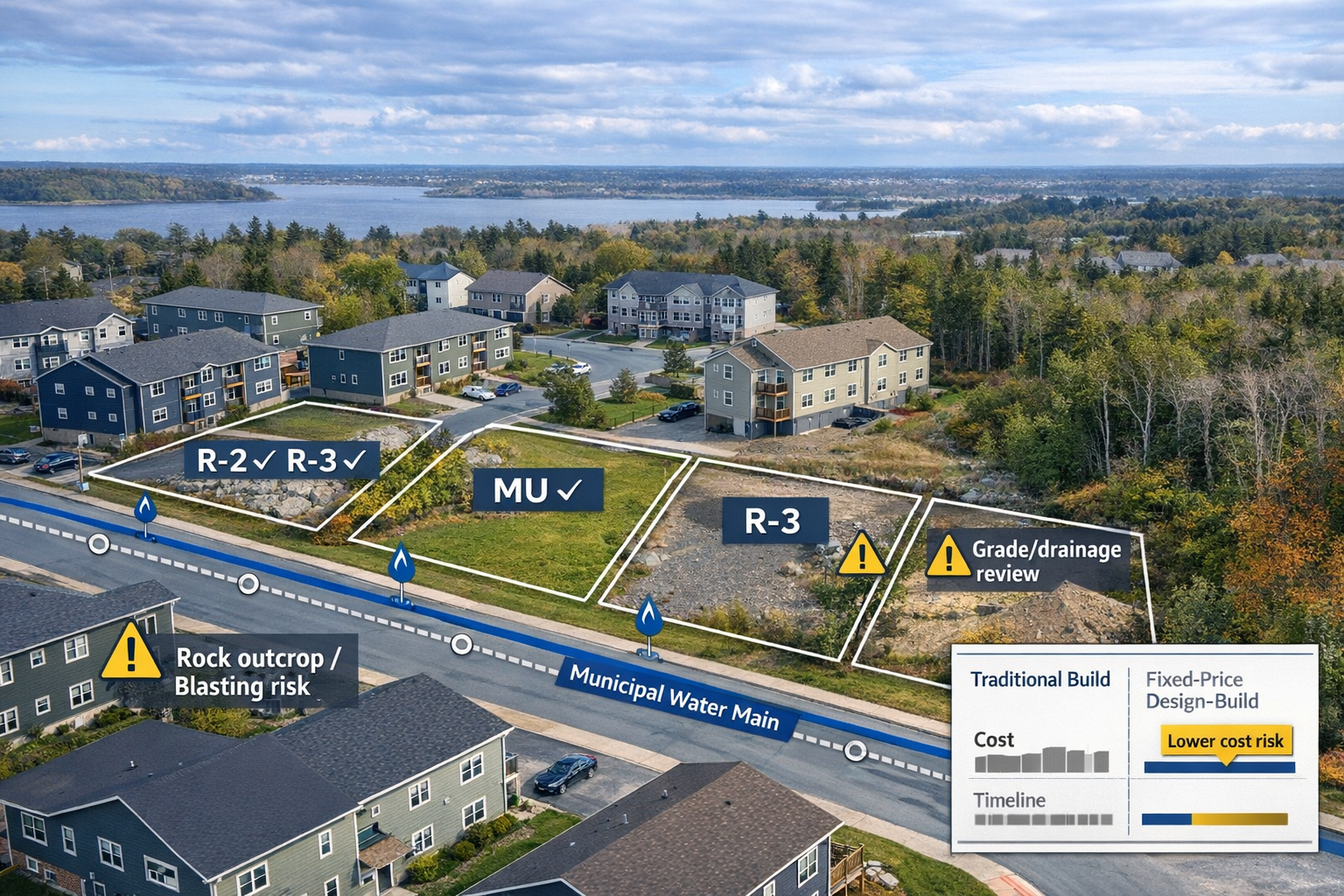
How to Evaluate Land for Rental Construction in Nova Scotia
If you're considering building a fourplex, sixplex, or larger rental property in Nova Scotia, the first question is: can your land handle it? The zoning, permits, and infrastructure on your property will make or break your project. For example, Halifax’s vacancy rate is just 1%, and housing starts in Nova Scotia jumped 37% from 2022 to 2023. But even with demand this high, skipping an upfront evaluation can cost you tens of thousands of dollars or delay your timeline by months.
This guide walks you through zoning classifications, municipal permits, and infrastructure requirements. Whether you already own land or are scouting for a property, these steps will help you avoid costly surprises and keep your project on track. Let’s break it down.
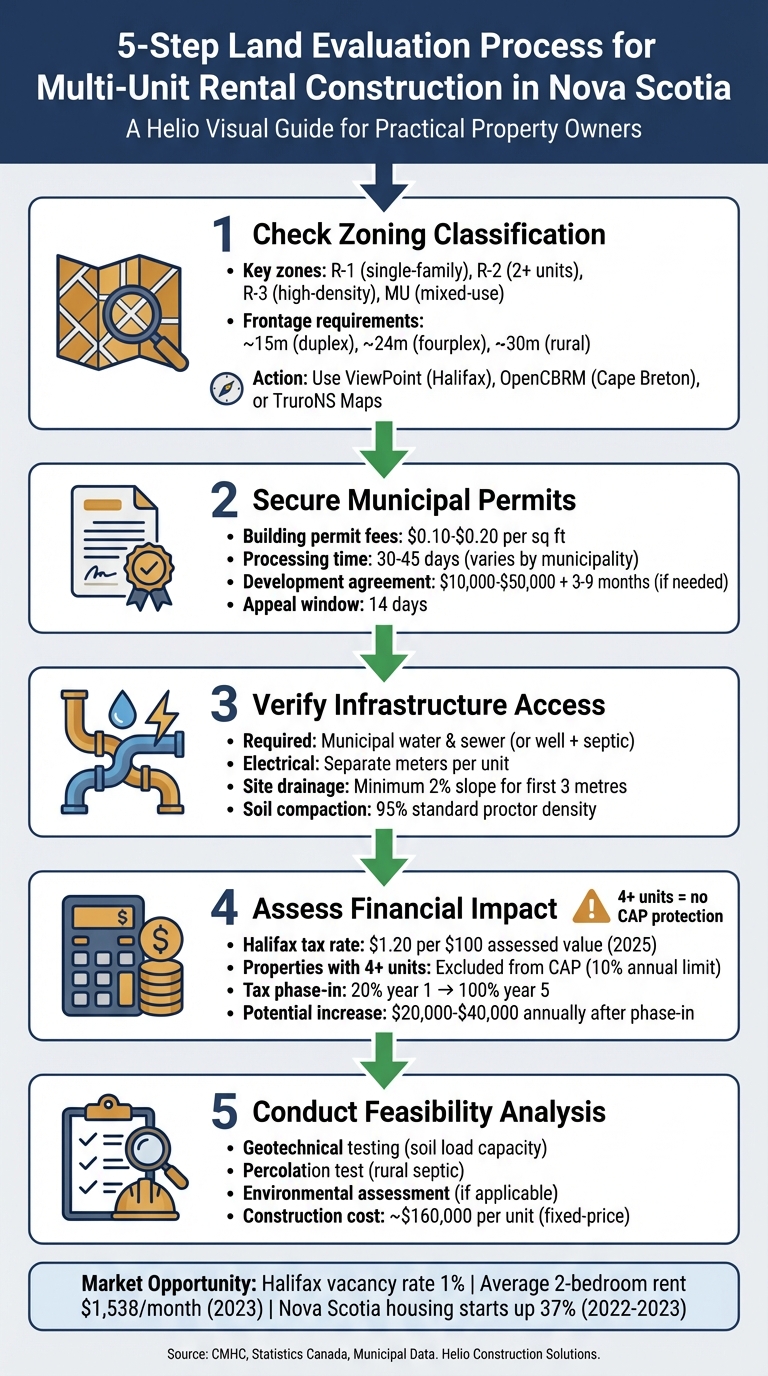
5-Step Land Evaluation Process for Multi-Unit Rental Construction in Nova Scotia
How to Build Apartments: Learn to Value Land and Analyze Deals! (Real Estate Development)
Zoning Classification: Can You Build Multi-Unit Rentals?
The zoning classification of your land determines whether you can construct a fourplex, sixplex, or larger rental property without needing extra approvals. In Nova Scotia, residential zones are typically labelled with codes like R-1 (single-family homes), R-2 (usually allowing two units, though variances can sometimes permit more), and R-3 (intended for higher-density housing like apartments). Mixed-use (MU) zones also allow residential units above ground-floor commercial spaces.
For property owners: If your land isn’t already zoned for the number of units you plan to build, you’ll need to go through a rezoning process or obtain a development agreement. This can add months to your timeline and introduce uncertainty. To avoid delays, it’s best to focus on land already zoned as R-2, R-3, or MU for multi-unit projects. Understanding zoning classifications is crucial as you move into municipal permits and infrastructure requirements, which we’ll cover later.
How to Read Municipal Zoning Maps
Once you know your zoning designation, use municipal tools to confirm the specifics. Zoning maps mark zone boundaries with bold lines and show individual property lots with thinner lines. Each zone is labelled with an alphanumeric code (like R-2 or MU) and colour-coded to differentiate between residential, commercial, and industrial areas. To check your property’s zoning, online tools like ViewPoint (Halifax), OpenCBRM (Cape Breton), or TruroNS Maps are helpful. These platforms let you search by address[4].
After identifying your zone code, cross-reference it with your municipality’s Land Use Bylaw. The bylaw will outline what’s allowed, including rules on building height, lot coverage, and setback distances. Pay attention to the map’s “last update” date - outdated maps can lead to costly errors or misjudgements[4].
Common Zoning Restrictions and Solutions
Even if your property’s zoning supports multi-unit rentals, other regulations might still require adjustments. For example, you might encounter restrictions on frontage, lot size, or building height. Generally, frontage requirements increase with unit density: approximately 15 metres for duplexes, 24 metres or more for fourplexes, and around 30 metres for rural lots. If your property doesn’t meet these standards, you may need to seek a variance. Minor variances address small adjustments, like setback or height issues, while major variances require municipal council approval for larger deviations.
If standard zoning rules don’t accommodate your project, a development agreement might be another option. This is a legal arrangement tailored to unique proposals and involves technical reviews, presentations to the Planning Advisory Committee, public notifications for neighbours, and a final decision by council. Written appeals against these decisions must be submitted within 14 days[4]. Municipal planning offices often offer free consultations with zoning officers, so it’s worth clarifying whether your project is permitted outright or requires additional steps before you finalise any property purchase.
Municipal Permits and Requirements
After confirming your land is zoned for multi-unit construction, the next step is securing the permits needed to start building. In Nova Scotia, any new residential project - especially multi-unit developments - requires a building permit to ensure compliance with the National Building Code and local bylaws. Depending on your municipality and the project's specifics, you may also need a development permit. This additional permit often involves reviews for elements like parking, setbacks, or landscaping.
Getting all the required permits upfront is critical to avoid delays or fines. The process is sequential: major construction, like foundation work, can only begin after all permits are approved. While minor tasks, such as clearing brush or small demolitions, might be allowed earlier with specific permits, structural work must wait. Once zoning is confirmed, navigating the permit process becomes your next priority to keep your project aligned with municipal and provincial regulations.
Building Permits and Development Agreements
If your municipality requires a development permit, submit your application along with site plans and fees. This review can take anywhere from 2–8 weeks, depending on the project's complexity and municipal workload. Once the development permit is approved, you can apply for the building permit. Delays in either process could push your project timeline back by weeks or even months.
To apply for a building permit, contact your municipal planning department. You'll need to include architectural drawings, structural calculations, and fire safety plans, all stamped by a licensed architect or engineer, to demonstrate compliance with the Nova Scotia Building Code. Fees for building permits typically range from $0.10 to $0.20 per square foot, so for a 7,500-square-foot development, costs might fall between $750 and $1,500. Processing times vary: Halifax generally takes about 45 days, while smaller municipalities like Lunenburg often complete reviews in around 30 days.
If your project doesn’t meet standard zoning rules, you may need a development agreement. This legal process involves technical reviews, public notifications, presentations to a Planning Advisory Committee, and council approval. Development agreements can add $10,000 to $50,000 in legal and planning fees and extend timelines by 3–9 months. If there’s opposition to a council decision, appeals must be filed within 14 days.
To avoid these hurdles, confirm zoning rules before purchasing land. Either focus on properties already zoned for your intended development or include a purchase condition that makes the sale contingent on securing the required permits.
Nova Scotia Building Code Requirements
Once permits are in place, strict compliance with the Nova Scotia Building Code is required for multi-unit developments.
The Nova Scotia Building Code, based on the 2015 National Building Code with provincial amendments, classifies buildings with 4 or more rental units as Group C Major Occupancy (residential). This classification comes with stricter requirements than those for smaller buildings under Part 9 (up to 3 storeys or 600 m²). Multi-unit projects must follow Part 3, which includes structural engineering reviews for load-bearing walls, higher wind resistance standards (1.5 kPa in coastal areas), and upgraded plumbing and ventilation systems, such as shared risers for multiple units.
Fire safety is another key consideration. For properties with 4 or more units, fire-rated assemblies and separations between units are required, with firewalls rated for 45 to 120 minutes. Buildings taller than three storeys also need automatic sprinkler systems and individual smoke alarms. Additionally, all multi-unit buildings must have at least two egress routes to ensure safe evacuation during emergencies.
Accessibility is a mandatory part of Part 3.8.3 of the code, which includes features like ramps with a 1:12 slope and doorways at least 1,100 mm wide. These safety and accessibility requirements can increase compliance costs by 20–30% compared to smaller residential projects. Inspections are required at various stages, including after foundation work (to check frost depth and drainage), during framing (to confirm compliance with plans), and at rough-ins for electrical, plumbing, and HVAC systems. A final inspection is necessary to secure an Occupancy Certificate, which confirms the building meets all standards and is ready for tenants.
These permit and code requirements are essential steps after zoning approval. Being familiar with them helps you stick to your timeline and budget, reducing the risk of unexpected delays or added costs.
Infrastructure and Site Conditions
After securing permits, the next step is evaluating whether your land can physically support a multi-unit build. Even if zoning aligns perfectly, the absence of key utilities or challenging site conditions can lead to prohibitive costs.
Utilities and Site Access
Access to municipal water and sewer is essential for multi-unit developments. Without these connections, you'll need to install a private well and septic system, which involves additional permits, percolation tests, and expenses. Erica, Research Analyst at Helio Urban Development, emphasizes:
"Check for municipal water and sewer. If they're not available, you'll need a well and septic system - adding extra permitting requirements and costs."[1]
For rural properties, testing soil with percolation tests early on is critical to confirm it can support a septic system before proceeding with a purchase.
Electrical service is another key consideration. Multi-unit buildings require separate meters for each unit, necessitating capacity upgrades and panel installations through Nova Scotia Power. Additionally, road access is crucial. Minimum street frontage requirements increase with the number of units. A duplex typically requires 15 metres of frontage, while a fourplex may need 24 metres or more[1]. Rural lots often face stricter regulations, with provincial requirements mandating at least 30 metres of frontage in some cases[1]. Confirm these details with your municipality before committing to a property, and arrange for temporary construction utilities - such as power and water - before foundation work begins.
Once utilities and access are sorted, the focus shifts to how the land's physical characteristics will impact construction.
Site Preparation: Grading, Setbacks, and Lot Coverage
The topography of your site plays a major role in determining construction costs. Steep slopes or rocky terrain can lead to higher expenses for specialized foundations, extensive excavation, and drainage solutions. According to the Nova Scotia Building Code, your site must ensure positive drainage away from buildings with a minimum 2% slope for the first 3 metres. For steeper grades exceeding 15%, engineering solutions are required. Additionally, soil must be compacted to 95% standard proctor density, and erosion control measures, like silt fences, must be in place during construction[9][8].
Setbacks - minimum distances between the building and property lines - vary by zoning and municipality. These directly influence your lot coverage, or how much of the land can be built on. A detailed survey is essential before designing your building footprint. It should outline property boundaries, elevations, and any environmental features. As Helio Urban Development advises:
"A detailed survey is a must - showing exact boundaries, elevations, and any environmental features. That feeds into your site plan, which lays out the building footprint, parking, landscaping, and drainage."[1]
This survey also informs your preliminary grading plan, which must address any flood zones and adhere to 100-year floodplain setback standards if applicable[9][8].
To mitigate risk, include a purchase condition in your offer that makes the sale contingent on verifying utilities and completing a thorough site assessment. This ensures you won't face unexpected infrastructure challenges after closing the deal.
sbb-itb-16b8a48
Property Assessment and Ownership Requirements
When planning a multi-unit development, it's not just about permits and infrastructure. Financial and legal factors play a huge role in determining whether your project will succeed. After confirming your site is physically suitable, the next steps involve assessing its market value and selecting the right ownership structure to manage costs and meet regulatory requirements.
How the Nova Scotia Assessment Act Impacts Multi-Unit Properties
In Nova Scotia, property assessments are based on market value - essentially, the price your property might fetch in an open market. For multi-unit buildings with four or more rental units, assessments factor in location, condition, potential rental income, and comparable sales. Because these properties generate income, they often face higher assessments, which directly affect municipal property taxes. For example, Halifax's 2025 property tax rate is $1.20 per $100 of assessed value[10][6].
Key takeaway for owners: Properties with four or more units are excluded from the Capped Assessment Program (CAP), which limits annual assessment increases to 10% for residential properties. This exclusion can significantly impact your tax bill. Let’s say your 4-unit rental property increases in market value by 20%, jumping from $800,000 to $960,000. Without CAP protection, you’d face the full increase immediately, which could raise your annual taxes by $1,920 at Halifax’s rate. By contrast, a single-family home with CAP protection would only see a phased 10% increase.
New multi-unit developments, however, benefit from a phased assessment over five years. Initially, only 20% of the market value is taxed, gradually rising to the full amount. This means your annual property taxes could jump by $20,000–$40,000 once the phase-in period ends[10][5]. When calculating long-term returns, make sure to account for this eventual increase in taxes. These tax considerations are as important as zoning and permitting when evaluating a project’s financial viability.
Ownership and Legal Requirements
The ownership structure you choose will influence both your liability exposure and financing options. For rental properties with four or more units, limited partnerships or corporations are popular choices. These structures protect personal assets and make it easier to secure financing. For properties with 2–4 units, you might qualify for residential financing with a 20% down payment. However, for 5+ unit buildings, lenders typically require 25–35% down under commercial lending terms[1].
Incorporating your business federally or through Nova Scotia’s Registry of Joint Stock Companies costs around $350. This setup offers tax advantages, including the ability to claim depreciation on rental income[10][11].
Most municipalities in Nova Scotia, including Halifax, don’t require owner-occupancy for long-term rentals zoned ER-2 or R-2. However, short-term rentals are limited to primary residences in these areas[6][11]. In rural areas, buildings with more than six units may require live-in superintendents under local building codes. Additionally, legal compliance involves securing clear title through land registry searches, obtaining all necessary municipal approvals, and registering for HST if your annual revenue exceeds $30,000. The HST rate will be 14% as of 2025, and failing to comply can result in fines up to $10,000[5][7].
Before starting construction, ensure your ownership structure meets municipal requirements and aligns with your financing strategy. Adopting a corporate ownership model can simplify the process, especially when using pre-qualified designs that streamline permits and provide clearer assessment projections. This approach not only reduces delays but also ensures you’re meeting building code standards[10][8].
Conducting a Feasibility Analysis
Once you’ve tackled permits and ownership structures, the next step is ensuring your land can physically support construction. A feasibility analysis is your safeguard against unexpected roadblocks, aligning technical assessments with design needs to keep your budget and timeline on track.
Soil Testing and Environmental Assessments
Geotechnical testing is key to understanding your soil's load-bearing capacity, which directly impacts foundation design and frost depth requirements. If your property is rural and lacks municipal sewer access, a percolation test will determine if the soil can handle a septic system. For land with industrial history or proximity to protected wetlands, environmental assessments are often mandatory [1]. Tackling these tests early can save you from costly delays and ensure your project meets code requirements.
When purchasing land, include a condition that makes the sale contingent on passing soil tests and securing permits. Also, keep in mind that challenging terrain - like steep slopes or rocky ground - can lead to higher excavation and foundation costs. A quick site visit by your builder can flag these issues early, giving you leverage in negotiations.
How Pre-Qualified Designs Simplify Land Evaluation
Pre-qualified designs take much of the guesswork out of evaluating land by pairing proven building plans with your site’s specific conditions. These designs are already tailored to meet common municipal zoning rules (R-1, R-2, R-3), ensuring they fit within typical setbacks and density limits [4]. They also comply with National Building Code standards, covering essentials like fire separations and structural integrity, which speeds up the permitting process [1].
The financial benefits are just as compelling. Fixed-price contracts, which typically run about $160,000 per unit for standard finishes in Nova Scotia, lock in construction costs once the project scope is set. As Helio Urban Development explains:
"Under a fixed-price contract, the construction costs are locked in once the scope is defined, which lenders love because it reduces surprises" [1].
This cost certainty is a major advantage when securing financing. Lenders prefer clear project pro formas with minimal risk of cost overruns, and fixed-price contracts deliver exactly that. Pre-qualified designs also streamline the process of comparing multiple parcels, helping you focus on land that maximizes rental income without blowing your budget. With this analysis complete, you’ll be ready to move into detailed project planning.
Conclusion
Evaluating land for multi-unit rental construction in Nova Scotia comes down to four main considerations: zoning compliance, municipal permits, infrastructure access, and financial feasibility. Properties zoned for multi-unit use (R-2, R-3, or mixed-use) with municipal water and sewer connections offer a straightforward starting point. On the other hand, rural parcels that require well and septic systems bring additional permitting challenges and costs. It's also important to note that properties with four or more units are excluded from Nova Scotia's Capped Assessment Program. This program only applies to properties with fewer than four dwelling units, owned at least 50% by Nova Scotia residents [2][3]. As a result, you'll face full property tax assessments, which must be factored into your long-term rental income calculations.
For property owners: Neglecting critical steps like soil tests, setback requirements, or accurate estimates for infrastructure costs can derail your budget quickly. After confirming zoning and infrastructure requirements, secure construction financing through options like construction mortgages or CMHC-insured loans, which release funds in stages. Additionally, a professional survey is essential to establish boundaries and elevations for your municipal site plan [1]. Avoid starting major construction until you’ve secured your building permit - though minor site preparation may begin earlier [1].
Pre-qualified designs can streamline the process by combining tested building plans with your site’s specific conditions. This approach provides the cost certainty that lenders favour and helps maintain project timelines. It turns what might feel like an overwhelming checklist into a series of clear, manageable steps.
The Nova Scotia rental market remains an attractive opportunity for property owners who plan carefully. With Halifax vacancy rates near 1% and average two-bedroom rents around $1,538 per month in 2023, building strategically on well-evaluated land can yield strong returns [1]. By addressing these key factors, you’ll be well-positioned to move confidently from planning to construction.
FAQs
Can I turn an R-1 or R-2 lot into a fourplex or sixplex?
In Nova Scotia, the possibility of building a fourplex or sixplex on an R-1 or R-2 lot hinges on local zoning regulations. In Halifax, recent updates to zoning laws now permit up to four units on serviced lots without the need for rezoning. However, outside Halifax, you'll need to review your municipality's specific bylaws to determine what’s allowed. If you're considering a sixplex or higher-density development, you’ll likely need a zoning variance or full rezoning. Always consult with municipal planning authorities to get accurate and up-to-date information.
What’s the fastest way to confirm zoning, setbacks, and lot coverage?
To get zoning details quickly, use online tools and official maps provided by your municipality. Visit municipal websites to access detailed zoning maps and land-use bylaws, or reach out directly to municipal planning staff. These resources offer precise and reliable information about zoning, setbacks, and lot coverage, helping you assess your property efficiently.
How do 4+ units affect property taxes and financing in Nova Scotia?
Multi-unit properties, such as duplexes and fourplexes, fall under the residential classification according to Nova Scotia's Assessment Act. However, their typically higher assessed value compared to single-family homes often leads to increased property taxes - a factor to consider when budgeting for such investments.
On the financing side, properties with four or more units are seen by lenders as income-producing assets. This classification can make securing financing more straightforward, as lenders often prioritize the predictable cash flow these properties generate. Additionally, compliance with local zoning bylaws and the steady rise in rental demand across Nova Scotia further strengthen the case for developing or investing in multi-unit residential properties.