Energy Rebates for Fourplex Construction in Nova Scotia
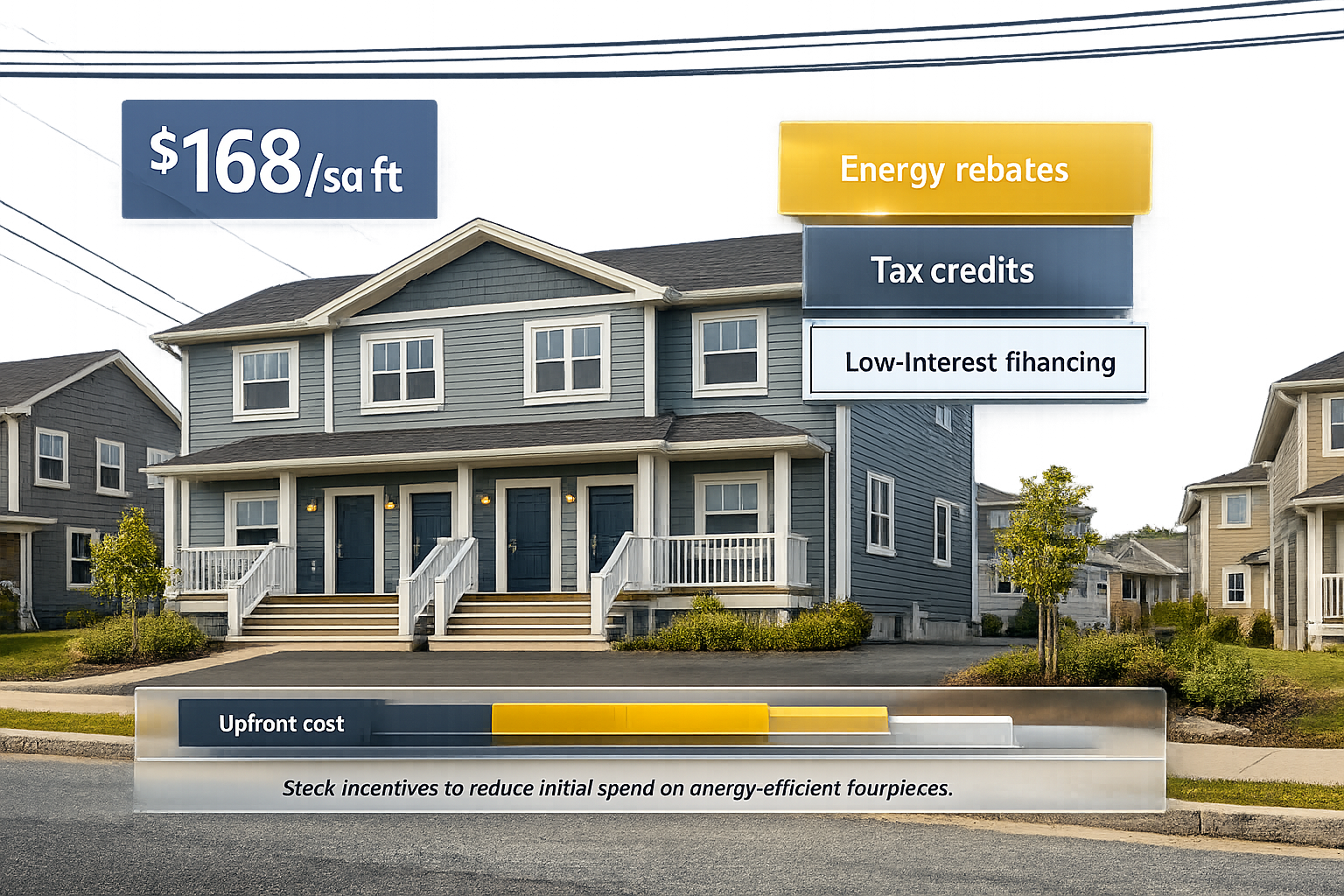
Building a fourplex in Nova Scotia is expensive, typically costing $220 per square foot for conventional construction. But with energy rebate programs, you could cut that to $168 per square foot - saving thousands per unit. The province has allocated $21.9 million for energy efficiency initiatives, including $6.39 million for the Affordable Rental Construction (ARC) pilot, which supports multi-unit developments. For property owners, this article breaks down how to take advantage of rebates like Efficiency Nova Scotia’s Commercial New Construction program, federal tax incentives, and renewable energy credits. By combining these with smart financing, you can lower upfront costs and improve long-term returns. Let’s dig into the numbers and steps you’ll need to maximize these programs.
$11B in Energy Incentives: Are Developers Missing Out? ft. Jayden Haywood | BLD Podcast Ep.25
sbb-itb-16b8a48
Efficiency Nova Scotia Rebates for New Construction
Efficiency Nova Scotia runs the Commercial New Construction program, designed for multi-unit residential projects like fourplexes. This initiative focuses on reducing electricity consumption through energy-efficient design and construction. It provides rebates for both the planning stage - via energy modelling incentives - and the implementation of efficiency upgrades [3].
Once you register, you’ll sign a project agreement that outlines your efficiency goals and the rebate amounts tied to your fourplex. This agreement ensures your project meets the required standards [3].
Eligibility Requirements
To access the Commercial New Construction rebates, your fourplex must be registered before any energy modelling or construction begins. The program mandates that energy modelling is carried out by consultants approved by Efficiency Nova Scotia, which unlocks up to $15,000 in modelling incentives [3]. It’s critical to bring in an approved energy consultant during the design phase - not after construction.
The program’s primary focus is on cutting electricity use through specific design and construction strategies. While efficiency targets vary by project, the aim is to achieve measurable reductions in annual electricity consumption compared to baseline building code standards. For projects seeking advanced incentives, such as Pay-for-Performance - which requires at least a 10% reduction in electricity use - working with consultants from the Efficiency Preferred Partner network is essential [4].
Rebate Amounts and Savings
Once your project qualifies, here’s what you can expect in terms of rebates and savings. The program funds up to 50% of eligible expenses, with a maximum rebate of $750,000 per project [3]. Additionally, the energy modelling incentive covers as much as $15,000 in fees for hiring approved consultants to conduct building performance analysis [3]. These rebates help reduce upfront construction costs, easing the financial burden.
To put this into perspective, energy-efficient fourplex construction in Nova Scotia typically costs around $168 per square foot, compared to $220 per square foot for conventional builds. Incorporating energy-efficient features - like advanced insulation, high-performance windows, and efficient HVAC systems - not only trims construction costs but also boosts returns on equity. Projects using energy-efficient designs have shown returns on equity of 262% after refinancing, compared to 116% for traditional builds [2].
Keep detailed records throughout construction. Save all receipts and photograph installations that could later be hidden, such as insulation behind walls or siding. Efficiency Nova Scotia may require this documentation during final verification before releasing the full rebate [2].
Federal Energy Rebates and Incentives
Federal programs have played a role in shaping project costs, but the landscape has shifted in recent years. For instance, the Canada Greener Homes Grant stopped accepting new applications on December 31, 2025, and the Canada Greener Homes Loan program ended on October 1, 2025 [2][6]. If you're planning to build a new fourplex, these programs won't apply, as they were designed for retrofitting existing buildings.
Important: New construction projects - defined as buildings six months old or newer - are excluded from federal energy rebates like the Canada Greener Homes Grant. Instead, consider provincial-level programs such as Efficiency Nova Scotia's Commercial New Construction initiative, which actively targets new builds.
Canada Greener Homes Initiative Overview
Previously, fourplexes fell under the Low‐rise Multi‐Unit Residential Buildings (MURBs) category. This classification included buildings with three or fewer storeys above ground and a footprint of 600 m² or less [7]. However, these federal programs were structured for retrofitting older buildings, not for new construction.
Another federal program, the Oil to Heat Pump Affordability Program, remains available as of April 2026. It offers up to $10,000 federally (or up to $25,000 in provinces with co-delivered programs) for converting oil heating systems to heat pumps. However, this program excludes buildings with more than two units [5][6][7].
Other Federal Support Programs
While some programs have ended, others remain relevant for new construction projects:
- Federal GST/HST New Housing Rebate: This rebate allows developers and homeowners to recover part of the GST or HST paid on newly built or substantially renovated residential properties [5]. It’s a straightforward way to ease the tax burden during construction.
- Federal Tax Incentive for Clean Energy Equipment: This incentive offers a 100% Capital Cost Allowance (CCA) rate for eligible clean energy and energy-efficient equipment [5]. Installing solar panels, high-efficiency HVAC systems, or similar equipment in your fourplex can help you fully deduct these expenses in the construction year. This not only improves cash flow but also lowers taxable income. Be sure to consult with your accountant to confirm which equipment qualifies and how to structure the deductions for maximum benefit.
Rebates for Renewable Energy Systems
Adding solar panels or EV charging stations to your property can cut upfront costs while making your rental more appealing to tenants who value green features and EV access. These renewable energy incentives can work alongside other efficiency rebates to bring down the total cost of your project.
Solar Electricity for Community Buildings Incentive
The Clean Technology Investment Tax Credit provides a 30% refundable tax credit on capital investments in solar and energy-storage technologies. This program is available until 2034 and is particularly beneficial for new construction projects. For instance, if you install a $50,000 rooftop solar system, you’ll receive a $15,000 refundable tax credit, reducing your actual cost to $35,000 [8][10].
Nova Scotia also offers an Enhanced Net-Metering program for systems up to 100 kW. This program allows you to bank excess energy for up to 12 months, with any unused credits paid out at full retail rates [9][10]. For properties with separately metered units, this means you can not only offset electricity costs but also generate additional revenue during peak solar months, such as the summer. These benefits are especially impactful when paired with EV charging infrastructure, which aligns with sustainable property design.
EV Charging Infrastructure Incentives
The Affordable Rental Construction (ARC) pilot supports developers building net-zero or net-zero ready affordable housing. If your fourplex meets ARC’s affordable housing criteria, you could qualify for funding to help cover the costs of installing EV charging stations [1].
Additionally, Efficiency Nova Scotia’s Commercial New Construction program offers up to $15,000 for energy modelling [3]. This program encourages developers to include EV charging infrastructure during the design phase, which can prevent costly retrofits down the line. By integrating these features early, you position your property as forward-thinking while keeping long-term costs in check.
How to Apply for Energy Rebate Programs
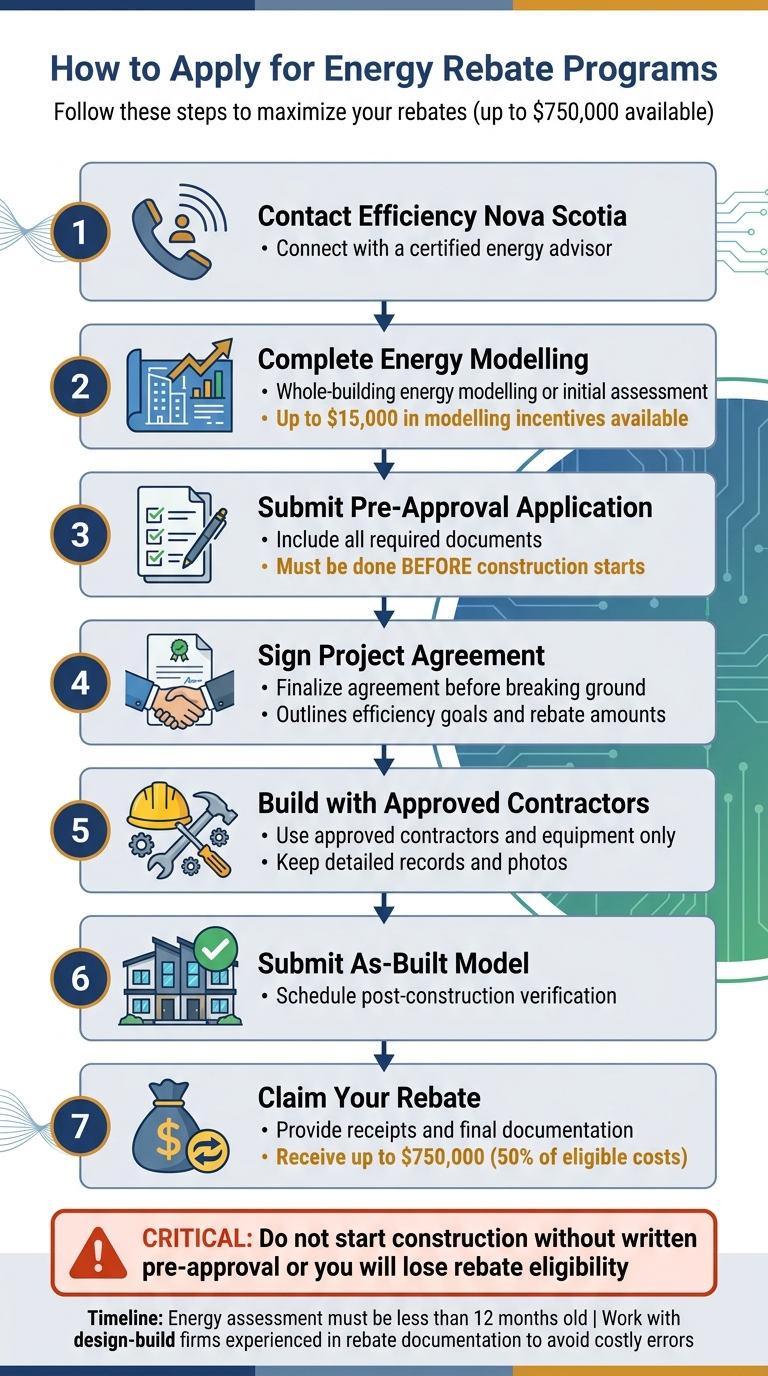
7-Step Process to Apply for Energy Rebates in Nova Scotia Fourplex Construction
Start your energy rebate application during the design phase - pre-approval is non-negotiable. Skipping this step is a common reason applications get rejected, and it can cost you significant savings on your fourplex project.
Required Documentation
You'll need to prepare the following documents:
- Proof of ownership or development rights
- Energy assessment report (dated within the last 12 months)
- Detailed construction drawings highlighting energy-efficient features like R-value insulation or triple-pane windows
- Energy modelling reports showing projected efficiency improvements
- Cost estimates from certified contractors
- Building permits and contractor certifications
- Signed Energy Modelling Incentive Application, which may provide up to $15,000 in funding for new fourplex construction [3]
Make sure to keep updated photos and receipts for the final verification steps.
Once you've gathered these, follow the application process carefully:
- Contact Efficiency Nova Scotia to connect with a certified energy advisor.
- Complete whole-building energy modelling or an initial energy assessment.
- Submit your pre-approval application with all required documents.
- Sign the Project Agreement before starting construction.
- Build using approved contractors and equipment.
- Submit the as-built model and schedule the post-construction verification.
- Provide receipts and final documentation to claim your rebate.
Common Application Errors to Avoid
To avoid delays or rejections, watch out for these common mistakes:
- Starting without written pre-approval: Construction or installations must not begin until Efficiency Nova Scotia provides written approval.
- Non-compliant equipment or contractors: Only use Energy Star-rated equipment or materials meeting U-value requirements, and hire contractors approved by the rebate program.
- Outdated or incomplete documentation: Ensure your energy assessment report is current (within 12 months) and submit all required photos, receipts, and documentation promptly after construction.
- Missed deadlines: Keep track of submission deadlines and maintain proof of all upgrades to avoid payment delays.
For property owners: Begin your rebate application as early as possible - ideally during the design stage. Efficiency Nova Scotia’s Commercial New Construction program offers up to $750,000 in funding, capped at 50% of project costs [3]. Working with a design-build firm familiar with rebate requirements can help you avoid costly mistakes and maximize the incentives available to you.
Combining Multiple Rebate Programs
Individual rebate programs can lead to considerable savings on their own. When you combine them, the financial benefits for your project increase even further. By stacking provincial, federal, and CMHC incentives, you can reduce construction costs and increase equity right from the start.
Using Energy Rebates with CMHC MLI Select Financing
Pairing energy rebates with CMHC MLI Select financing can significantly cut your overall expenses. For example, projects that exceed NECB standards by 15% can qualify for Efficiency Nova Scotia's Commercial New Construction program, which offers funding of up to $750,000 (covering 50% of eligible costs) [3]. Add to this the CMHC MLI Select program, which provides financing of up to 95% loan-to-value with amortizations extending to 50 years. On top of that, the federal Clean Technology Investment Tax Credit offers a 30% refundable credit on capital investments in renewable energy equipment through 2033 [11].
To take full advantage of these incentives, it’s crucial to integrate them early in the design phase. Start by getting an energy assessment from a certified advisor. Choose energy-efficient plans that meet CMHC MLI Select standards. Submit energy modelling reports and contractor quotes to secure pre-approval before construction begins. Once the project is complete, a post-build assessment will confirm compliance, allowing you to access the final rebates.
Sample Savings Calculations
The impact of combining these incentives is clear when you look at the numbers. Take a standard fourplex project in Halifax, where construction costs average $220 per square foot. By stacking rebates - such as Efficiency Nova Scotia's energy modelling incentive, the Solar Homes Program ($0.30 per watt up to $3,000), and the federal Clean Technology Investment Tax Credit - along with CMHC MLI Select's 95% financing, you can bring the effective construction cost down to about $168 per square foot. This approach could increase your return on equity from 116% to 262%, adding as much as $166,400 in additional equity on a single project [11].
For property owners: Partner with a design-build firm experienced in stacking rebate programs. They can help you maximize incentives while ensuring all documentation is handled efficiently.
Next Steps for Property Owners
Energy rebates can make a big difference in fourplex construction costs, but timing is everything. Programs like EnergyForward New Homes require you to enrol within 30 days of getting your building permit or before construction starts [12]. Miss this deadline, and you could lose out on significant savings. The registration fee is $199 plus tax, and if your project hits a $0 annual energy bill target, you could see a return of up to $25,000 [12]. The key is to include rebate planning right in the design phase - don’t wait until after construction begins.
Efficiency Nova Scotia offers a $15,000 modelling incentive, which can help you qualify for the Commercial New Construction program. This program covers up to 50% of project costs [3]. By starting early, you can ensure your design meets all the requirements before shovels hit the ground.
For property owners: Work with an integrated design-build firm that manages rebate documentation as part of the construction process. Traditional setups involve separate contractors - architects, engineers, general contractors, and energy advisors - which increases the risk of errors in documentation. These mistakes can cost you rebates. A unified team ensures that everything - pre-approval applications, energy modelling, and post-build assessments - is done correctly and on schedule.
Combining smart financing with energy rebates can further improve your project's financials. Pair provincial and federal energy incentives with CMHC MLI Select financing to stretch your dollars. By stacking these programs, you could reduce your effective construction cost from $220 per square foot to $168 per square foot, boosting your return on equity from 116% to 262%.
To get started, schedule an energy assessment (less than 12 months old), ensure your plans exceed NECB standards by 15%, and submit pre-approval applications with contractor quotes before excavation begins. This sequence helps you secure every rebate dollar while keeping your project on track.
FAQs
When do I need to apply for Efficiency Nova Scotia rebates?
To qualify for Efficiency Nova Scotia rebates, start by scheduling an energy assessment. Once that's done, you'll need to take the following steps:
- Submit pre-approval: Provide your project plans and contractor quotes for review.
- Complete the upgrades: Work with approved contractors to carry out the energy-efficient improvements.
- Wrap up with follow-ups: Schedule a follow-up assessment and submit all required documentation.
Make sure to stick to the outlined process to ensure you meet all eligibility requirements for the rebates.
Can I stack Efficiency Nova Scotia rebates with CMHC MLI Select and tax credits?
Yes, it's possible to combine Efficiency Nova Scotia rebates with CMHC MLI Select discounts and applicable tax credits, but eligibility will depend on the specific rules of each program.
- Efficiency Nova Scotia: Offers rebates for energy-efficient upgrades, such as better insulation, high-performance windows, or efficient heating systems. These rebates are designed to reduce upfront costs for property owners.
- CMHC MLI Select: Provides discounts on mortgage loan insurance premiums for homes that meet energy efficiency standards, which can lower financing costs.
- Tax Credits: Depending on your upgrades, you might qualify for federal or provincial tax credits tied to energy efficiency or home improvements.
To make the most of these benefits, carefully review the eligibility criteria for each program and confirm they align with your planned upgrades. Combining them could help you save significantly on both upfront and long-term costs.
What documents do I need to get the rebate paid out?
To qualify for the rebate, you'll generally need to gather and submit several documents. These often include proof of completed upgrades, energy assessment reports, contractor invoices, and in some cases, photos or certifications of the energy-efficient installations. Make sure to complete an energy assessment, get pre-approval for your project plans, and carefully follow all application instructions. Keeping your documentation in order and scheduling follow-up assessments are key steps to ensure you receive the rebate without delays.