How Energy Efficiency Requirements Affect Your Building Costs and Returns
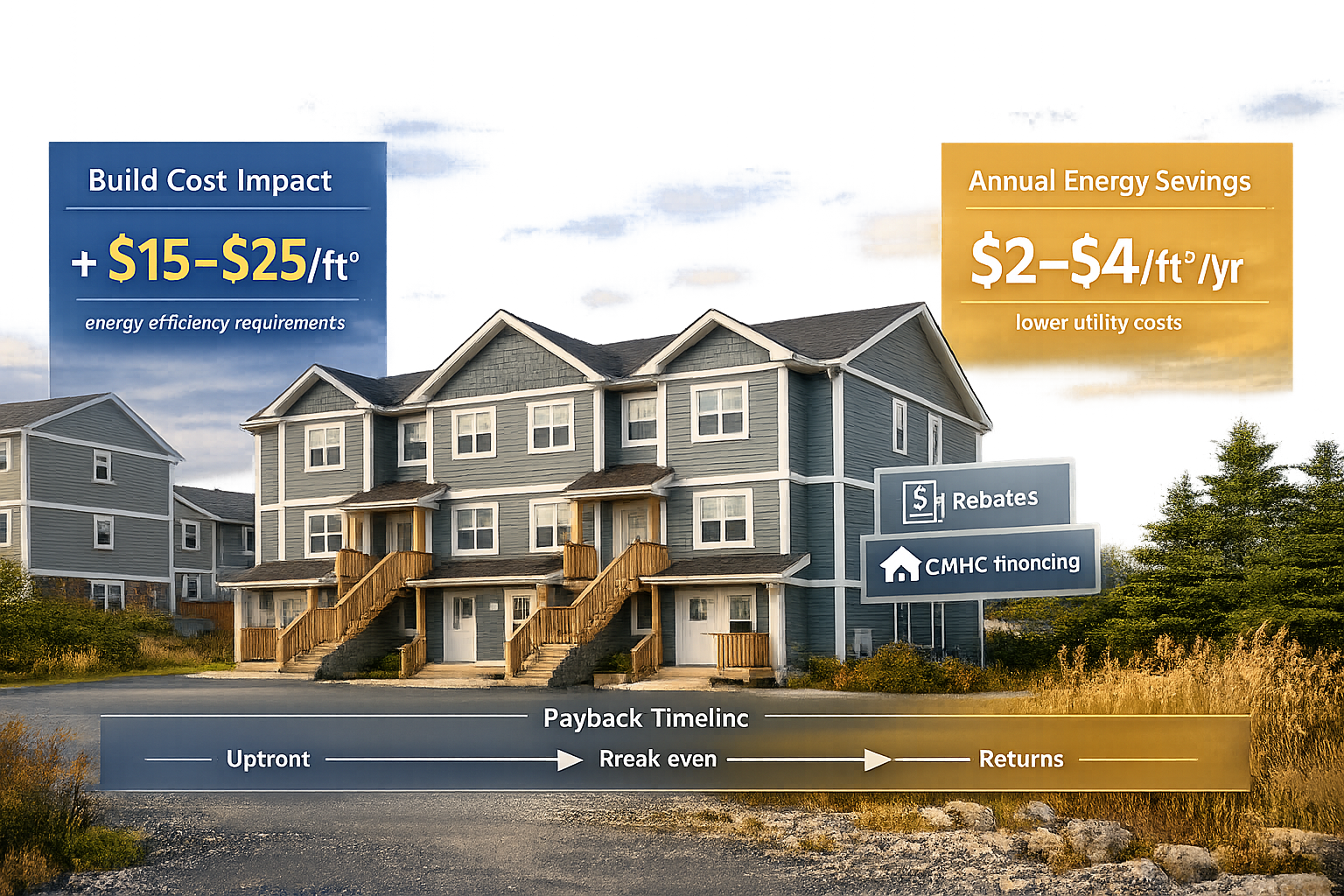
If you're planning a rental property project in Nova Scotia, you're probably asking: "How much will energy efficiency requirements add to my construction costs, and will it pay off?" Here's the quick answer: Nova Scotia's new Energy Step Code Tier 3 increases construction costs by $15–$25 per square foot. For a 4+ unit rental, that’s an extra $15,000–$30,000 per unit. But it also slashes annual energy bills by $2–$4 per square foot, saving $2,000–$6,000 annually for a small building.
This article breaks down the numbers so you can decide if the upfront investment makes sense for your project. We'll cover construction costs, rebate programs, financing options, and how these upgrades impact your long-term returns. Whether you're building a fourplex or a 20-unit complex in Halifax, you'll leave with a clear understanding of how these rules affect your bottom line.
EXTRA COSTS OF NET-ZERO
sbb-itb-16b8a48
Nova Scotia's Energy Efficiency Requirements for Multi-Unit Buildings
Starting April 1, 2026, Nova Scotia adopted Tier 2 of Section 9.36 from the 2020 National Building Code of Canada for housing and small buildings [4]. This change requires a 10% improvement in energy performance compared to older codes [4]. If you're planning a 4+ unit rental project, understanding these rules is key to shaping your budget and securing financing.
Required Standards for 4+ Unit Construction
For multi-unit projects, knowing the specific building code requirements helps balance compliance costs with long-term savings. The applicable code depends on your building’s classification. Low-rise residential buildings (three storeys or less, under 600 m²) follow Part 9 of the National Building Code [3]. High-rise buildings (four or more storeys) typically fall under the National Energy Code for Buildings (NECB 2020) or Part 3 of the NBC, as these involve more complex engineering [3][5]. Most 4+ unit properties in Nova Scotia - whether fourplexes, sixplexes, or small apartment buildings - are considered low-rise and must meet Tier 2 standards under Part 9.
Builders have three compliance options:
- Tiered Prescriptive Path: Earn 10 energy conservation points through upgrades like better insulation, efficient windows, heat recovery ventilation (HRV) systems, and tighter building envelopes [4].
- Tiered Performance Path: Use energy modelling software (e.g., HOT2000) for a customized approach [4].
- Direct NECB 2020 compliance: Typically for larger, more complex projects.
For property owners working with design-build firms, the Prescriptive Path is often the simplest and most predictable route.
What this means for property owners: For typical fourplexes or eightplexes, the Prescriptive Path is likely the most practical choice. Larger or more custom projects might benefit from the flexibility of the Performance Path.
Meeting Efficiency Nova Scotia and CMHC Standards
To unlock Efficiency Nova Scotia rebates or secure CMHC financing, meeting basic code requirements isn’t enough. These programs demand higher energy performance, which can lead to lower operating costs and increased tenant appeal. For projects aiming for net-zero or net-zero ready status, developers must apply through the Affordable Rental Construction (ARC) pilot. This requires submitting a whole-building energy model to determine funding eligibility [8].
For retrofits on existing buildings, pre-approval from Efficiency Nova Scotia is mandatory. Any upgrades completed without prior approval won’t qualify for rebates [6].
The Affordable Multifamily Housing Program offers rebates up to CA$150,000 or covers 80–100% of eligible energy upgrade costs [6]. An additional CA$13.49 million in funding is available for top-up rebates [8]. To qualify for an ENERGY STAR score - often needed for premium financing - your building must meet these criteria:
- At least four storeys or a horizontal footprint of 600 m² or more.
- At least 50% of the space must be heated.
- A residential density of no more than three units per 100 m² [7].
"The buildings we plan, design and construct today will shape our future. To meet our efficiency goals and increase the housing supply, we are building affordable, accessible, comfortable homes for Nova Scotians today and in the future" [8].
- Minister John Lohr
Next, we’ll break down how these requirements impact energy upgrade costs and potential financial returns.
Common Energy Upgrades: Costs and Financial Returns
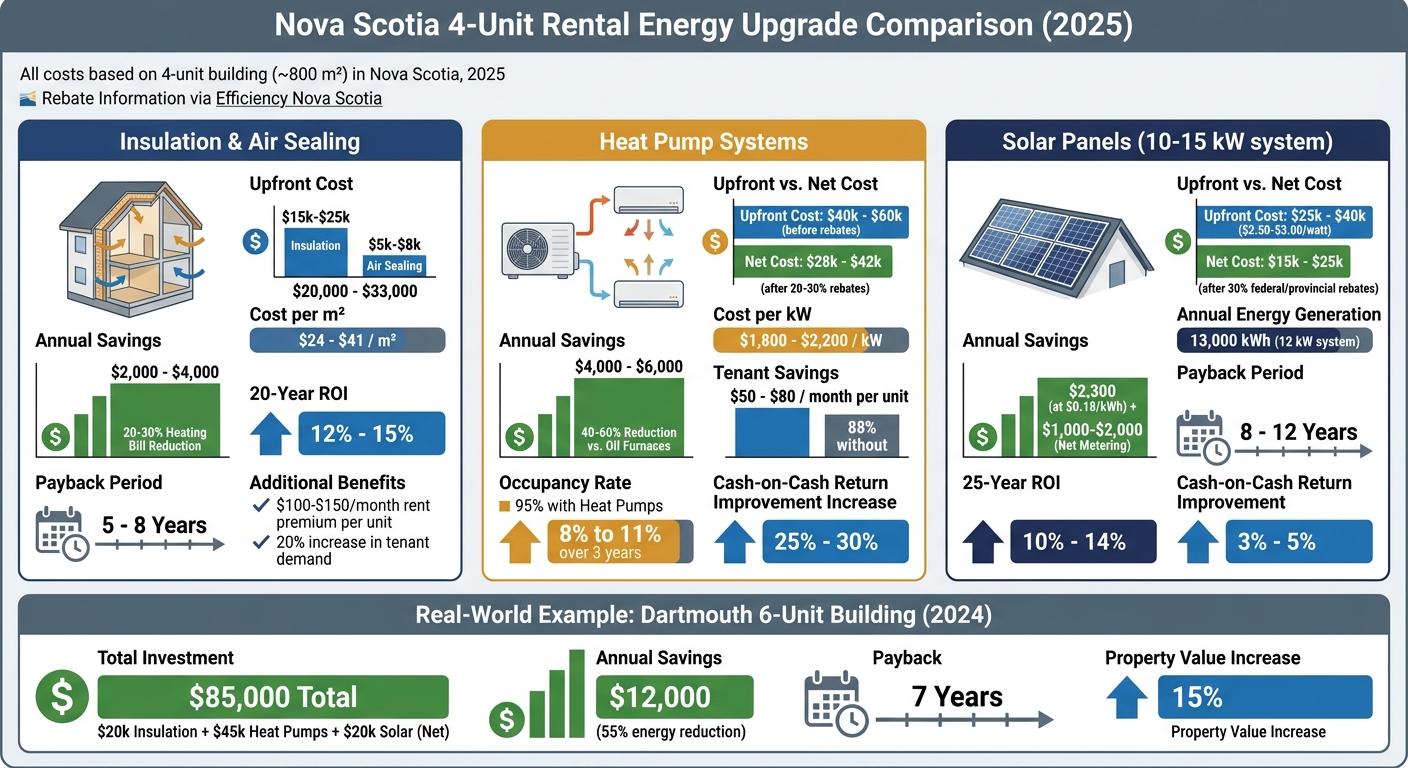
Energy Upgrade Costs, Savings, and ROI Comparison for Multi-Unit Buildings in Nova Scotia
Keeping up with Nova Scotia's energy standards while ensuring solid financial returns requires a clear understanding of upgrade costs and savings. The three most common upgrades - insulation and air sealing, heat pump systems, and solar panels - each carry unique costs and payback periods. Knowing these details helps property owners plan budgets that meet code requirements while improving long-term profitability.
Insulation and Air Sealing
For a typical 4-unit building (around 800 m²), upgrading to R-20 wall insulation and R-40 attic insulation costs between $15,000 and $25,000, translating to $18–$31/m². Adding air sealing increases the total by $5,000–$8,000 ($6–$10/m²). For older buildings, expect a 20% cost hike. Efficiency Nova Scotia highlights that bulk purchases for multi-unit projects can reduce costs by 10–15%, compared to single-family homes [1].
Nova Scotia's winters, with temperatures averaging -5°C to -10°C, make these upgrades particularly beneficial. They cut heating bills by 20–30%, saving $2,000–$4,000 annually for a 4-unit property (based on $0.15/kWh natural gas rates). A Halifax case study reported a 25% drop in energy bills after similar upgrades [1][2]. Payback periods range from 5 to 8 years, with ROI improving to 12–15% over 20 years due to lower maintenance costs.
What this means for property owners: These upgrades boost annual ROI by 2–4% through direct energy savings and allow for a rent premium of $100–$150 per unit per month for "energy-efficient" properties. According to CMHC data, this also increases tenant demand by 20% [1]. While insulation and air sealing provide passive savings, active systems like heat pumps can take energy performance even further.
Heat Pump Systems
Heat pumps are another effective upgrade that balances upfront costs with long-term savings. Installing a multi-zone air-source heat pump system (20–30 kW) costs $40,000–$60,000, but rebates can offset 20–30% of this expense, significantly reducing net costs. Adding ducted systems raises the cost by $5,000–$10,000. Efficiency Nova Scotia estimates installation costs at $1,800–$2,200 per kW in 2025 [2].
Replacing oil furnaces with high-efficiency heat pumps can cut heating costs by 40–60%, saving $4,000–$6,000 annually for a 4-unit property in Nova Scotia's climate (with roughly 2,500 heating degree-days). Tenants benefit too, with monthly utility savings of $50–$80 per unit while maintaining a steady indoor temperature of 21°C. CMHC data reveals that properties with heat pumps achieve higher occupancy rates (95% versus 88%) and see tenant demand increase by 25–30% [1][2]. Over three years, cash-on-cash returns improve from 8% to 11%, demonstrating the balance between initial investment and financial gains.
Solar Panels
Installing a 10–15 kW rooftop solar system for a 4-unit building costs $25,000–$40,000, or $2.50–$3.00 per watt installed. This includes panels, inverters, and mounting. After federal and provincial rebates (up to 30%), net costs drop to $15,000–$25,000. Local installers in 2025 quoted an average of $18,000 for a 12 kW system [1].
At Nova Scotia Power’s rate of $0.18/kWh, a 12 kW system generates roughly 13,000 kWh annually, saving $2,300 on energy bills, plus $1,000–$2,000 through net metering. Payback periods range from 8 to 12 years, and over 25 years, ROI reaches 10–14%, even accounting for a 0.5–1% annual panel degradation. Solar systems also improve cash-on-cash returns by 3–5% and meet CMHC green financing criteria, which can increase property appraisals [2].
A Dartmouth 6-unit building retrofit completed in 2024 combined insulation ($20,000), heat pumps ($45,000), and solar panels ($20,000 net), resulting in $12,000 in annual energy savings - a 55% reduction. An Efficiency Nova Scotia expert commented:
"Upgrades paid off in 7 years, boosting value 15%"
[1][2]. These numbers provide a clear picture of how energy upgrades can improve both financial performance and property value.
Cost and Return Comparison
Evaluating the financial impact of various energy upgrades is crucial for property owners looking to maximize returns. Some upgrades, like insulation and air sealing, pay off quickly by cutting energy loss and operating costs. Others, such as heat pumps, offer substantial annual savings, especially in colder regions. Solar panels, while requiring a moderate upfront investment, contribute long-term savings by lowering utility bills and may benefit from net metering arrangements. Here's a quick breakdown of the costs and returns for these upgrades:
Energy Upgrade Cost Breakdown
- Insulation & Air Sealing: These upgrades reduce energy loss and operating costs, offering the fastest return on investment.
- Heat Pump Systems: Though they come with a higher upfront price tag, they provide significant yearly savings, particularly in colder climates where heating demands are higher.
- Solar Panels: Moderate initial costs are offset by long-term reductions in utility expenses.
Efficiency Nova Scotia rebates make these upgrades even more attractive financially. For properties that meet affordable rental rate criteria, the rebates can cover 80–100% of eligible project costs [6].
Key takeaway for property owners: Selecting the right combination of energy upgrades can significantly lower operating expenses over the building's lifespan while improving its overall efficiency and value.
It's important to note that all upgrades must be pre-approved by Efficiency Nova Scotia, with a maximum of three comprehensive applications allowed per year [6]. Electrically heated buildings may qualify for additional rebate packages, which can include heating systems, building envelope improvements, water heating, and lighting upgrades [6].
Using Rebates and Financing to Lower Costs
Energy upgrades can feel like a hefty expense, but rebates and financing options can dramatically cut the upfront costs. By combining provincial rebates with federal financing, energy-efficient upgrades shift from being a financial hurdle to a practical investment.
Efficiency Nova Scotia Rebate Programs
The Affordable Multifamily Housing Program offers rebates covering up to 80% of project costs for for-profit rental properties, with a cap of CA$150,000 per project [6]. Non-profit organizations can qualify for full rebates [6]. Backed by a CA$13.49 million provincial investment, this program underscores Nova Scotia’s focus on energy-efficient, affordable housing [8]. Eligible upgrades include insulation, high-efficiency heat pumps, energy-efficient windows and doors, and improved lighting in common areas.
To qualify, property owners must meet specific affordable rental rate criteria and commit to maintaining those rates over the long term. Importantly, all upgrades require pre-approval from Efficiency Nova Scotia before starting the work. For eligibility details, property owners can email affordable@efficiencyns.ca or call 1-877-999-6035. Note that participants are generally limited to three approved properties per calendar year [6]. Another initiative, the Affordable Rental Construction (ARC) Pilot, focuses on new builds aiming for net-zero or net-zero ready standards, supported by a CA$6.39 million provincial investment [8].
"These new programs will support the building sector to help ensure even more Nova Scotians have access to affordable, energy-efficient homes", said Stephen MacDonald, President and CEO of EfficiencyOne [8].
While rebates cover a significant portion of costs, financing options can address the remaining upfront capital.
CMHC MLI Select Financing Benefits
Projects meeting CMHC energy efficiency standards can qualify for MLI Select financing, which allows property owners to finance up to 95% of their total project costs. This means only a 5% down payment is required. For example, if a fourplex costs CA$160,000 per unit (CA$640,000 total), the down payment drops to about CA$32,000 instead of the usual 20–25% (CA$128,000–CA$160,000). Additionally, MLI Select offers reduced mortgage insurance premiums and extended amortization periods of up to 50 years, which can significantly improve monthly cash flow.
How this impacts property owners: By combining Efficiency Nova Scotia rebates with CMHC MLI Select financing, property owners can reduce their equity requirements by 60–70% compared to traditional financing. For instance, building an energy-efficient eightplex might qualify for CA$150,000 in rebates. With 95% financing on the remaining costs, the equity needed could drop from over CA$250,000 to roughly CA$80,000–CA$100,000.
Conclusion
Nova Scotia's energy efficiency mandates may increase upfront construction costs, but they also set the stage for stronger long-term financial performance. The real opportunity lies in creating properties that not only meet regulations but also deliver sustained cost savings and appeal to tenants who prioritize affordability. This approach doesn’t just impact your budget - it enhances your property's marketability and competitiveness.
Energy-efficient buildings stand out by reducing total housing costs - rent plus utilities - a factor that directly impacts tenant demand and vacancy rates. The Canada Mortgage and Housing Corporation (CMHC) advises that "housing costs should be less than 30% of before-tax household income. This includes: Utilities (electricity, heat and water), Rent, Municipal services (if applicable)" [9]. For example, a unit renting for CA$1,400 with CA$200 in utilities (CA$1,600 total) is more appealing to cost-conscious tenants than a unit renting for CA$1,350 with CA$300 in utilities (CA$1,650 total). Lower utility costs make your property more attractive, expanding your tenant pool and reducing the risk of vacancies.
When marketing energy-efficient units, emphasize the lower utility bills. Compare your property's total housing costs with similar units using tools like annual Rental Market Reports and provincial rental registries. A property that saves tenants CA$100–CA$150 per month on utilities creates a clear edge in markets where affordability is a top concern.
These energy efficiency standards aren’t roadblocks - they’re a way to achieve operational savings and retain tenants for the long haul. By focusing on cost savings and tenant appeal, you're building properties that thrive in both today's market and tomorrow's.
FAQs
Does my 4+ unit building follow Part 9 or Part 3/NECB?
If you own a 4+ unit building in Nova Scotia, be aware of the updated energy code requirements coming into effect on April 1, 2026. These changes align with national energy efficiency standards and are designed to follow guidelines similar to Part 9 of the National Building Code, rather than the more complex Part 3 or NECB standards. For detailed information, consult the Nova Scotia Building Code Regulations to ensure your property meets the new rules.
What’s the cheapest upgrade mix to meet the Step Code?
The most cost-effective way to comply with the Nova Scotia Step Code is by prioritizing energy-efficient upgrades that deliver quick returns. Key approaches include improving insulation, installing heat pumps, and using high-performance windows. Among these, insulation is usually the cheapest and simplest to implement. Heat pumps, on the other hand, not only pay for themselves quickly but also attract tenants due to their comfort and efficiency. Combining these upgrades helps meet code requirements, lowers expenses, and takes advantage of rebate programs like Efficiency Nova Scotia, improving your overall return on investment.
How do I qualify for rebates and CMHC MLI Select?
To get started, arrange an energy assessment through Efficiency Nova Scotia or your province's equivalent program. This will help gauge your property's current energy performance. Once you have the results, prepare a detailed submission that includes project plans, contractor quotes, and any necessary documentation for pre-approval.
After receiving approval, proceed with the upgrades - this might include adding insulation or installing heat pumps. Once the work is complete, you'll need to schedule follow-up assessments and provide all required documentation to confirm compliance.
For those pursuing CMHC MLI Select, make sure your project aligns with their energy efficiency, size, and financial requirements. Refer to CMHC's official guidelines to ensure everything is in order.