Building Permit Timelines by Nova Scotia Municipality
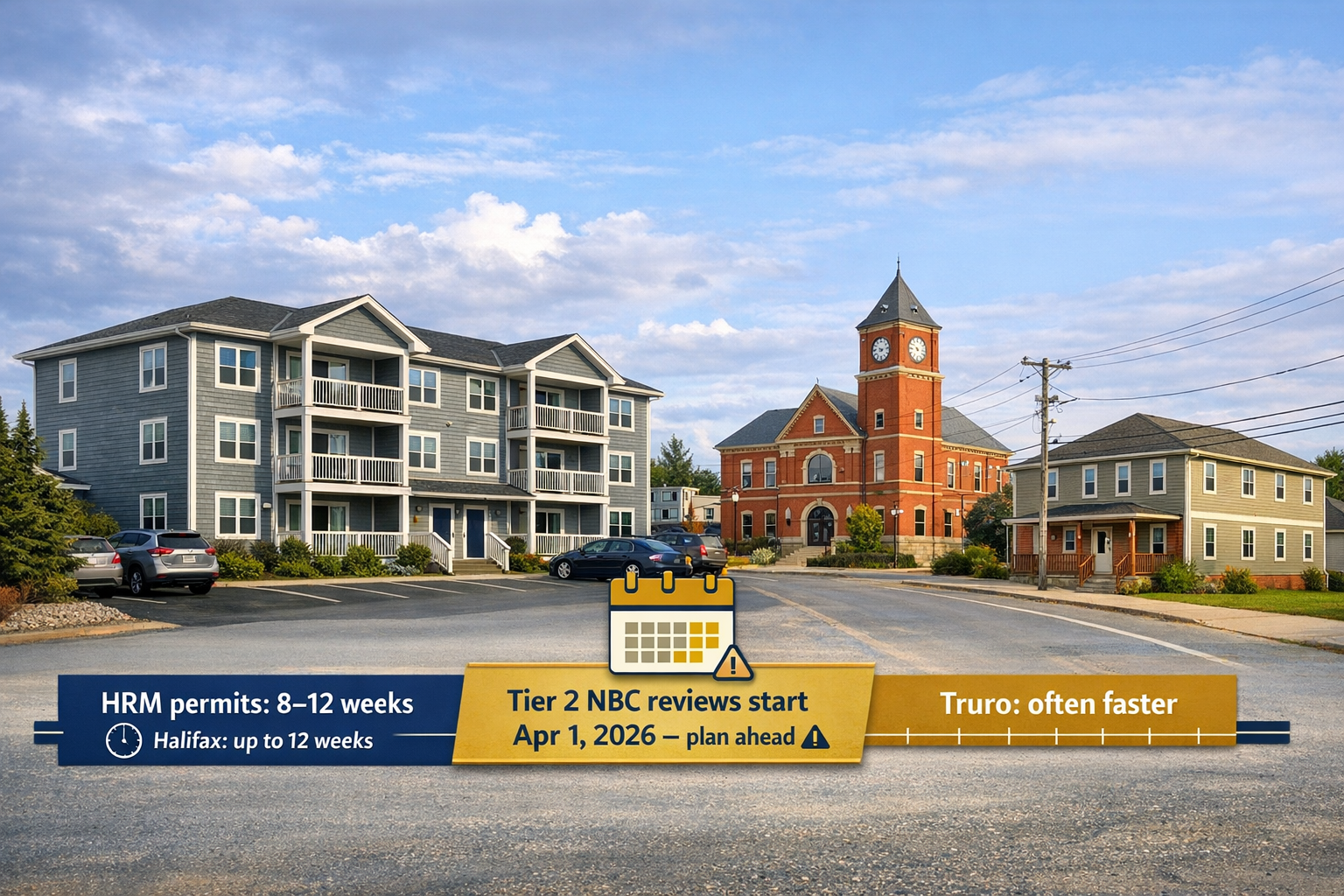
When you're planning a new build or renovation in Nova Scotia, the time it takes to get a building permit can make or break your project schedule. In Halifax, for example, permits for multi-unit developments can take up to 12 weeks, while Truro might process them faster thanks to lower application volumes. Starting April 1, 2026, all applications must meet stricter energy performance standards under Tier 2 of the 2020 National Building Code, which could extend timelines across the board. This article breaks down how permit timelines differ between Halifax, Dartmouth, Bedford, and Truro, and how these timelines impact your project. Let’s dive in.
1. Halifax
Multi-Unit Permit Timelines
In Halifax, the sheer volume of permit applications directly impacts approval times for multi-unit rental properties. Unlike a fixed standard timeline, the municipality's processing times vary based on factors like the complexity of the application, seasonal workload, and the type of structure involved. For property owners, keeping an eye on current processing times is essential, as these durations can shift. Digital tools are increasingly being used to help manage this variability.
Recent Improvements
The Halifax Regional Municipality has introduced an interactive Planning & Development Dashboard. Updated nightly with data from the municipal permit system, this dashboard provides a wealth of information. It tracks the total number of permits submitted and issued, displays average processing times, and includes a permit status map that shows development progress. For property owners, this tool offers real-time insights into housing trends and metrics, aiding in better alignment of project timelines with local growth patterns [1].
Factors Influencing Timelines
Even with digital advancements, the complexity of multi-unit applications remains a key factor affecting processing times. These applications demand more detailed reviews compared to single-family homes. Areas like site servicing, parking requirements, and building code compliance add layers of scrutiny, which naturally extend review periods.
Using Halifax's Digital Tools
Halifax's POSSE Customer Portal allows you to track and manage your permit status online. The Permit Status Map is particularly helpful, offering real-time updates on where your application stands in the process and showing how similar projects are advancing [1].
sbb-itb-16b8a48
2. Dartmouth
Multi-Unit Permit Timelines
Dartmouth operates under HRM's centralized permitting system, meaning the process for multi-unit developments mirrors that of Halifax. Applications are managed through the POSSE online system, which handles permits, planning, and licensing. For multi-unit or mixed-use projects, you'll need to apply for a "Mixed Use or Commercial Building Permit" through this platform [3].
The typical processing time for multi-unit permits is 8 to 12 weeks, though this depends on the complexity of the application and the seasonal workload. For standard projects, the design and planning phase usually takes 2 to 4 months, while more intricate developments can stretch this timeline to 3 to 6 months or even longer [4]. If you're planning a 4–8 unit rental property, expect the entire process - from design to permit approval - to take around 4 to 6 months. These timelines can shift depending on local factors outlined below.
Factors Influencing Timelines
Multi-unit developments in Dartmouth often undergo more detailed reviews than single-family homes. For instance, if your building is within 5 metres of the street line, you'll need to include a Construction Management Plan with your application. This requirement sets Dartmouth apart from some other areas [3]. Additionally, starting 1 April 2026, all building permit applications must meet Tier 2 of the 2020 National Building Code. This introduces stricter energy performance standards for residential and commercial buildings, adding another layer of review that could extend processing times [2].
Recent Improvements
Dartmouth, like Halifax, benefits from HRM's Planning & Development Dashboard, which updates nightly. The POSSE Customer Portal allows for 24/7 application submissions and real-time tracking, eliminating the need for in-person status checks [1][3].
3. Bedford
Multi-Unit Permit Timelines
Bedford falls under HRM's centralized permitting system. Once you submit your application through the POSSE online system, expect a processing time of 8–12 weeks. Projects requiring Tier 2 compliance will undergo an additional technical review, which can extend timelines further [1][2]. These factors form the baseline for how long multi-unit permits typically take in Bedford.
Factors Influencing Timelines
If your building is within 5 metres of the street property line, a Construction Management Plan will be mandatory [5]. To avoid unnecessary delays, verify your property's zoning designation using HRM's ExploreHRM interactive map. This step is especially important if your project might require a variance or a Land Use By-law amendment [5].
Submitting complete, scale-accurate construction drawings is another way to keep the process on track and minimize back-and-forth with reviewers.
Recent Improvements
Bedford has adopted several digital tools to make the permitting process more efficient. The HRM Planning & Development Dashboard provides nightly updates on permit volumes and processing times, giving you a clearer picture of what to expect [1]. Additionally, the interactive Permit Status Map allows you to monitor your application's progress from submission to approval. All submissions and communications are handled through the POSSE Customer Portal, making the entire process accessible online [1].
4. Truro
Multi-Unit Permit Timelines
In Truro, the permit process for residential new construction is managed locally. The town charges $0.06 per square metre and requires a refundable $100 occupancy deposit. Applications can now be submitted online, and fees can be paid using a credit card, streamlining the process for developers and property owners [2].
Factors Influencing Timelines
If your project connects to Truro's sanitary sewer system, the town will issue a "footings-only" permit to start. However, construction beyond the footings stage is on hold until the Engineering and Public Works Department installs sewer laterals to the property line and you provide a location certificate [2]. To avoid delays, it’s critical to contact the Engineering and Public Works Department early in your planning process to coordinate sewer installations.
When submitting your application, be thorough. Include a site plan, building elevations, floor plans, sections, and structural drawings. Missing documents will delay the approval process [2]. Additionally, starting 1 April 2026, all applications must meet Tier 2 of the 2020 National Building Code. This update focuses on energy performance, requiring improved insulation, windows, doors, and mechanical systems [2].
Recent Improvements
Truro has introduced an online permit portal that allows electronic submissions and fee payments through Visa or MasterCard. This makes the process faster and more convenient. To help developers meet the updated energy standards, the Planning Department has also introduced the NBC 2020 Energy Compliance Pathways Form, which offers guidance on adhering to the stricter requirements for insulation, windows, doors, and mechanical systems [2].
The inspection process in Truro includes five mandatory stages: footings, pre-backfill, before covering framing and plumbing, pre-drywall, and final inspection before occupancy [2]. These updates set Truro apart, offering a more streamlined and structured approach compared to other municipalities.
Comparison of Permit Processes
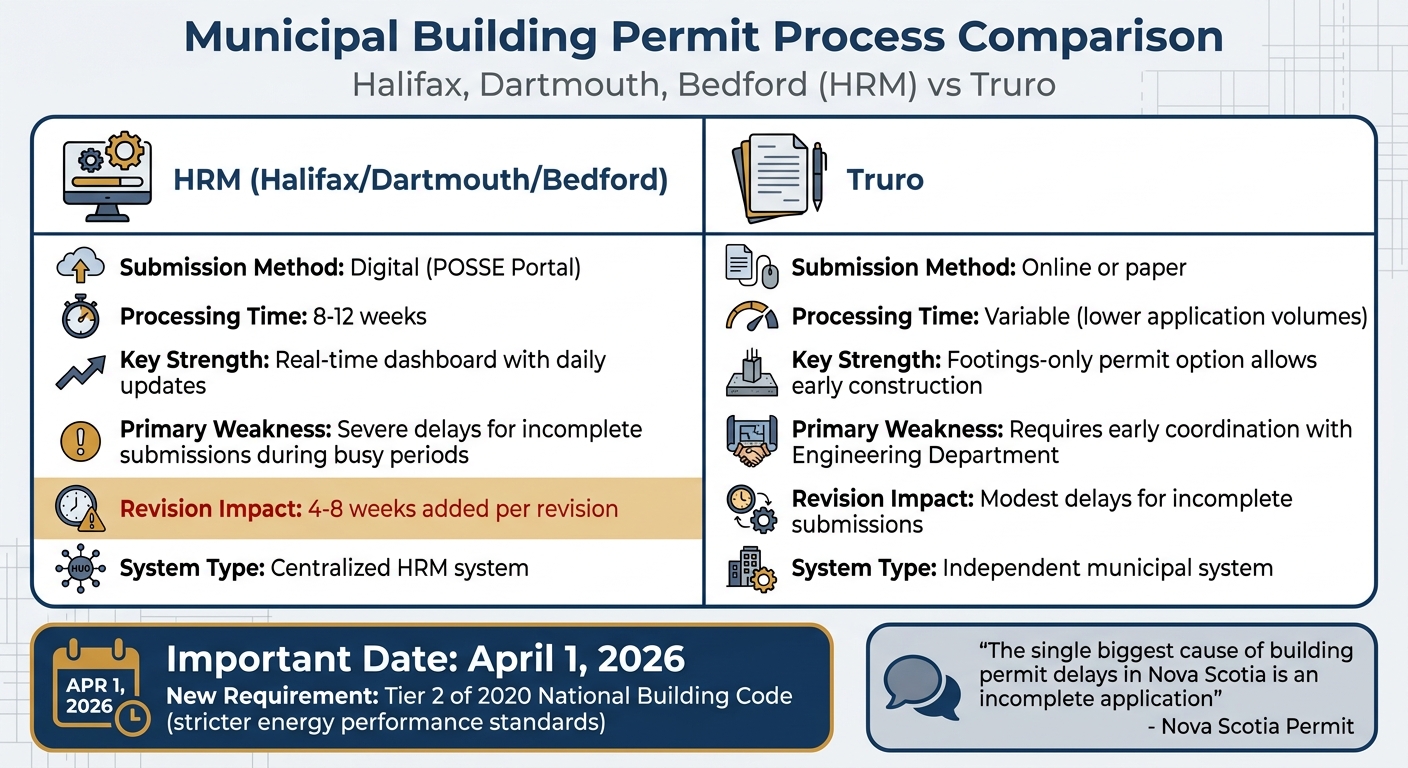
Nova Scotia Building Permit Timeline Comparison: Halifax, Dartmouth, Bedford vs Truro
This section dives into the key differences in how municipalities handle building permits, focusing on Halifax, Dartmouth, Bedford, and Truro, and how these differences impact project timelines.
Halifax, Dartmouth, and Bedford fall under the Halifax Regional Municipality (HRM) and share the same centralized system, following identical procedures and timelines [6]. Truro, on the other hand, operates with its own independent municipal system, which introduces some variation in permit timelines.
One of the most notable distinctions is how incomplete submissions are treated. In HRM, if your application is missing information or needs revisions, it’s bumped to the back of the review queue. This can add anywhere from 4 to 8 weeks to your timeline - a significant delay, especially in busier urban areas like Halifax [7]. As Nova Scotia Permit explains:
The single biggest cause of building permit delays in Nova Scotia is an incomplete application
In Truro, while complete documentation is still required upfront, the smaller volume of applications means delays from revisions tend to be less severe. However, property owners must still be diligent to avoid unnecessary setbacks. The table below illustrates these differences:
| Municipality | Submission Method | Key Strength | Primary Weakness | Revision Impact |
|---|---|---|---|---|
| Halifax/Dartmouth/Bedford (HRM) | Digital (POSSE Portal) [1] | Real-time dashboard with daily updates | Severe delays for incomplete submissions during busy periods | 4–8 weeks added per revision [7] |
| Truro | Online or paper [2] | Footings-only permit option allows early construction | Requires early coordination with Engineering Department | Modest delays for incomplete submissions |
For property owners, HRM’s digital tools, like the real-time dashboard, offer transparency, but they also highlight the importance of submitting a complete application to avoid costly delays. In Truro, the footings-only permit option allows construction to begin sooner, but coordinating with the Engineering Department for sewer installations is critical to prevent mid-project issues.
All municipalities now enforce Tier 2 of the 2020 National Building Code as of 1 April 2026 [2]. Understanding these local differences and planning accordingly can save time and help keep projects on track.
Conclusion
When it comes to municipal processes, one thing is certain: submitting a complete application is critical. Even a minor omission can delay your project by 4–8 weeks [7].
Halifax, Dartmouth, and Bedford benefit from HRM's centralized system, which includes tools like the POSSE portal and real-time tracking. However, these tools are only effective if your application is thorough. Ensure you have complete, stamped technical drawings, accurate energy documentation, and zoning confirmation before submission [7]. Start by verifying your zoning early, organize your paperwork systematically, and double-check that all required elements are included. For projects in HRM, the Planning & Development Dashboard is a valuable resource to track processing volumes and adjust your expectations accordingly [1].
FAQs
How can I avoid my HRM permit getting bumped to the back of the queue?
To keep your HRM permit process on track, make sure your application is thorough and error-free right from the beginning. Double-check that all required documents are included, and ensure your plans comply with zoning and building codes. Follow the application steps carefully. Bringing in professionals to review your plans can catch potential mistakes early. A well-prepared application that meets local requirements will help you avoid unnecessary delays and keep things moving smoothly.
What Tier 2 energy documents will I need for a permit after April 1, 2026?
Starting April 1, 2026, building permit applications in Nova Scotia will require Tier 2 energy documents. These include energy efficiency compliance forms and any other documentation mandated by the updated energy regulations. Requirements can vary by municipality, so it's crucial to confirm the specific details for your area to stay compliant and prevent potential delays in your project timeline.
When does Truro issue a footings-only permit, and what can delay the rest?
Truro provides a footings-only permit once your application clears the necessary steps. However, moving forward with construction beyond the footings stage can face delays due to zoning regulations or further review processes.