Atlantic Immigration and Rental Demand: How Federal Policy Creates Local Opportunity
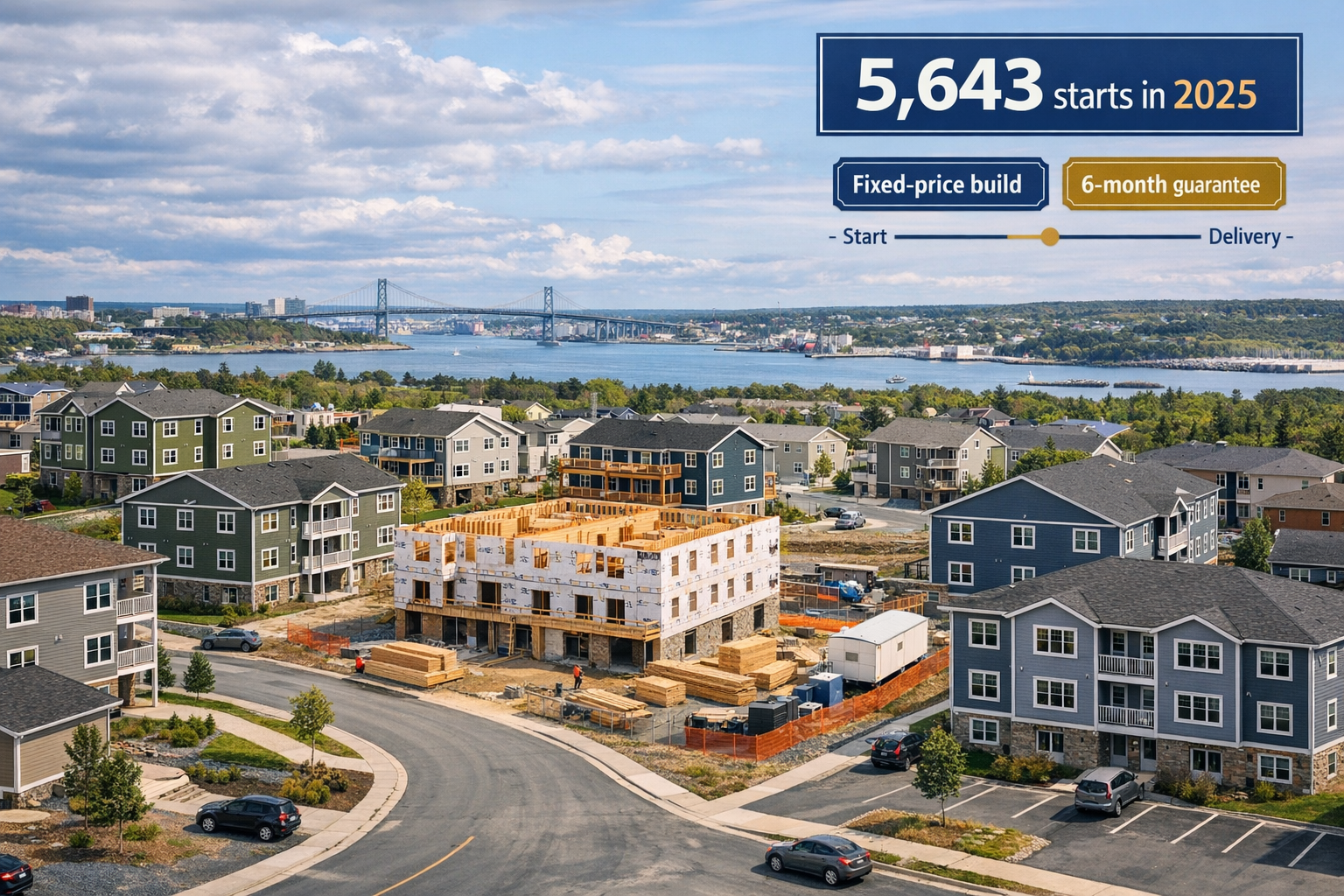
Looking to understand how Nova Scotia’s rental market is being shaped by immigration? Here’s the crux: Halifax had 5,643 housing starts in 2025, 81% of which were rentals, yet the city’s vacancy rate remained a tight 2.7%. Average rents in February 2026 hit $2,268, well above the national average of $2,030. Immigration, driven by the Atlantic Immigration Program (AIP), is fuelling this demand, with Nova Scotia welcoming 13,736 immigrants in 2024 alone. For property owners, this article will break down how immigration trends, construction costs, and financing options like CMHC MLI Select create opportunities in Nova Scotia’s rental market - and how to position your investments to meet this demand.
Nova Scotia Immigration and Rental Market Statistics 2020-2026
Atlantic Immigration Program: Population Growth in Nova Scotia
How the AIP Works
The Atlantic Immigration Program (AIP) is designed to help Nova Scotia businesses address labour shortages by hiring skilled foreign workers and international graduates. Unlike broader immigration pathways, the AIP specifically targets gaps in critical sectors like healthcare, skilled trades, and childcare - areas essential to the province's daily functioning.
Employers participating in the AIP must first obtain provincial designation and ensure that candidates meet the National Occupational Classification (NOC) criteria. The program covers a range of roles from TEER levels 0 to 4, which include everything from management positions to technical and intermediate-level jobs[10]. International graduates from recognized institutions in Atlantic Canada get an added advantage - they are exempt from standard work experience requirements if they’ve spent at least 16 months in the province during their studies.
As Jill Balser, Nova Scotia’s Minister of Labour, Skills and Immigration, highlighted:
"Work may bring people here, but it's communities and friends that keep them here."[7]
This focus on community integration sets the AIP apart from purely economic immigration programs. Newcomers are required to have settlement plans facilitated by approved providers, ensuring they can build lasting ties in Nova Scotia. These efforts have contributed to the population growth outlined below.
Immigration Numbers in Nova Scotia (2020–2025)
The impact of the AIP is evident in the province's immigration trends and population shifts.
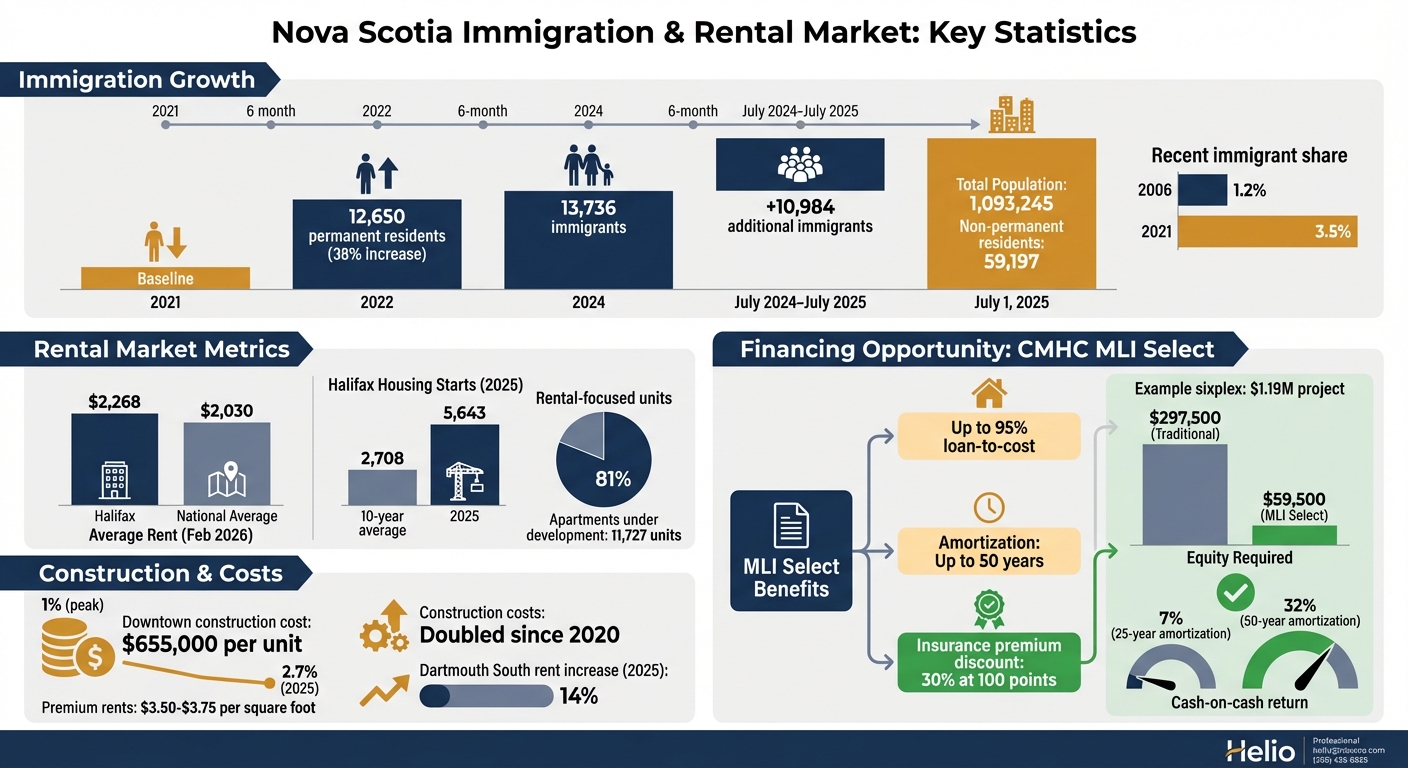
In 2022, Nova Scotia welcomed 12,650 permanent residents, marking a 38% increase from the previous year and setting a new record[7]. By 2024, this number rose to 13,736 immigrants[5]. Between July 2024 and July 2025, 10,984 additional immigrants arrived, pushing the province’s total population to 1,093,245 as of July 1, 2025[8].
These numbers reflect a significant change in settlement patterns. The proportion of recent immigrants in Nova Scotia grew from 1.2% in 2006 to 3.5% in 2021, with the province adding over 35,000 residents since the end of 2021[7][9]. However, natural population changes - such as births minus deaths - resulted in a net loss of 3,327 people between 2024 and 2025, making international migration critical for sustaining population growth[8].
This influx of newcomers, many in their prime renting years, has driven demand for rental housing, particularly within the Halifax rental market. By July 2025, there were 59,197 non-permanent residents in Nova Scotia, including students and temporary foreign workers[8]. Both permanent and temporary residents contribute to tighter rental markets, particularly in high-demand areas like Halifax, where vacancy rates remain low and rents continue to climb.
sbb-itb-16b8a48
Buying an Investment Property in Halifax | HOW TO ANALYZE (PART 2)
How Immigration Affects Nova Scotia's Rental Market
An influx of immigrants has put noticeable pressure on Nova Scotia's rental market, tightening key metrics across the province.
Vacancy Rates and Rent Prices
Halifax's rental vacancy rate hit a low of 1% during the peak of immigration growth but later improved to 2.7% by 2025 [3][4]. By February 2026, the average asking rent for an apartment in Halifax had climbed to $2,268 [4], surpassing the national average of $2,030 [4]. Rent prices in Halifax have been rising faster than the national rate, creating challenges for tenants [4].
This dynamic has caused a bottleneck at the lower end of the rental market, where immigrants and new workforce entrants often compete for housing. At the same time, developers have been focusing on higher-end rentals. For example, Killam Apartment REIT’s Eventide project - a 55-unit building with a $36 million budget - offers units priced between $3.50 and $3.75 per square foot [2].
The Housing Shortage in Numbers
Although rents have been rising, new construction hasn’t kept pace with demand, worsening the housing shortage. In 2025, Halifax saw 5,643 construction starts, more than doubling the 10-year average of 2,708 [4]. Of the units under development, 11,727 were apartments, with 81% specifically designed for the rental market [2].
Despite the boom in construction, the gap between supply and demand remains significant. Jeremie LeBlanc, Director at First National Financial, explained:
"All of the cranes we see across the sky and the significant housing starts numbers we're seeing now are really a response to those market fundamentals of demand [from] about two or three years ago." [2]
This persistent supply-demand imbalance presents an opportunity for investors to focus on purpose-built, multi-unit rental properties. Even as the market begins to stabilize, the need for rental housing remains strong.
Where to Invest: High-Demand Rental Markets in Nova Scotia
Nova Scotia's rental landscape is shaped by immigration trends, particularly under the Atlantic Immigration Program. While Halifax leads the way, other areas are also showing strong growth potential.
Halifax and Surrounding Areas
Halifax continues to attract the bulk of newcomers. According to Kelvin Ndoro, CMHC Lead Economist, "Halifax is still seeing relatively strong population growth mostly driven by people in prime renting and homebuying ages" [11]. Vacancy rates remain tight, rents are high, and construction costs have surged - doubling since 2020 [2]. Premium developments in the city now aim for rents between $3.50 and $3.75 per square foot [2].
What this means for property owners: While the core of Halifax sees rising costs, more affordable areas within the Halifax Regional Municipality (HRM) present opportunities. Dartmouth South, for instance, saw a rent increase of about 14% in 2025 [11], reflecting the growing demand in lower-cost markets. These areas are particularly appealing for immigrants and other newcomers who are competing for affordable housing. Investing in these districts could allow property owners to tap into the steady rental demand driven by immigration. Beyond Halifax, university towns and smaller markets are also worth considering.
University Towns and Smaller Markets
University towns like Wolfville and Antigonish are gaining traction due to long-term residency trends among international graduates. Rental construction is expanding beyond Halifax to meet the province's growing housing needs [11]. The Atlantic Immigration Program remains a key driver, with Nova Scotia receiving more applications than it can process as of late 2025 [1]. This indicates that demand for rentals is not limited to Halifax but is spreading across the province, creating opportunities in smaller markets as well.
Building Multi-Unit Rentals to Meet Immigration Demand
Meeting the growing rental demand driven by immigration requires more than just finding the right location. It demands a construction approach that ensures projects are delivered on time, within budget, and with the necessary features to attract tenants. An integrated construction model addresses the inefficiencies often seen in traditional methods.
Why Integrated Design-Build Works Better
The traditional construction process typically involves hiring multiple specialized contractors, which can lead to coordination headaches, cost overruns, and delays. Integrated design-build simplifies this by consolidating all responsibilities - design, engineering, and construction - under one company, one contract, and one price.
Jody Comeau, Assistant Vice President of Commercial Mortgages at First National, highlights the growing adoption of this model in Halifax:
"Everything is vertically integrated. They hold on to their assets long-term and feel a responsibility to contribute directly to the local economy" [3].
This approach ensures better attention to detail and higher-quality results because the builder’s reputation depends on the finished product, not just the construction process.
What property owners gain: Fixed-price contracts with guaranteed timelines eliminate the two biggest construction risks: unexpected cost increases and delays. With construction costs having doubled since 2020 [2], locking in a price before breaking ground protects against market fluctuations. Turnkey delivery - where the building is fully completed, inspected, and tenanted before handover - means property owners can start generating rental income immediately, avoiding prolonged vacancies [12].
Integrated design-build also allows for tighter cost control and precision, enabling projects to be sized and tailored effectively for high-demand markets.
Which Building Types and Locations Make Sense
Smaller-scale projects like fourplexes and sixplexes are ideal for addressing immigration-driven rental needs. These projects remain eligible for CMHC MLI Select financing, which offers attractive terms such as a down payment as low as 5% and amortization periods of up to 50 years [12]. Recent zoning changes in Halifax have made development easier, with many areas now allowing "as-of-right" construction, reducing delays caused by rezoning [3].
Choosing the right scale and location is just as important. Downtown Halifax boasts premium rents, ranging between $3.50 and $3.75 per square foot [2], but suburban areas like Dartmouth South, Lower Sackville, and neighbourhoods near NSCC campuses often offer a better balance of lower land costs and strong rental demand from newcomers looking for affordability [6]. University towns such as Wolfville and Antigonish are also becoming popular as international graduates settle permanently [11].
Designing buildings to meet CMHC MLI Select energy and affordability standards can unlock better financing options. This includes incorporating features like triple-pane windows, ductless heat pumps, and high-efficiency insulation [12]. Additionally, property owners should take advantage of the provincial HST rebate for new purpose-built rentals. This rebate, available for projects starting construction before 31 December 2035, is expected to save $54.1 million in fiscal impact by 2026–27 [6].
Using CMHC MLI Select to Finance Rental Properties
Nova Scotia’s rental market is booming, fuelled by steady immigration. To navigate this demand, property owners are turning to federal-backed financing options like CMHC MLI Select. This program, backed by CMHC mortgage loan insurance, is tailored for purpose-built rental buildings with five or more units. It rewards developers who prioritize affordability, energy efficiency, and accessibility with improved financing terms - an essential edge given rising construction costs [2][13].
"Having a well thought out pro forma for your project and exploring the different levels of financial vehicles available, including CMHC-insured loans, is important to ensure your project aligns with the various financing incentives and programs available" [3].
Jody Comeau, Assistant Vice President of Commercial Mortgages at First National, emphasizes the importance of planning in Halifax’s rental-focused market. With returns often as tight as 2% to 3%, tools like MLI Select are critical for developers aiming to maintain profitability [2]. The program’s design incentivizes smart choices, which can lead to better financing terms.
What CMHC MLI Select Offers
MLI Select uses a points-based system to evaluate projects across three categories: affordability (up to 100 points), energy efficiency (70 points), and accessibility (50 points). Scoring 50 points or more unlocks enhanced terms, with the best benefits available at 100 points [13].
Key advantages for property owners: At the 100-point level, developers can access financing up to 95% loan-to-cost (LTC), benefit from amortization periods of up to 50 years, and receive a 30% discount on insurance premiums [13]. For example, a $1.19-million sixplex financed through MLI Select at this tier reduces permanent equity requirements from $297,500 to just $59,500. Extending the amortization from 25 to 50 years can increase cash-on-cash returns from around 7% to 32% [13].
However, as of July 2025, CMHC applies a surcharge of 0.25% on insurance premiums for every five years added beyond a 25-year amortization. A 50-year term, for instance, adds a 1.25% surcharge, but the 30% premium discount generally keeps the net rate lower than conventional CMHC-insured loans [13]. Additionally, during the construction phase, property owners should anticipate providing about 25% equity, as CMHC typically holds back advances above 75% LTC until the building achieves stable rental income [13].
To qualify, borrowers need a minimum net worth equal to 25% of the project’s total cost, liquidity of at least 10% of the property’s value, and five years of experience managing similar properties. First-time developers can meet the experience requirement by partnering with a professional property management firm [13]. CMHC underwriting typically takes 8 to 12 weeks, so factoring in this timeline is crucial for project planning [13].
Meeting Energy Efficiency and Affordability Requirements
To achieve high scores under MLI Select, developers must focus on affordability and energy efficiency. In Nova Scotia, many projects naturally earn 20 to 40 affordability points because local rents are often below the national median [13]. Developers can boost this score by committing to below-market rents or collaborating with non-profit housing providers. Energy efficiency points (typically 25 to 40) are earned by exceeding National Energy Code benchmarks. Features like high-performance building envelopes, triple-pane windows, and ductless heat pumps - which are becoming standard in new builds - help secure these points [13].
Using pre-approved designs that incorporate these elements from the outset can save on consulting fees and reliably achieve scores between 70 and 100 points. Fixed-price construction contracts also strengthen the appeal of MLI Select loans by addressing lender and CMHC concerns about cost overruns - an important factor when accessing high-leverage financing at 95% LTC [13].
Property owners can further enhance project viability by combining MLI Select financing with the provincial HST rebate for new purpose-built rentals. This rebate applies to projects that begin construction on or after 14 September 2023 and are completed by 31 December 2035. Rob Lough, Broker/Owner at Century 21 Optimum Realty, explains:
"arguably the single most impactful measure in the budget for real estate investors... this significantly improves the financial viability of new multi-unit rental development" [6].
Together, these financing tools and incentives make constructing new rental housing a competitive option, even in a challenging cost environment. By aligning design choices with programs like MLI Select, developers can meet Nova Scotia’s growing rental demand with confidence.
Conclusion: From Federal Policy to Local Investment
Federal policy has significantly influenced Nova Scotia's rental market. The immigrant share of the population climbed from 1.2% in 2006 to 3.5% by 2021[14], and as of October 2025, 81% of Halifax's housing starts were focused on rentals[2]. This shift underscores a growing, long-term demand for rental housing.
For property owners, this presents a clear opportunity, but success hinges on precise planning and execution. Current downtown construction costs hover around $655,000 per unit[2], and approval processes remain lengthy[15]. With tight margins, choosing the right location - such as Halifax or university towns with strong rental demand - and maintaining strict operational efficiency are non-negotiable. These challenges highlight the need for more efficient construction methods.
Helio Urban Development offers an integrated design-build approach to tackle these hurdles. With fixed-price construction at $160,000 per unit, pre-approved CMHC MLI Select designs, and 95% loan-to-value financing, Helio removes the coordination headaches that often plague traditional builds. With over 40 units currently under construction, their six-month timeline - backed by a $1,000 per day late penalty - ensures minimal execution risk.
Federal policies, such as those supporting AIP-driven immigration, CMHC financing, and HST rebates, have created a fertile environment for rental development in Nova Scotia. The market is primed - are you ready to act? Now is the time to transform policy insights into tangible investments.
FAQs
How long will immigration keep Halifax rents high?
Immigration is likely to keep rents high in Halifax for the long term. Even with rising vacancy rates, the growing population and limited housing supply are driving rental demand upward. Reports from April 2026 indicate that rental prices are still climbing, highlighting how these pressures continue to shape the market.
Which Nova Scotia neighbourhoods have the best rental demand?
Rental demand in Nova Scotia is strongest in Halifax, Bedford, Dartmouth, and smaller towns within a 90-minute drive of Halifax. This surge comes from steady population growth and a rising need for rental housing. For property owners, these areas offer promising opportunities to develop multi-unit rental properties, tapping into a market hungry for additional housing options.
How hard is it to qualify for CMHC MLI Select?
Qualifying for CMHC MLI Select hinges on meeting a few key criteria. Your project must be a multi-unit development with at least 5 units (or 50 units/beds if we're talking about retirement homes) and fall into one of three categories: affordable, energy-efficient, or accessible. Along with this, you'll need to prepare and submit detailed documentation to prove eligibility.
For specifics on the required documents and criteria, it's best to refer to the official CMHC resources. They'll outline exactly what you need to get started.