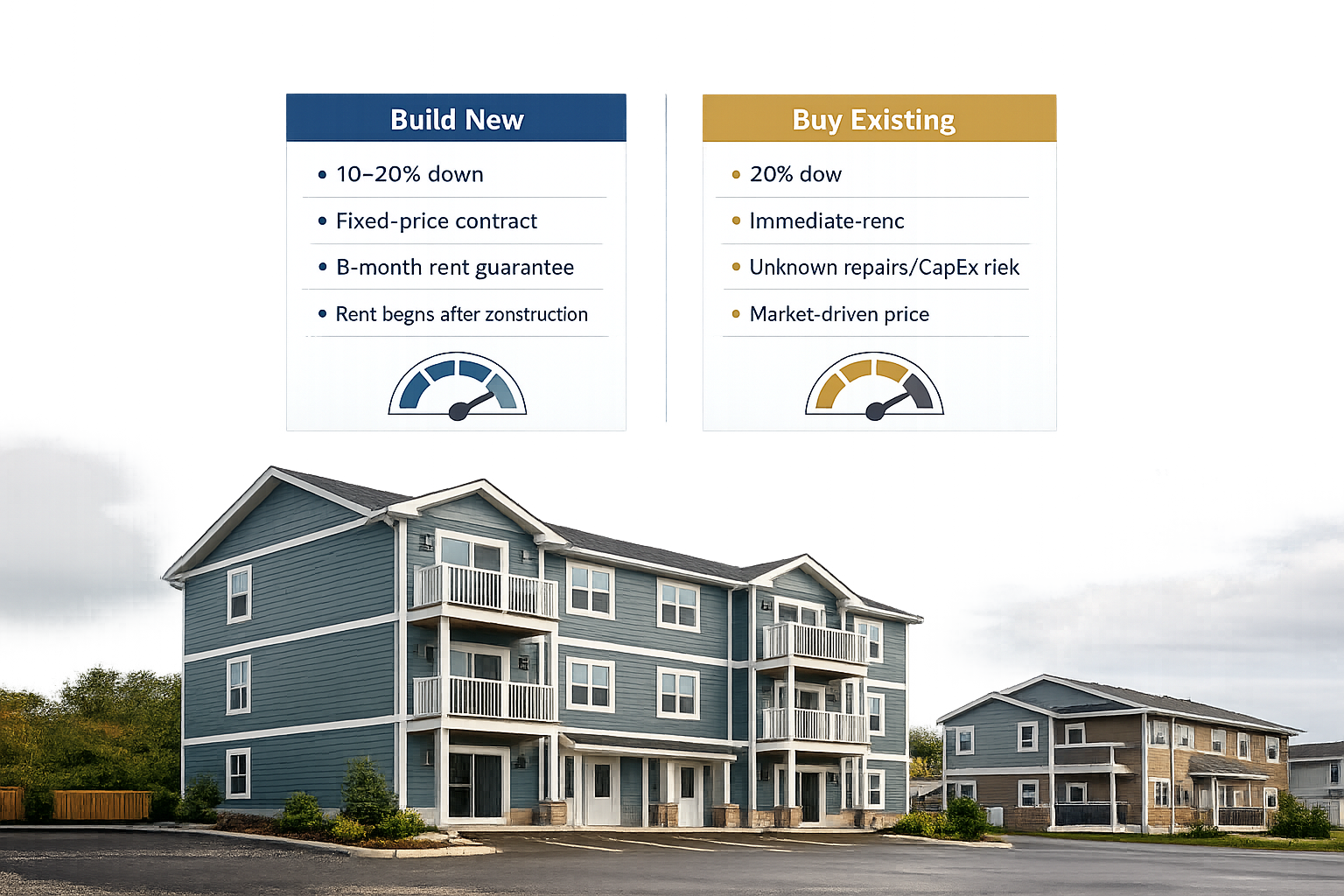
Risk Comparison: New Rental Construction vs. Buying an Existing Investment Property
When you're deciding between building a new rental property or buying an existing one in Nova Scotia, you're really asking: which option gives me better control over costs, timelines, and long-term returns? As of 2025, the average property price in Nova Scotia is $449,312, while new construction costs average $160,000 per unit. But upfront costs don’t tell the whole story. Construction comes with risks like delays and budget overruns, while older properties often hide expensive maintenance issues - think $15,000 for a septic system or a 30% contingency fund for surprise repairs. This article breaks down the risks tied to each strategy so you can make an informed decision based on your goals and risk tolerance.
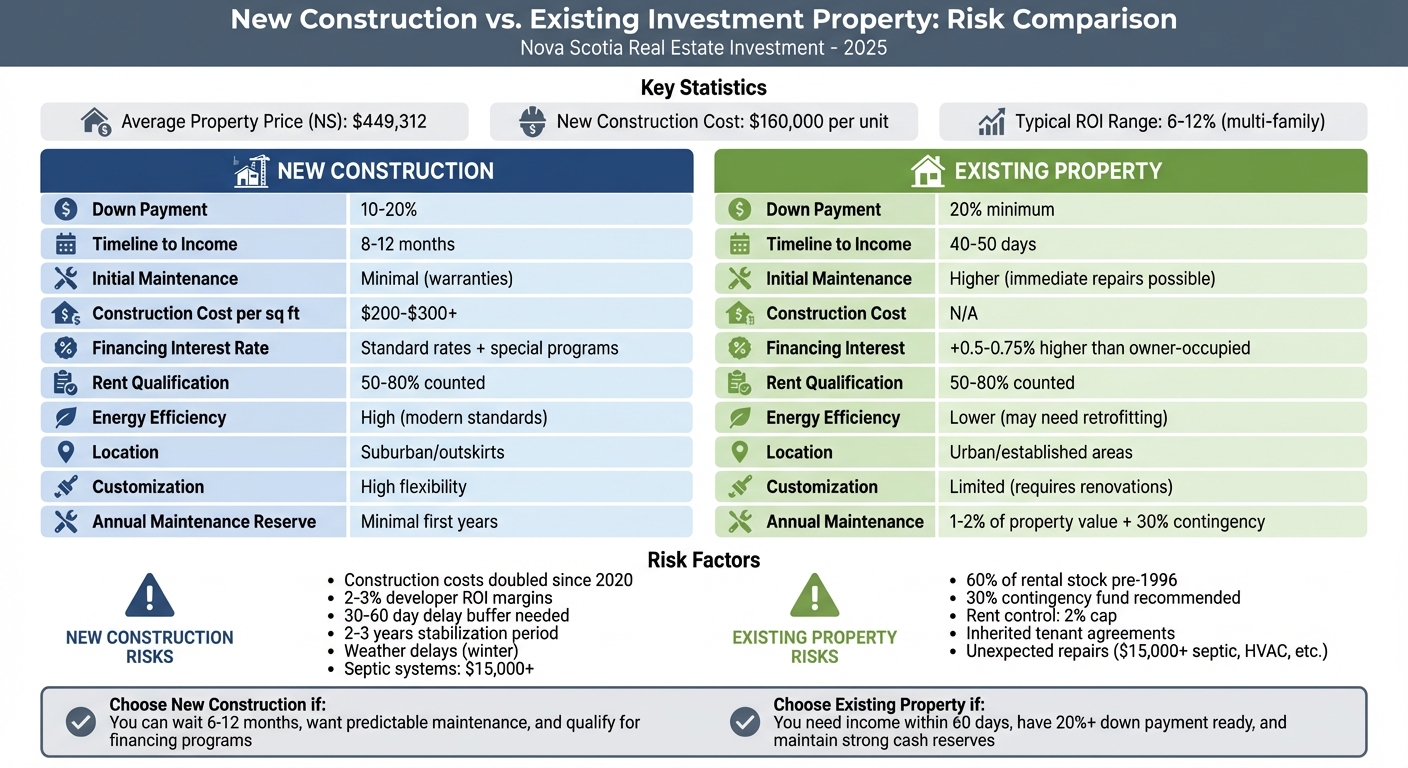
New Construction vs Existing Property Investment Comparison Nova Scotia 2025
Are new construction rental properties a good investment opportunity? [Ask Coach]
sbb-itb-16b8a48
1. New Rental Construction
This section examines the risks tied to new construction, an important factor when weighing the build versus buy strategies discussed throughout the article.
Cost Predictability
Building new rentals comes with unpredictable costs. In Nova Scotia, construction expenses have doubled since 2020, largely due to labour shortages and the reliance on imported materials - about 25% of the total - which are subject to international tariffs [4]. Duncan Williams, President of the Construction Association of Nova Scotia, highlights the slim margins developers face:
many projects are operating on a two to three per cent return on investment which, with a business model that's high risk … that can evaporate pretty quickly [4].
Even small cost overruns can wipe out profits. To reduce this risk, aim for a fixed-price contract so you’re not left covering every unexpected price increase during the build.
Site-specific challenges also add uncertainty. For example, in rural or waterfront locations, installing critical infrastructure like septic systems can cost upwards of $15,000, with final costs heavily influenced by ground conditions uncovered only during excavation [5]. General contractors in Nova Scotia typically charge $200 to $250 per square foot, while specialized builders may charge over $300 per square foot [5]. As a benchmark, Killam Apartment REIT’s 55-unit project on Carlton Street in Halifax hit approximately $655,000 per unit in late 2025 [4].
Timeline Certainty
Delays in construction directly impact rental income, which is crucial to covering loan payments and carrying costs. To manage this, build in a 30- to 60-day buffer beyond the projected completion date [7]. Common causes of delays include supply chain disruptions, labour shortages, and weather. In Nova Scotia, winter conditions can stall progress for weeks, adding further uncertainty.
Additionally, market conditions can shift significantly during the years it takes to complete a project. Interest rates, tenant demand, and rental pricing that seemed favourable when you started may look very different by the time your units are ready. Once completed, new developments often require two to three years of stabilization before rental comparables and resale values become dependable [7].
These uncertainties make it essential to evaluate how financing options can help manage the risks tied to new construction.
Financing Options
Certain financing programs are designed to offset some of the risks associated with building new rentals. These programs are not available for purchasing existing properties, offering a distinct advantage for developers. For instance, the Nova Scotia Affordable Housing Development Program provides forgivable loans to developers who include at least five affordable units - defined as being rented at least 20% below the average market rent for a minimum of 15 years. However, this program requires a 20% equity contribution [6].
Another option is the CMHC’s Apartment Construction Loan Program, which offers low-cost loans tailored for purpose-built rental projects [8]. On a broader scale, the federal government has committed an additional $15 billion to support new rental housing development loans [9].
To take advantage of these programs, you’ll need to meet specific requirements. These include demonstrating at least five years of property management experience (or hiring a professional third-party firm) and securing a fixed-price contract with a reputable general contractor [6]. By combining provincial and federal funding, you may improve the financial viability of your project while minimizing some of the inherent risks.
2. Buying an Existing Investment Property
This section highlights the risks involved in purchasing existing rental properties, contrasting them with the considerations of new construction. While buying an established property might seem straightforward, it comes with financial uncertainties that require careful evaluation.
Cost Predictability
Purchasing an existing property often brings financial surprises. Older buildings, especially in a market where around 60% of rental stock predates 1996, are at higher risk of expensive repairs as they near the end of their lifecycle [3][10]. Experts recommend setting aside a contingency of at least 30% to cover unexpected maintenance costs [3].
Financing an investment property also comes with added expenses. Interest rates for these properties are typically 0.5% to 0.75% higher than those for owner-occupied homes [1][12]. Additionally, Canadian lenders require a 20% minimum down payment for non-owner-occupied properties and only consider 50% to 80% of projected market rent in mortgage qualification calculations [1]. These financial factors make buying an existing property less predictable compared to the structured financing options often available for new builds.
These uncertainties can also lead to delays and complications, as discussed in the next section.
Timeline Certainty
While new construction faces risks like potential building delays, existing properties can have their own timeline challenges. A tenant-ready property might generate income immediately, but many older units require renovations. Renovation timelines can be unpredictable due to delays in obtaining permits, contractor availability, or surprise repair needs. These delays can strain cash flow, especially if vacancy periods or non-payment of rent occur during the renovation process [1].
Operational Challenges
Managing older properties often means dealing with ongoing maintenance and reinvestment. Kevin Russell, Executive Director of the Investment Property Owners Association of Nova Scotia, points out that "the most affordable housing Nova Scotia has is its existing rental stock... [it] is nearing the end of its building lifecycle, further underlining the need for action" [10]. This highlights the constant need to allocate capital to maintain aging infrastructure, which can reduce long-term returns when compared to the lower maintenance needs of newly constructed units with modern systems and warranties.
Regulatory hurdles also add complexity. Under the Residential Tenancies Act, resolving tenant disputes can be slow [10]. Temporary rent control, currently capped at 2%, further limits an owner's ability to adjust rents to match rising costs. Russell underscores that "existing rental housing providers must be allowed to re-invest into their properties to extend the building lifecycle and receive a reasonable return on their investment" [10]. Additionally, buyers may inherit fixed-term leases or long-term tenants under rent control, which limits flexibility in setting market-rate rents. This is in stark contrast to new construction, where leases can be established at current market rates from the outset [10][11].
Pros and Cons
Here's a breakdown of the key advantages and disadvantages of new rental construction versus purchasing an existing investment property:
| Feature | New Rental Construction | Existing Investment Property |
|---|---|---|
| Down Payment | Lower upfront deposits (10–20%) [13] | Minimum 20% upfront [1] |
| Maintenance | Minimal (covered by warranties) [13] | Higher (ongoing repairs) [2] |
| Financing Risk | High (qualification required at closing) [13] | Low (qualification happens at purchase) [1] |
| Income Timing | Delayed until construction is complete [13] | Immediate rental income [1] |
| Customization | High (options for finishes/layouts) [13] | Limited (requires renovations) [1] |
| Closing Costs | Includes development levies and HST [13] | Standard legal and transfer fees [2] |
| Timeline to Occupancy | 8–12 months (typical development timeline) [16] | 40–50 days [16] |
| Initial Maintenance | Minimal due to warranties [14][15] | Higher; may require immediate repairs [15][16] |
| Energy Efficiency | High (built to modern standards) [15] | Lower; often needs retrofitting [15] |
| Location | Often in suburban or outskirts areas [15][16] | Frequently urban or in established areas [14][17] |
New rental construction offers flexibility with lower upfront costs and reduced early maintenance thanks to builder warranties. However, it demands patience, as income is delayed until the project is completed, and there’s a risk of financing issues at closing. On the other hand, existing properties provide immediate rental income and a predictable product, but they require significant upfront capital and may come with unexpected repair or renovation expenses.
Your choice should depend on what you prioritize: immediate cash flow or long-term control over costs and customisation.
Conclusion
Deciding between building new rental units and purchasing an existing investment property depends on your goals, available capital, and risk appetite. New construction provides steady operating costs due to modern, energy-efficient systems and builder warranties, making it a strong choice for investors prioritizing consistent long-term cash flow. In Nova Scotia, favourable financing terms for new builds can also create immediate equity - something you typically don’t get when buying at market value.
Existing properties, however, offer instant rental income and a much shorter timeline to start generating cash flow. These are better suited for investors who have sufficient capital - usually requiring a 20% down payment - and can maintain a reserve for upkeep. Plan to allocate 1% to 2% of the property’s value annually for repairs and keep a contingency fund of at least 30% for unexpected expenses, like replacing outdated HVAC systems or addressing code compliance issues [18][3].
For property owners, if you need rental income within 60 days and already have your down payment ready, established properties in Halifax’s mature neighbourhoods can provide a quicker path. On the other hand, if you can wait 6–12 months and want to minimize maintenance unpredictability while maximizing returns, new construction - especially using CMHC pre-qualified designs - offers more predictable long-term ROI. Multi-family buildings, in particular, can yield annual returns in the 6% to 12% range [18]. Ultimately, your choice will depend on how you balance immediate income needs against long-term growth in Nova Scotia’s evolving rental market.
FAQs
How much cash should I keep in reserve for each option?
When planning your investment, it’s wise to set aside approximately 30% of the total cost as a reserve. For new builds, this buffer is especially important to account for unforeseen expenses that often arise during construction. If you’re working with existing properties, the reserve will help cover ongoing repairs, maintenance, and potential vacancies. Having this financial cushion ensures you’re prepared for surprises, no matter which investment route you choose.
What happens if rates change before a new build is finished?
During construction, shifts in interest rates can significantly affect financing costs. If rates go up, your borrowing costs increase; if they drop, you might save some money. Either way, these fluctuations can directly impact your project's bottom line. To manage this risk, it's crucial to focus on detailed financial planning. Opting for fixed-rate contracts can also help lock in predictable costs, reducing the chance of unexpected financial shocks.
How do rent controls affect buying an existing rental?
Rent controls in Nova Scotia can put a cap on how much you can increase rent, which directly affects your long-term return on investment (ROI) and overall profitability. These regulations often limit rent hikes to rates that may not even keep up with inflation or current market conditions. This can tighten your revenue margins and make it harder to keep up with necessary property maintenance. While owning existing rentals does provide steady income and established tenant relationships, these restrictions add a layer of uncertainty and risk for investors, making financial outcomes harder to predict.