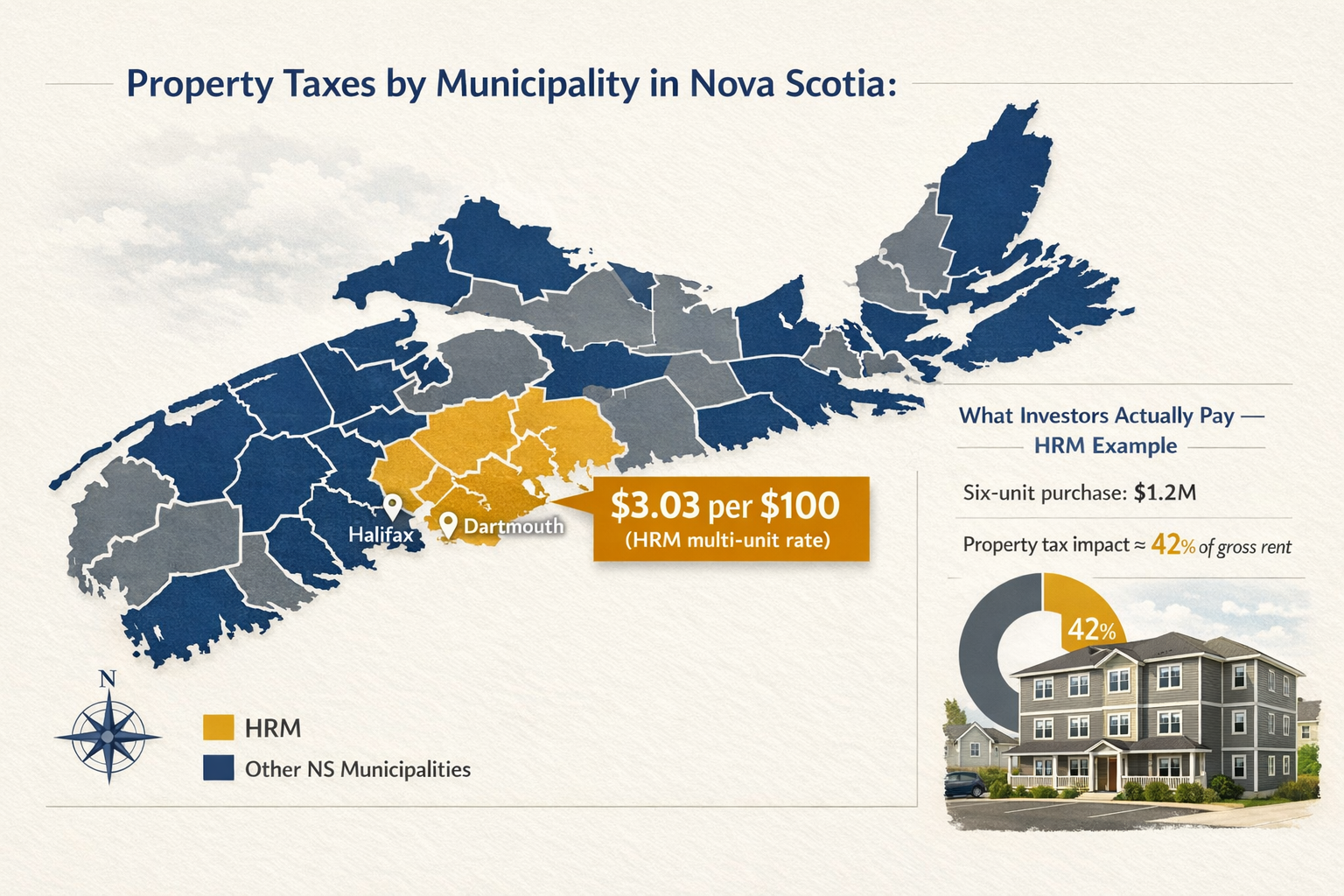
Property Taxes by Municipality in Nova Scotia: What Investors Actually Pay
Property taxes in Nova Scotia are a major expense for rental property owners, directly impacting cash flow and property value. If you're comparing Halifax, Dartmouth, or Truro, the tax rates and additional charges vary significantly. For example, Halifax's urban residential tax rate for 2026/27 is $0.687 per $100 of assessed value, while Colchester County, including Truro, charges $0.885 - 29% higher. This article helps you understand these differences, calculate costs, and assess how they affect your returns.
Nova Scotia Property Tax Comparison: Halifax vs Dartmouth vs Truro Multi-Unit Properties
1. Halifax Regional Municipality
Commercial Tax Rates
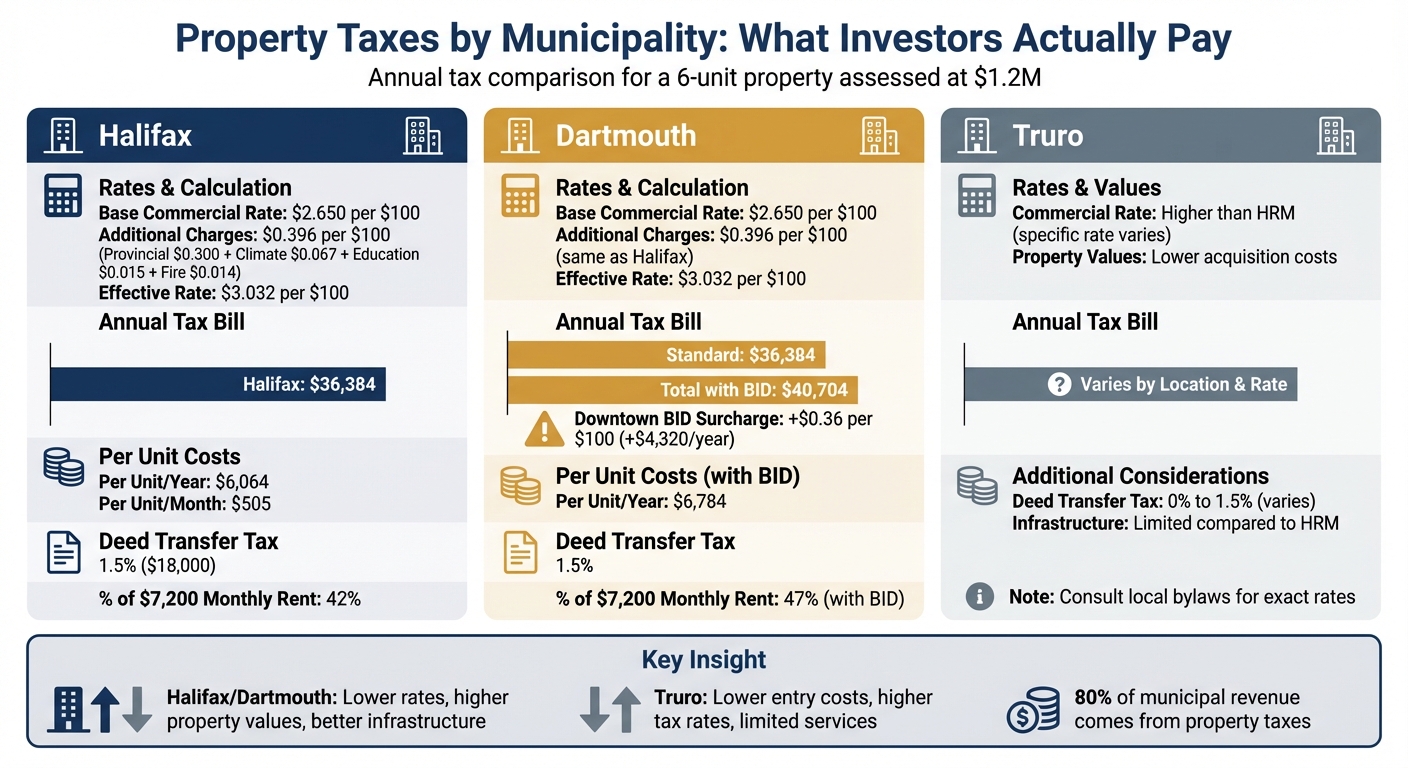
In 2026/27, Halifax's base commercial tax rate is $2.650 per $100 of assessed value. For properties under $1 million, the rate increases to $2.800 per $100, and for properties over $2 million located in Business Park areas, it can climb to $3.450 per $100.
On top of the base rate, commercial properties are subject to additional charges: a mandatory provincial rate of $0.300, a Climate Action rate of $0.067, and a Supplementary Education charge of $0.015. If your property is within 1,200 feet of a fire hydrant, an extra $0.014 per $100 is added. Altogether, these charges create an effective commercial tax rate of about $3.032 per $100 for most urban multi-unit properties - more than four times the residential rate of $0.687.
Estimated Annual Taxes for Multi-Unit Properties
Let’s break this down with an example. A six-unit property assessed at $1.2 million would face an annual tax bill of approximately $36,384, based on the effective rate of $3.032 per $100. That works out to about $6,064 per unit per year or $505 per month - directly impacting the property’s net operating income (NOI).
As Rob Lough explains: "Halifax tends to have lower tax rates but higher property values. Plus, that 1.5% deed transfer tax adds up quickly on expensive properties" [1].
For a $1.2 million property, the 1.5% deed transfer tax would cost around $18,000 at the time of purchase. This is a significant upfront expense that investors need to account for when planning their budgets.
Impact on Investment Returns
Taxes can take a significant bite out of rental income. For a property generating $7,200 in gross monthly rent, taxes could consume as much as 42% of that income. This makes it challenging to achieve a target debt coverage ratio of 1.25, which is a common benchmark for financing.
Investors should prepare for the full market assessment when budgeting, as capped rates do not apply to investment properties. The commercial classification also means a much higher tax load compared to similar residential properties. Next, we’ll look at how Dartmouth’s tax structure stacks up.
sbb-itb-16b8a48
2. Dartmouth
Commercial Tax Rates
Dartmouth, part of the Halifax Regional Municipality, follows a tax structure similar to Halifax. For the 2026/27 fiscal year, the base commercial tax rate is $2.650 per $100 of assessed value. Properties assessed under $1 million are subject to an additional $0.150 per $100 (Tier 1), while those valued over $2 million in downtown or community zones face an extra $0.300 per $100 (Tier 3) [3].
Mandatory charges include the provincial rate ($0.300), Climate Action ($0.067), Supplementary Education ($0.015), and a fire protection fee ($0.014). These combine to bring the effective rate for most urban multi-unit properties to approximately $3.032 per $100. Additionally, properties in the Downtown Dartmouth Business Improvement District (BID) incur an extra $0.36 per $100, which is considerably higher than the Downtown Halifax BID surcharge of $0.14 per $100 [3]. These added costs highlight how local surcharges can significantly influence the overall tax burden for property owners.
Estimated Annual Taxes for Multi-Unit Properties
Take a six-unit property in Downtown Dartmouth valued at $1.2 million. The standard annual tax bill for such a property is approximately $36,384. However, if it falls within the Downtown Dartmouth BID area, the BID surcharge adds about $4,320 annually, bringing the total to roughly $40,704. That works out to about $6,784 per unit per year [3].
By comparison, properties in Halifax's BID area face smaller surcharges, making Dartmouth's BID rates a more substantial factor for investors to consider.
Impact on Investment Returns
The Downtown Dartmouth BID surcharge can heavily affect cash flow. For a property generating $7,200 in monthly gross rent, the BID-adjusted tax bill would consume about 47% of rental income, compared to 42% in non-BID areas. This added expense makes achieving a 1.25 debt coverage ratio more difficult, especially for leveraged properties. It highlights the importance of verifying a property's exact location before purchase, as these small local adjustments can have a noticeable impact on net operating income.
As Rob Lough puts it: "When you buy a house, you might get hit with the full market value assessment the following year. It's something to factor into your budget when house hunting." [1]
For commercial-class multi-units, this reset happens immediately, as they don't benefit from CAP protection. These figures emphasize why location matters - a concept explored further when looking at Truro's tax structure.
3. Truro
Commercial Tax Rates
Truro, located outside Halifax, follows a distinct tax structure for property assessments. The Property Valuation Services Corporation (PVSC) evaluates properties annually, basing assessments on either market value or income potential [1]. Like other areas in Nova Scotia, multi-unit rental properties in Truro are taxed at commercial rates [4][5].
While Truro’s specific tax rates aren’t widely published, property taxes across Nova Scotia and the Atlantic provinces can be relatively high, with some municipalities exceeding 1.5% [2]. Taxes are calculated by multiplying the assessed property value by the mill rate per $100 [4][1]. These funds support essential municipal services. Unlike Halifax or Dartmouth, Truro’s tax rates require deeper consultation with local bylaws to estimate annual obligations accurately.
Estimated Annual Taxes for Multi-Unit Properties
For a six-unit building in Truro assessed at $1.2 million, the annual tax bill will depend on the town’s specific mill rate, which is outlined in its tax bylaw. Investors need to confirm this rate directly with the town to budget accurately.
Additionally, investors should account for the one-time deed transfer tax, which typically ranges between 0% and 1.5% of the property’s purchase price [1]. These upfront and ongoing tax considerations are critical for evaluating the property’s financial performance.
Impact on Investment Returns
Property taxes play a significant role in shaping cash flow and debt coverage ratios. Accurately knowing Truro’s mill rate is essential, especially since property reassessments - triggered by major renovations like adding units or building a second storey - can lead to higher annual taxes [1]. If an assessment seems excessive compared to market standards, investors have the option to appeal through the PVSC, but strict deadlines apply [1].
In Truro, property taxes are typically paid in instalments - monthly, quarterly, or semi-annually - depending on local regulations [2]. This payment structure requires careful cash flow planning to ensure financial stability throughout the year.
How Property Taxes REALLY Work in Halifax (Explained Simply)
Pros and Cons
Each municipality in Nova Scotia comes with its own set of advantages and challenges for multi-unit rental property investors. Halifax and Dartmouth, as part of the Halifax Regional Municipality (HRM), have a commercial tax rate of $2.65 per $100 of assessed value. They also benefit from well-developed infrastructure, including regional transit, professional fire services, and climate action initiatives. These services are backed by a municipal budget of $1,211.7 million for 2026/27, with a fixed 1.5% deed transfer tax at closing [3][1].
Urban areas like Halifax and Dartmouth offer scale and services, but smaller municipalities have their own appeal. Take Truro, for instance: property values there are generally lower, making it a more affordable entry point. However, smaller tax bases in these areas often lead to higher property tax rates, and deed transfer taxes can vary between 0% and 1.5%. Infrastructure in these regions, such as public transit and fire hydrant coverage, tends to be less comprehensive [1][3].
For investors prioritizing long-term appreciation and tenant demand, Halifax and Dartmouth may be the better choice. On the other hand, those looking for lower upfront costs might find Truro or other smaller municipalities more appealing, despite the higher ongoing tax rates. Since approximately 80% of municipal revenue in Nova Scotia comes from property taxes [1], understanding these differences is critical for accurate cash flow forecasting.
| Feature | Halifax / Dartmouth (HRM) | Truro and Smaller Municipalities |
|---|---|---|
| Commercial Tax Rate | $2.65 per $100 of assessed value [3] | Typically higher, reflecting smaller tax base [1] |
| Property Values | Higher, leading to increased acquisition costs [1] | Lower, offering a more accessible entry [1] |
| Deed Transfer Tax | Fixed at 1.5% [1] | Varies between 0% and 1.5% [1] |
| Infrastructure | Extensive services: transit, fire protection, climate initiatives [3] | More variable, fewer transit options, limited services [1][3] |
| Rental Demand | Strong, supported by urban density | Variable, depending on local market conditions |
These differences highlight the importance of aligning your investment market with your goals. HRM, for instance, imposes additional levies - such as $0.016 for climate action, $0.095 for transit (for properties within 1 km of a transit stop), and **$0.014 for fire protection) - to fund its robust municipal services, which in turn attract tenants [3]. Factoring in these nuances is essential for projecting net operating income (NOI) and overall returns accurately.
Conclusion
For building a small multi-unit in Nova Scotia, the Halifax Regional Municipality (HRM) stands out for its stable and predictable taxation. With an established residential tax structure and a fixed 1.5% deed transfer tax, it offers long-term consistency. Smaller municipalities, however, come with a different set of challenges and opportunities.
In towns like Truro, acquisition costs might be lower, but higher property tax rates can erode returns over time. These higher rates often stem from smaller tax bases and infrastructure constraints, which may also affect tenant demand and retention [1]. Over a 20- to 30-year hold period, these differences in tax structures can significantly impact your overall returns.
It’s also important to account for the Capped Assessment Program, which resets to full market value upon the sale of a property. This reset often leads to a sharp increase in property taxes in the year following the purchase [1]. For investors, this means careful budgeting is essential to avoid surprises.
When deciding between HRM and smaller municipalities, your timeline and strategy matter. HRM offers long-term tax stability, making it ideal for those prioritizing steady returns. On the other hand, smaller municipalities may appeal to those looking for lower upfront costs, provided they can manage higher ongoing taxes.
FAQs
How can I confirm a property’s tax class (commercial vs residential) before buying?
To verify a property's tax class, you can either reach out to your local municipality or check the assessment notice for the property. This notice provides details on both the assessed value and the tax classification. In Halifax, multi-unit rental properties are typically assessed using the income approach. Property valuations in the region are handled by the Property Valuation Services Corporation (PVSC).
Will my property tax increase after purchase due to reassessment or CAP reset?
Property taxes can increase after you buy a property due to reassessments or a CAP reset. This can happen if there are shifts in rental income, operating expenses, or overall market conditions. In Halifax, property assessments often rely on the income approach, which focuses on the rental income potential of a property rather than its sale price. This method can significantly impact how your taxes are calculated.
What extra surcharges could apply (BID, fire hydrant, transit, climate) to my building?
In Nova Scotia, property owners may face additional charges tied to Building Infrastructure Development (BID), fire hydrants, transit, and climate-related projects. These fees are set by municipal budgets and are incorporated into your property tax bill, representing the cost of local investments in public services and infrastructure.