Nova Scotia's Missing Middle: The Investment Thesis for 2026 and Beyond
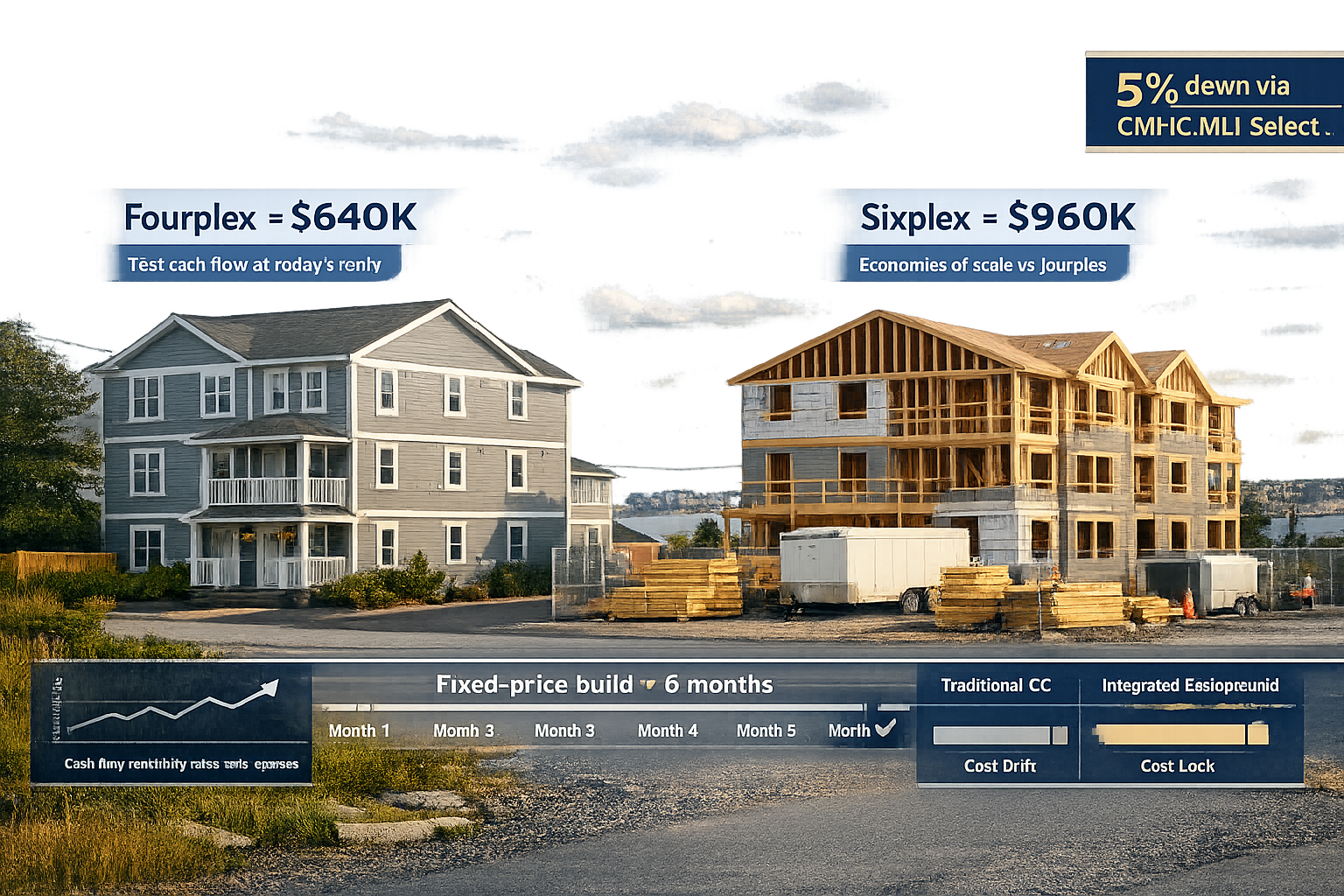
If you're looking at building a fourplex or sixplex in Nova Scotia, you're probably wondering: how much will it cost, and will it pay off? Here's the short answer: a fourplex costs about $640,000 to build, while a sixplex runs $960,000. With CMHC's MLI Select program, you could start with as little as $32,000 down for a fourplex. Add zoning changes in Halifax and other municipalities, plus tax rebates like the 15% HST rebate, and the numbers start to make sense. This article breaks down the costs, financing, and market trends to help you decide if building multi-unit rentals is the right move in 2026.
Housing Demand in Nova Scotia: 2026 and Beyond
Housing Shortage Projections Through 2032
Nova Scotia faces a pressing need for 71,600 new housing units by 2032 to address the current shortfall and support ongoing population growth [1]. This imbalance is driving new construction strategies, with the province's 2026–27 budget focusing on supply-side measures to boost housing availability and reduce hurdles for developers.
The construction landscape has shifted significantly. Apartment units are now being built at a rate five times higher than in the late 1990s [1]. Between 2011 and 2021, roughly 200,000 apartment units initially planned for ownership were instead converted to rentals by investors. Meanwhile, the construction of ground-oriented homes, such as single-detached houses and townhouses, dropped from 39 to 27 per 100 new adults during the same period [1]. The "missing middle" - duplexes, triplexes, and smaller apartment buildings - presents a practical way to address this gap without the high costs and extensive land needs of larger developments.
Why this matters for property owners: If you own a residential lot, the combination of rising demand and incentives like the HST rebate (available for projects starting after September 14, 2023, and completing by December 31, 2035) creates a strong case for building purpose-built rentals [3]. Rob Lough, Broker/Owner at Century 21 Optimum Realty, highlights the impact of these incentives:
"If you're an investor or developer evaluating a purpose-built rental project in HRM or elsewhere in Nova Scotia, this [HST rebate] is the pro forma improvement that could make a project pencil out" [3].
With demand showing no signs of slowing, multi-unit properties targeting the missing middle are increasingly attractive investments. These trends suggest a rental market where new units are quickly absorbed, reinforcing the financial viability of such developments.
Rental Market Pressure and Vacancy Rates
The widening housing gap is putting immense pressure on Nova Scotia's rental market. With a vacancy rate of just 1%, renters face fierce competition, pushing prices higher. In 2025, the average rent for a two-bedroom unit in Canada rose by 5.1% year-over-year [1], while Nova Scotia's average home prices climbed 11.3% as of January 2026 [3]. These conditions mean that new multi-unit developments are often fully leased before construction wraps up.
This pressure is especially pronounced in areas like Halifax Regional Municipality (HRM), Cape Breton Regional Municipality (CBRM), and the Annapolis Valley. For instance, CBRM is grappling with a surge in international student enrolment, which has collided with a lack of purpose-built rental housing. Similarly, towns like Wolfville and Kentville are seeing rising demand for smaller, multi-bedroom units as student populations grow. These are precisely the types of homes that the missing middle can provide. In Halifax's Fairview area, affordable rental options currently range from $828 to $1,600 per month [2].
Rising rents are not just a challenge for tenants but also a key factor in making new developments financially viable. For private investors, higher rental revenues help offset the increasing costs of modern construction. With vacancy rates so low, it’s common for 4+ unit properties to be fully leased before the first tenant moves in, making them a compelling option for property owners looking to expand their portfolios.
sbb-itb-16b8a48
Zoning and Regulatory Changes Supporting Multi-Unit Development
Recent regulatory changes in Nova Scotia are speeding up the development of multi-unit properties, especially those with four or more units. Provincial mandates and municipal reforms are cutting through red tape, making projects more feasible for property owners eyeing construction in 2026 and beyond. These updates align with rising demand and financing incentives, reinforcing the rationale for investing in the "missing middle" housing segment.
Halifax Regional Municipality (HRM) Zoning Updates
The Halifax Regional Municipality (HRM) has rolled out a Planning & Development Dashboard that offers real-time data on permits. Updated daily, the dashboard includes an interactive Permit Status Map, which lets developers track the progress of permits from submission to approval. For property owners, the "Permit Volumes and Processing Times" feature is particularly useful - it provides data to predict processing times, schedule projects more effectively, and identify active neighbourhoods. This tool reduces the uncertainty that has often delayed multi-unit developments in the past [4]. Alongside HRM's efforts, provincial policies are further helping to streamline approval processes.
Provincial Policies for Regional Development
At the provincial level, reforms are addressing housing shortages by simplifying the approval process for multi-unit projects. For example, as-of-right development now permits up to four units per lot in areas serviced by municipal water and sewer systems. This eliminates the need for rezoning, shaving 12–18 months off timelines and cutting down on carrying costs. Additionally, a combined 15% HST rebate (10% provincial and 5% federal) eliminates the tax burden for multi-unit developments, significantly improving project economics.
Special Planning Areas are another key initiative. These allow the Minister of Municipal Affairs and Housing to bypass traditional municipal processes, enabling faster approvals. The province is also focusing on regional hubs like Truro, Bridgewater, and Kentville - towns within a 90-minute drive of Halifax - to absorb demand spilling over from the city and meet population growth targets [Provincial Policy].
CMHC MLI Select Financing for 4+ Unit Properties
CMHC's MLI Select program provides a game-changing approach to financing multi-unit rental properties in Nova Scotia. Designed to address the province's "missing middle" housing gap, this program offers government-backed financing with up to 95% loan-to-value ratios, extended amortization periods, and significantly reduced insurance premiums. With these terms, property owners can start projects with as little as 5% down - far less than the 25–35% equity typically required for traditional commercial loans.
95% Loan-to-Value Financing and Program Benefits
The MLI Select program applies to buildings with five or more self-contained units and operates on a point-based system. To qualify, projects must score at least 50 points across three categories: affordability, energy efficiency, and accessibility. In Halifax and nearby municipalities, developers often meet the affordability criteria by committing to rent-controlled units for a minimum of 10 years.
For projects scoring 100 or more points, MLI Select offers up to 95% loan-to-value financing with amortization periods of up to 50 years. Insurance premiums are tiered based on points: 1.0% for 50 points, 0.5% for 70 points, and 0.3% for 100 points - far lower than the 1.75–4.50% premiums typical of standard commercial mortgage insurance. Additionally, the program allows debt coverage ratios as low as 1.10, enabling property owners to maximize borrowing capacity.
Here's what this means in practical terms: For a $640,000 project, the down payment could be as low as $32,000 (5%), compared to $160,000–$224,000 (25–35%) under conventional loans. This structure makes MLI Select financing particularly appealing for property owners looking to scale their developments.
CMHC Financing vs Traditional Mortgage Loans
The cost advantages of MLI Select over traditional financing options are striking. Conventional construction loans and residential mortgages typically come with higher interest rates, making them more expensive. As Mike Moffatt from the Missing Middle Initiative pointed out:
"Paying for infrastructure with development charges places the financing costs for that infrastructure on residential mortgages and construction loans, which carry much higher interest rates than government debt" [6].
With Canadian interest rates projected to drop from 5.25% to 3.5% by early 2026, MLI Select financing - tied to government bond rates - offers access to capital at lower costs than commercial loans [5].
The program's extended amortization periods - up to 50 years compared to the standard 25–30 years - further reduce monthly debt payments, improving cash flow for rental properties. When combined with Nova Scotia's provincial HST rebate for purpose-built rental projects (applicable to developments started on or after September 14, 2023) and the federal GST/HST rental rebate, the financial case for multi-unit developments becomes even stronger. As Melinda Fleming, a Partner at Doane Grant Thornton, highlighted:
"residential developers should proactively mitigate inflated GST/HST assessments and defend their entitlement to the new purpose-built housing rebate" [5].
For property owners planning projects in 2026, the combination of 95% financing, lower insurance premiums, and tax incentives creates a financial landscape that makes multi-unit development far more accessible than it was just a few years ago.
Construction Costs and Returns for Multi-Unit Rentals
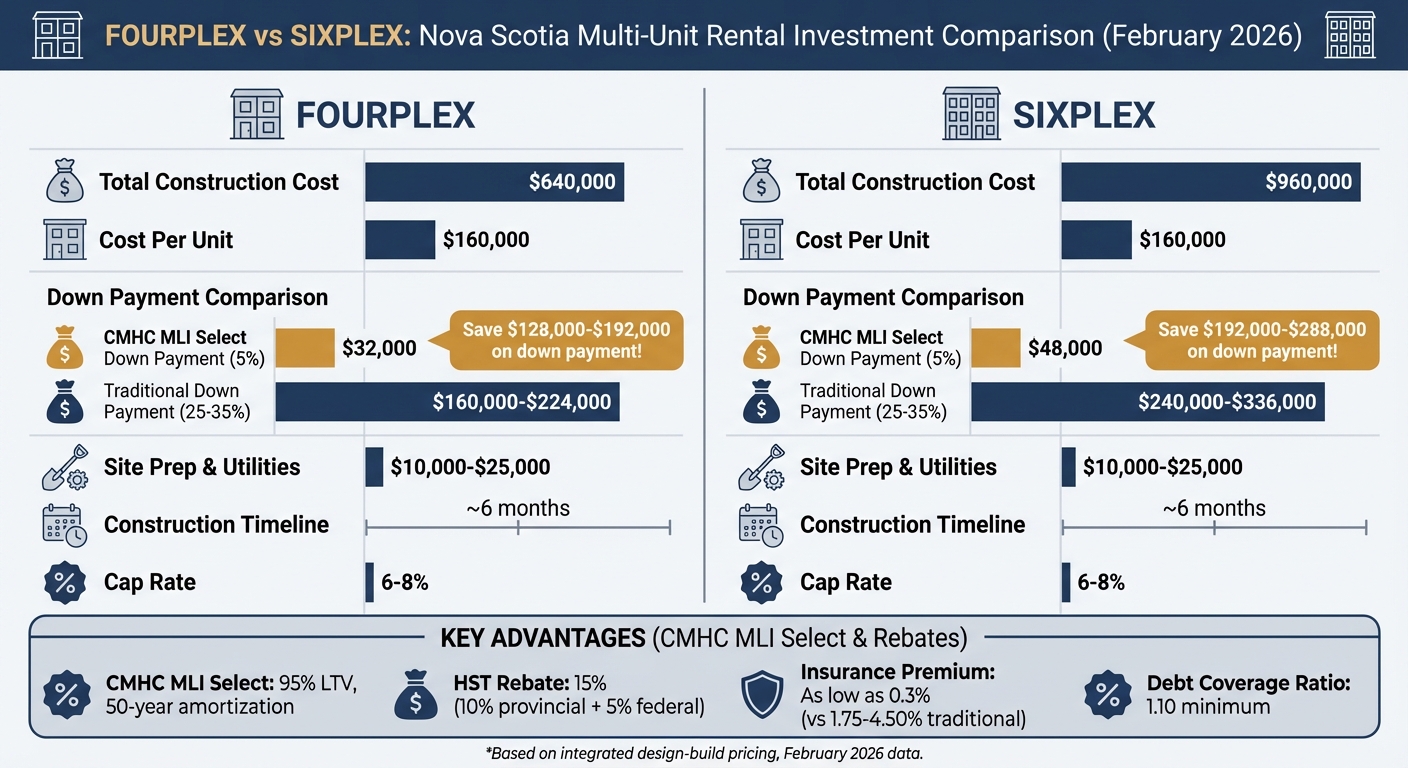
Nova Scotia Fourplex vs Sixplex Investment Comparison: Costs, Financing & Returns
Per-Unit Costs and Project Budget Breakdown
The Nova Scotia government's 2026-27 Capital Plan offers a clear benchmark for multi-unit construction costs. In February 2026, the province allocated $36.8 million to build 222 new public housing units in areas like Lower Sackville, Glace Bay, Kentville, Windsor, and Shannon Park in Dartmouth. This works out to roughly $165,765 per unit [3]. For private developers using integrated design-build models, the price can drop to $160,000 per unit, significantly lower than the $200,000–$250,000+ range seen with traditional methods.
What this means for property owners: A fourplex would cost about $640,000 to build, while a sixplex comes in at approximately $960,000. With the Canada Mortgage and Housing Corporation's (CMHC) MLI Select program offering up to 95% financing, the required down payments are minimal - just $32,000 for a fourplex and $48,000 for a sixplex. Additional costs like site preparation (ranging from $10,000 to $25,000) and utility connections will vary depending on the municipality. However, tax relief measures, such as the HST rebate for purpose-built rentals, help ease the overall financial burden.
Using an integrated design-build approach trims construction timelines to about six months, as site preparation and foundation work can happen simultaneously. This approach also reduces the likelihood of costly change orders. While labour shortages remain a challenge in Nova Scotia, the province's $34.3 million investment in skilled trades training aims to alleviate these bottlenecks [3]. Standardized designs and partnerships with prefabrication suppliers further help keep projects on schedule.
These efficiencies not only control costs but also set the stage for strong investment returns, as detailed below.
Return on Investment Analysis
Lower construction costs and easier financing requirements make these projects attractive for both addressing Nova Scotia's housing shortage and generating solid returns for investors. Rental market fundamentals in the province remain strong. For example, the average rent for two-bedroom units across Canada rose 5.1% year-over-year in 2025 [1]. Additionally, Nova Scotia's expansion of rent supplements to 10,500 active recipients reduces the risk of tenant defaults, as landlords benefit from government-backed income streams. Combined with low vacancy rates and favourable CMHC financing terms, these factors make building new purpose-built rentals more appealing than acquiring older properties.
Take a sixplex as an example. Built at $160,000 per unit, construction costs total $960,000, with an additional $25,000 for site preparation and utility connections. This brings the total project cost to approximately $985,000. With 95% CMHC MLI Select financing, structured over a 50-year amortization period and tied to competitive bond rates, monthly debt servicing remains manageable, even with conservative rent projections. Tax rebates further improve project economics. For instance, the provincial HST rebate, which is expected to have a fiscal impact of $54.1 million in 2026-27, and the federal GST rebate on new homes priced up to $1 million, both reduce upfront costs.
New construction also avoids the hidden costs of older "missing middle" properties, such as deferred maintenance and lower energy efficiency. This translates into higher net operating income over the long term. Institutional investors are increasingly favouring purpose-built rentals in 2026, drawn by policy incentives and strong demographic demand [1]. For property owners, these projects represent a practical and financially sound way to meet market needs while maximizing returns.
Building New vs Other Investment Options
Addressing the missing middle gap in housing requires a smarter approach to both building and financing, as outlined below.
Cost Savings Through Integrated Design-Build
In Nova Scotia, traditional construction often involves juggling multiple contractors, which can inflate costs by 20–30% due to coordination inefficiencies. By contrast, an integrated design-build model simplifies everything under a single fixed-price contract, cutting out unnecessary overhead and streamlining the process.
Here’s the math: traditional construction costs typically range between $200,000 and $250,000 per unit. With integrated design-build, that cost drops to about $160,000 per unit. For a fourplex, this means spending roughly $640,000 instead of the $800,000–$1,000,000 you’d expect with conventional methods. Combine these savings with CMHC MLI Select’s 95% financing, and the equity requirements for new builds become far lower than those for existing properties. Older assets not only tend to secure less financing but also come with deferred maintenance and lower energy efficiency, making them more capital-intensive in the long run.
This streamlined approach doesn’t just reduce upfront costs - it opens the door to scaling your rental portfolio more effectively.
Scaling Your Rental Portfolio with CMHC Financing
The cost advantages of integrated design-build align perfectly with CMHC’s favourable financing options, making it easier than ever to grow your rental portfolio. With MLI Select, you may only need a 5% down payment (plus soft costs), allowing you to build multiple multi-unit properties with the same equity you’d need for just one existing property. Once stabilized, these properties can be refinanced to pull equity for future projects, creating a cycle of growth over time.
Institutional investors are already capitalizing on this. Tanis Read, Managing Broker at Coldwell Banker Horizon Realty, highlights:
"institutional investors are doubling down on purpose-built rentals in 2026, as TELUS, CAPREIT and others bet that steady, long-term rental demand is the safest play" [1].
At the same time, policy discussions for 2026 are pushing for investment capital to shift away from buying single-family homes and toward building new purpose-built rentals to increase housing supply [1]. For individual property owners, this is a clear opportunity. By combining CMHC’s favourable terms with the cost savings of integrated design-build, you can tackle multiple projects over time, boost your rental income, and contribute to addressing Nova Scotia’s housing challenges.
Conclusion: The Missing Middle Investment Opportunity
Nova Scotia's "missing middle" housing gap is more than just a policy issue - it’s a clear investment opportunity for property owners heading into 2026 and beyond. The numbers tell the story: a projected shortage of 27,300 housing units by 2032, Halifax rental vacancy rates stuck at around 1%, and zoning reforms that now allow up to four units as-of-right on most residential lots. This combination creates strong demand for duplexes, triplexes, and fourplexes - types of housing that have been historically overlooked.
From a financial and construction perspective, the advantages are hard to ignore. Hitting the four-unit threshold opens the door to CMHC MLI Select financing, which offers up to 95% loan-to-value, 50-year amortizations, and equity requirements as low as 5%. Compare this to the typical 25–35% equity needed for purchasing existing properties, and the appeal is obvious. Add to that integrated design-build pricing, which averages $160,000 per unit. A fourplex can be built for about $640,000 - far less than what traditional construction methods would cost. HST rebates further improve project economics, increasing cash flow and helping property owners expand their portfolios faster.
But it’s not just about costs - it’s about execution. While institutional investors focus on large-scale purpose-built rentals, individual property owners can act quickly on smaller, more flexible sites. New builds offer cap rates of 6–8%, significantly better than the 4–5% seen with single-family rentals. Plus, new construction avoids the headaches of deferred maintenance and outdated energy systems that come with older properties.
The timing couldn’t be better. Halifax’s 2026 zoning changes have removed barriers like parking minimums, which previously added 20–30% to project timelines and costs. With CMHC financing, provincial policy backing, and lower construction costs aligning, property owners are well-positioned to benefit from both immediate rental income and long-term property appreciation as Nova Scotia’s housing shortage continues over the next decade. The opportunity is right in front of us.
FAQs
Will my lot allow a fourplex as-of-right?
In Nova Scotia, whether you can build a fourplex on your lot without needing rezoning depends entirely on local zoning rules, which differ by municipality. To find out, review your municipality's zoning bylaws or use tools like the Halifax Regional Municipality's Planning & Development Dashboard to confirm if a fourplex is permitted as-of-right.
How do I qualify for CMHC MLI Select points?
To meet the requirements for CMHC's MLI Select program, your project needs to score at least 50 points by aligning with criteria in areas such as affordability, energy efficiency, or accessibility. Basic eligibility includes having five or more units, meeting affordability benchmarks - like ensuring 10% of units are rented at rates below 30% of the median renter income - and staying within non-residential limits, such as capping non-residential space at 30% of the gross floor area. The program offers benefits like higher loan-to-value ratios and lower insurance premiums, making it an attractive option for qualifying projects.
What rents make a fourplex or sixplex cash flow?
In Nova Scotia, a typical fourplex needs to pull in over $10,000 per month in rent to generate positive cash flow. For context, some properties bring in about $9,600 per month, which falls slightly short of this threshold. A sixplex, naturally, would need even higher monthly rental income to achieve comparable cash flow results.