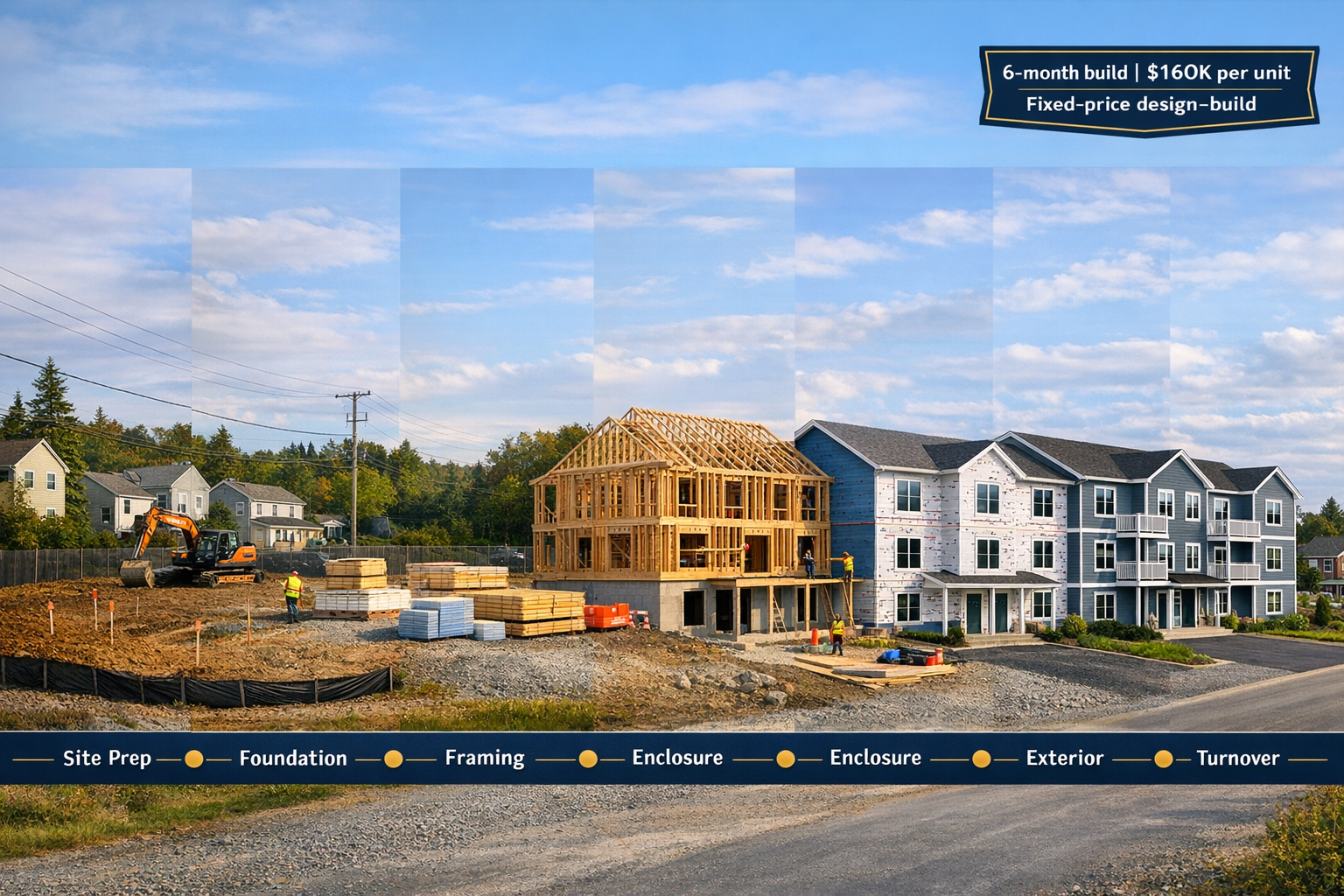
Construction Timeline Demystified: What to Expect Month by Month on a Nova Scotia Rental Build
Building a rental property in Nova Scotia can feel like a marathon, especially with the province's unpredictable weather and lengthy permit processes. But what if you could go from a building permit to collecting rent in just six months? That’s exactly what Helio promises with their fixed-price, design-build model - starting at $160,000 per unit. With Halifax alone seeing 12,832 units under construction as of August 2025, delays are common, costing property owners about $8,000 per month in carrying costs. This guide breaks down the six-month process step-by-step, so you know exactly what to expect and how to avoid common setbacks. Let’s dive in.
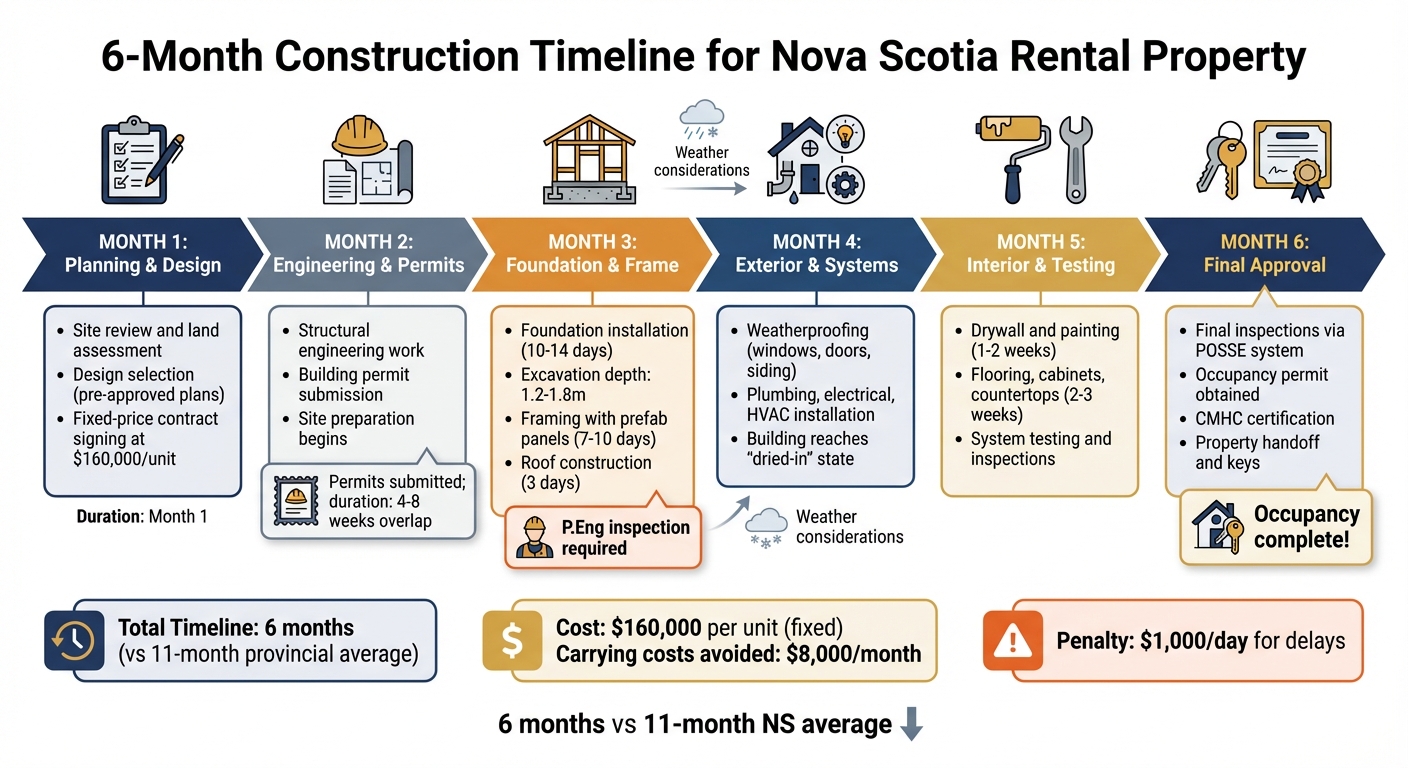
6-Month Nova Scotia Rental Construction Timeline: Month-by-Month Breakdown
Month 1: Initial Consultation, Site Review, and Design Selection
The first month is all about key decisions. By the end of these 30 days, you'll have a finalized design, a fixed price, and a signed contract. From there, the focus shifts entirely to execution.
Site Review and Land Assessment
Helio begins by evaluating your land's potential for a multi-unit build. This includes checking zoning regulations, lot dimensions, and access to utilities like sewer, water, and power. They also review the topography, natural barriers such as ravines, and how close the site is to transit and amenities. If your lot needs extra preparation - like grading or utility upgrades - expect costs between $10,000 and $25,000, depending on the specifics.
Why this matters for property owners: This upfront analysis avoids unexpected costs later. If your lot has zoning challenges or requires significant prep work, you'll know before committing to the project. Helio provides this service for free, giving you a clear understanding of your land's buildability without any upfront financial risk.
Choosing Your Building Design
Once the site is confirmed as buildable, it's time to select a design that matches your goals and financing plan. Helio offers a range of pre-approved designs, from fourplexes starting at $691,000 to larger 18-unit apartment buildings. A major benefit of these designs is their pre-qualification for CMHC MLI Select financing, allowing you to secure up to 95% loan-to-value financing with as little as 5% down.
"Their team is highly responsive and adapts the design to my specific needs, ensuring the final result aligns perfectly with my vision" [1]
If you want customizations, plan for an additional 2–3 weeks for layout tweaks or specific feature adjustments. Completely custom designs take 4–6 weeks, but most property owners stick to pre-approved plans to keep the six-month timeline and financing perks intact.
Signing the Fixed-Price Contract
The contract ties everything together - design, engineering, permits, construction, and project management - into one fixed-price agreement at $160,000 per unit.
"The fixed pricing model let me lock in my financing with confidence. My lender was impressed that every line item was guaranteed before we broke ground" [1]
This pricing model avoids the cost creep common in traditional builds by eliminating change orders and scope adjustments. It also includes a $1,000-per-day penalty if Helio misses the six-month timeline, ensuring their goals align with yours. Make sure the contract covers drawings, engineering specifications, and permit strategies to prevent disputes later. This structure gives you peace of mind that the project will stay on schedule and within budget.
sbb-itb-16b8a48
Month 2: Engineering, Permits, and Site Preparation
Month two marks the shift from planning to tangible progress. Structural plans are finalized, permits are submitted, and the site is prepped for construction.
Structural Engineering Work
This phase begins with engineers conducting soil tests, assessing the water table, and evaluating the ground's load-bearing capacity[6]. These assessments determine the type of foundation required and identify any adjustments needed to ensure structural integrity. In a design-build model, architects and engineers collaborate from the outset, aligning structural needs with the overall budget.
Engineers also complete Form 4: Commitment Certificate - Structural Design Requirements, a mandatory document for municipal approval in Nova Scotia[7]. Without this certification, your permit application won't proceed. Proper coordination at this stage avoids costly errors, such as mismatches between engineering and architectural plans, which can lead to three-week delays and $8,000 monthly carrying costs[1]. Once the engineering work is done, attention shifts to obtaining permits and prepping the site.
Building Permit Submission
After finalizing the structural plans, the building permit application is submitted to the municipality. In a typical custom build, this process can take 2 to 3 months in Canada[8]. Helio’s pre-approved designs and coordinated engineering plans simplify this step, reducing the risk of errors that could delay approval.
For property owners, this means less stress and fewer setbacks. A rejected permit not only halts construction but also delays potential rental income and increases financing costs. By integrating design and construction teams from the start, the design-build model avoids the inefficiencies common when architects, engineers, and contractors work independently.
Preparing the Construction Site
While permits are under review, site preparation begins to ensure no time is wasted. This includes clearing the land, confirming utility connections (water, sewer, and power), and grading the site. If utility upgrades are needed - expenses flagged during the initial site review - this work is tackled now. The permit and site preparation phases typically overlap, lasting 4 to 8 weeks[2]. By the end of Month 2, the site should be ready for foundation work as soon as the building permit is granted, keeping your six-month timeline intact.
Month 3: Foundation and Framing Work
In Month 3, the construction site starts to take shape as crews pour the foundation and raise the building frame, turning blueprints into tangible progress.
Foundation Installation
The foundation process kicks off with excavation, typically reaching depths of 1.2–1.8 m. This ensures the base is below the frost line, crucial in Halifax's coastal areas where frost depth can extend to 1.8 m. Without this precaution, freeze-thaw cycles could compromise the structure's stability. Crews then install rebar reinforcement grids and pour high-strength concrete (minimum 25 MPa) into forms for footings, stem walls, and slab-on-grade bases - designed to support a 4+ unit rental.
What property owners should know: Using prefabricated components like insulated concrete forms (ICF) can slash on-site forming time by 30–50%. This reduces the pour-to-cure timeline from 7–10 days to just 3–5 days. For a 4-unit rental with an 800–1,200 m² footprint, the entire foundation process typically takes 10–14 days. This includes 3–4 days for excavation and forming, 1 day for pouring, 5–7 days for curing and stripping, and 2–3 days for backfill and inspection. However, Nova Scotia's spring and fall rains - averaging 100–150 mm monthly - can add 1–3 days of delays. Helio mitigates this with pre-scheduled pours and modular ICF systems, keeping weather-related setbacks to a minimum.
Midway through the month, a licensed Professional Engineer (P.Eng) inspects the foundation. This inspection covers rebar placement, concrete slump tests (100–150 mm), and compliance with Nova Scotia Building Code standards, including radon mitigation for basements. Only after this mandatory inspection can framing begin, ensuring the structure is built on a verified, stable foundation. Helio backs this up with a 2-year warranty for added peace of mind. With the foundation approved, the project moves smoothly into framing and roof construction.
Frame and Roof Construction
Once the foundation is ready, framing begins. Prefabricated wood or light-gauge steel panels - already factory-insulated to R-20+ standards - are delivered to the site and installed. These panels cut framing time significantly, reducing it from 3 weeks to just 7–10 days. Structural carpenters and crane operators assemble the walls, followed by pre-engineered roof trusses designed to withstand Nova Scotia's harsh conditions, including 4.8 kPa snow loads and wind speeds of 200–300 km/h. For reference, a Helio 4-plex in Halifax completed framing in just 1 week during March rains. Traditional stick-built methods, where prolonged material exposure to moisture can cause damage, would have taken 2–3 weeks under similar conditions.
Roofing comes next, with synthetic underlayment and metal drip edges installed within 3 days to weatherproof the structure. By the end of Month 3, the building is fully enclosed, keeping the project on track for the six-month timeline. A single on-site supervisor coordinates all trades - carpenters, crane operators, roofers, and P.Eng inspectors - ensuring smooth communication and quick decisions, such as finalizing window rough-ins. This streamlined approach avoids the common delays caused by fragmented coordination. As Lloyd’s team at Helio puts it:
"We employ the planner, architect, engineer, and builders. They sit in the same room. One contract. One accountable party" [1].
Month 4: Exterior Completion and Mechanical Systems
Month 4 focuses on sealing the building's exterior and installing critical mechanical systems, ensuring interior work can continue without interruptions - essential in Nova Scotia, where the weather can be highly unpredictable.
Weatherproofing the Building
The goal of weatherproofing is to create a "dried-in" state, where the building envelope is sealed, allowing interior work to progress regardless of the weather outside [10][8]. Crews install windows, exterior doors, weather-resistant barriers, and siding during this phase. In Nova Scotia, these steps must comply with the National Building Code 2020, which becomes part of provincial regulations as of April 1, 2025 [7]. Halifax's climate underscores the importance of this step, with spring and fall rainfall averaging 100–150 mm per month and coastal winds reaching 200–300 km/h during storms [10]. As Keith Sawlor, President of Sawlor Built Homes, puts it:
"The Building Code is a MINIMUM standard of construction" [11].
For property owners: A properly sealed building envelope protects your investment from moisture damage and ensures the project stays on track. Once the building is weatherproofed, the focus shifts to installing systems that make the space functional and comfortable.
Installing Plumbing, Electrical, and HVAC
With the exterior sealed, crews can now install the plumbing, electrical, and HVAC systems that serve all four units. This phase follows a clear sequence: bulky and rigid components like HVAC ducts and plumbing drains go in first, while more flexible elements like electrical wiring are installed later to adapt around the existing infrastructure [5][6]. Major equipment - furnaces, heat pumps, water heaters, and electrical panels - is positioned, and piping, conduit, and ductwork are run through walls and floors before drywall installation begins. This stage requires precise coordination among all trades.
Traditional construction often struggles here. When architects and engineers work separately, designs can clash mid-project, leading to costly adjustments, such as adding unplanned steel supports or rerouting ducts to avoid structural beams [1]. Mismatched architectural and engineering plans can also result in permit rejections, causing delays and additional carrying costs of roughly $8,000 per month [1]. Helio avoids these pitfalls by integrating planners, architects, engineers, and builders under one roof. Licensed P.Eng inspections at every stage catch potential issues early, contributing to Helio's perfect on-time delivery record [1][2]. By the end of Month 4, all mechanical systems are roughed in and ready for inspection, keeping the project firmly on schedule.
Month 5: Interior Finishing and System Testing
Month 5 is where the construction site starts looking like a rental property, with interior finishing and system testing taking centre stage. These steps are crucial to secure occupancy permits and stick to the six-month timeline.
Completing Interior Finishes
Interior finishing is all about following a logical sequence to avoid damage to completed work and to keep things moving efficiently. It starts with drywall installation and painting, which takes about 1–2 weeks. Painting early helps protect surfaces during later stages. Next comes flooring, cabinets, and countertops, which typically take another 2–3 weeks to install [6][12]. Choosing neutral colours is a smart move - they appeal to a broader range of tenants and make maintenance easier down the road [6].
Once finishes are in place, the focus shifts to connecting and testing plumbing, electrical fixtures, and other components to ensure everything works as it should [6][12]. Important for property owners: avoid making design changes at this stage. Even small tweaks can lead to costly rework and delays [12]. To sidestep future headaches, a pre-drywall inspection of the vapour barrier and insulation is a must. Catching issues at this point can save you from tearing down walls later [6].
With the interiors wrapped up, attention turns to testing the building's mechanical systems.
Testing All Building Systems
After finishing the interiors, all mechanical systems - plumbing, electrical, and HVAC - are put through rigorous testing to ensure they meet Nova Scotia's codes and safety standards. Municipal inspectors step in to confirm that everything is up to par. As RE/MAX Canada explains:
"You can only move forward with the building once you have approval at every stage" [10].
Helio takes no chances here, relying on licensed P.Eng professionals to inspect systems at every phase. This proactive approach helps catch and fix issues before they snowball into bigger problems [1]. By the end of Month 5, all systems are tested, approved, and ready for final inspections, setting the stage for a smooth handoff in Month 6.
Month 6: Final Inspections and Property Handoff
Month 6 wraps up your Nova Scotia rental build by tackling final inspections, securing occupancy permits, and handing over the property. At this stage, the focus is on compliance, documentation, and ensuring everything is tenant-ready.
Obtaining Occupancy Permits and CMHC Certification
In Halifax, final inspections are managed through the online POSSE system [13]. Municipal inspectors review all building systems to ensure they meet Nova Scotia's building codes. Once everything checks out, the occupancy permit is issued, allowing tenants to move in. For projects financed through CMHC, Helio also takes care of the necessary documentation to obtain certification [9]. Both the occupancy permit and CMHC certification are non-negotiable for legally renting out the units and completing your financing. Helio handles the scheduling and coordination of inspections and paperwork, ensuring your project stays on track.
Construction timelines in Nova Scotia have seen notable improvements. Jigme Choerab, Manager of the Economic Intelligence Unit at Turner Drake and Partners Ltd., explains:
"Apartment buildings are now being completed at a faster pace. Jigme's numbers from this spring show the average completion time for a multi-unit building is now 11 months, compared with 22 months in the past two years" [14].
Helio's six-month timeline places you well ahead of these averages, giving you a competitive edge.
Handing Over the Completed Property
Once all approvals are secured, the project moves into its final stage. Helio's team conducts a final walkthrough with you to identify any outstanding tasks - commonly referred to as a "punch list" - and to confirm that all systems are functioning properly [15][6]. This walkthrough is documented to ensure any remaining items are addressed before possession is officially transferred.
After the punch list is resolved, Helio hands over the keys [6]. At this point, your rental property is fully operational, with all systems tested and approved, paving the way for you to start generating rental income.
How Helio Prevents Common Construction Delays
Construction delays are a recurring issue in Nova Scotia, often stemming from weather challenges and supply chain disruptions. For example, housing starts in the province plummeted by 56.7% between July and August 2025 due to such factors [3][4]. Helio's integrated design-build model is built to minimize these setbacks.
Managing Weather and Supply Chain Challenges
Nova Scotia's unpredictable weather frequently disrupts construction timelines. Winter conditions can halt foundation work, while heavy spring rains often delay framing. On top of that, material shortages - like the ongoing lumber supply issues since 2024 - have caused significant project slowdowns [4]. Helio tackles these hurdles with two key strategies: off-site prefabrication and strategic scheduling buffers.
By manufacturing components in controlled environments, Helio reduces the time spent on-site. Assembly, which might typically take weeks, is condensed into just a few days. This method has already proven its effectiveness, delivering 266 units ahead of schedule [3]. To further safeguard timelines, Helio incorporates monthly scheduling buffers of 5–10% to absorb unavoidable delays. Additionally, its fixed-price contracts shield property owners from fluctuating material costs by transferring supply chain risks to Helio. Together, these measures reduce weather-related disruptions and ensure smoother project execution.
Faster Permit Approvals
Permit delays are another common roadblock for construction projects. Recognizing this, Nova Scotia has introduced measures to speed up approvals. Sixteen special planning areas in the Halifax Regional Municipality (HRM) now allow for faster processing, cutting development timelines by 3 to 24 months. By mid-2025, these zones had facilitated 15 development agreements covering 10,205 units [3].
Helio leverages these streamlined processes with its pre-approved, CMHC-certified designs, which align with municipal requirements. This eliminates common issues like mismatched drawings that often lead to permit rejections and costly revisions [1]. Helio’s integrated design-build model brings planners, architects, and engineers together from the outset, ensuring all documentation is meticulously coordinated before submission. These efforts not only accelerate approvals but also reinforce Helio’s commitment to completing projects within six months.
Fixed-Price vs Cost-Plus: Understanding Construction Pricing Models
When planning a rental build in Nova Scotia, the pricing model you choose can make or break your budget. It determines whether costs stay predictable or spiral out of control. The two main models - fixed-price contracts and cost-plus arrangements - differ in how they handle financial risks like material price increases or delays. Helio’s integrated design-build model simplifies this by bringing all parties under one contract, offering pricing certainty that’s hard to match.
How Fixed Pricing Keeps Costs Under Control
A fixed-price contract sets the total project cost upfront, covering everything from initial designs to the occupancy permit. With Helio’s fixed-price model, the cost is locked at CAD $160,000 per unit, meaning any increases in material or labour costs are absorbed by the builder - not the property owner. In contrast, cost-plus contracts bill the owner for actual costs plus a markup, typically 10–20%. This means every cost fluctuation - whether from rising material prices or unexpected delays - falls on the owner. Overruns can easily push total costs 20–30% higher than the original estimate.
For owners seeking financing, fixed pricing offers another advantage: it gives lenders a guaranteed number, making the approval process simpler and more predictable.
Fixed Pricing Means a Reliable Timeline
Helio commits to delivering units within 6 months, starting from permit issuance to handing over the keys. This timeline is backed by a contractual penalty of CAD $1,000 per day for late delivery. Such guarantees are rare in the construction world. Cost-plus projects, on the other hand, often take 10–12 months due to delays caused by uncoordinated subcontractors or unexpected permit issues. In some cases, an 8-month build can drag out to 18 months, adding carrying costs of roughly CAD $8,000 per month.
The integrated nature of Helio’s design-build team helps avoid these delays by streamlining communication and coordination, ensuring a smoother process from start to finish.
Minimizing Risk with a Single Contract
In cost-plus builds, multiple contracts for architects, engineers, general contractors, and trades can lead to finger-pointing and confusion over who’s responsible for what. As Helio puts it:
"Everyone did their job perfectly. But success wasn't anyone's job." [1]
A fixed-price model eliminates this issue. Helio’s integrated team works under one contract, with clear deliverables and penalties for delays. If weather or permit issues cause setbacks, the builder - not the owner - absorbs the extra costs and timeline impacts.
Sarah Mitchell from Halifax shared her experience with Helio:
"Lloyd's team delivered exactly what they promised - on time and on budget. No surprises. That alone sets them apart from every other builder I've worked with." [1]
Comparing Fixed-Price and Cost-Plus Models
| Feature | Fixed-Price (Helio) | Cost-Plus / Traditional |
|---|---|---|
| Total Cost | CAD $160,000 per unit locked in [1] | Variable; typically 20–30% above the initial estimate [1] |
| Timeline | 6 months guaranteed [1] | 10–12 months average [1] |
| Owner Risk | Low – builder absorbs overruns [1] | High – owner bears delays and increases [1] |
| Accountability | Single contract with a CAD $1,000/day penalty [1] | Multiple contracts with split responsibility [1] |
FAQs
When does the 6-month clock actually start?
The 6-month construction timeline kicks off once all required permits and approvals are in place, and the site is fully prepped for work. This phase is often called 'breaking ground.'
What could still delay the timeline in Nova Scotia?
Delays in construction timelines across Nova Scotia often stem from several factors, including incomplete permit applications, bad weather, shortages in skilled labour, material supply disruptions, or rejected permits. Even with careful planning, these issues can push a typical six-month schedule beyond its original timeframe.
What isn’t included in the $160,000 per unit price?
The $160,000 per unit cost covers construction but leaves out several key expenses. These include land acquisition, financing costs, interior furnishings, landscaping, and any site-specific challenges that might come up during the build. The exact amount for these extras will vary based on the specific needs and conditions of your project.