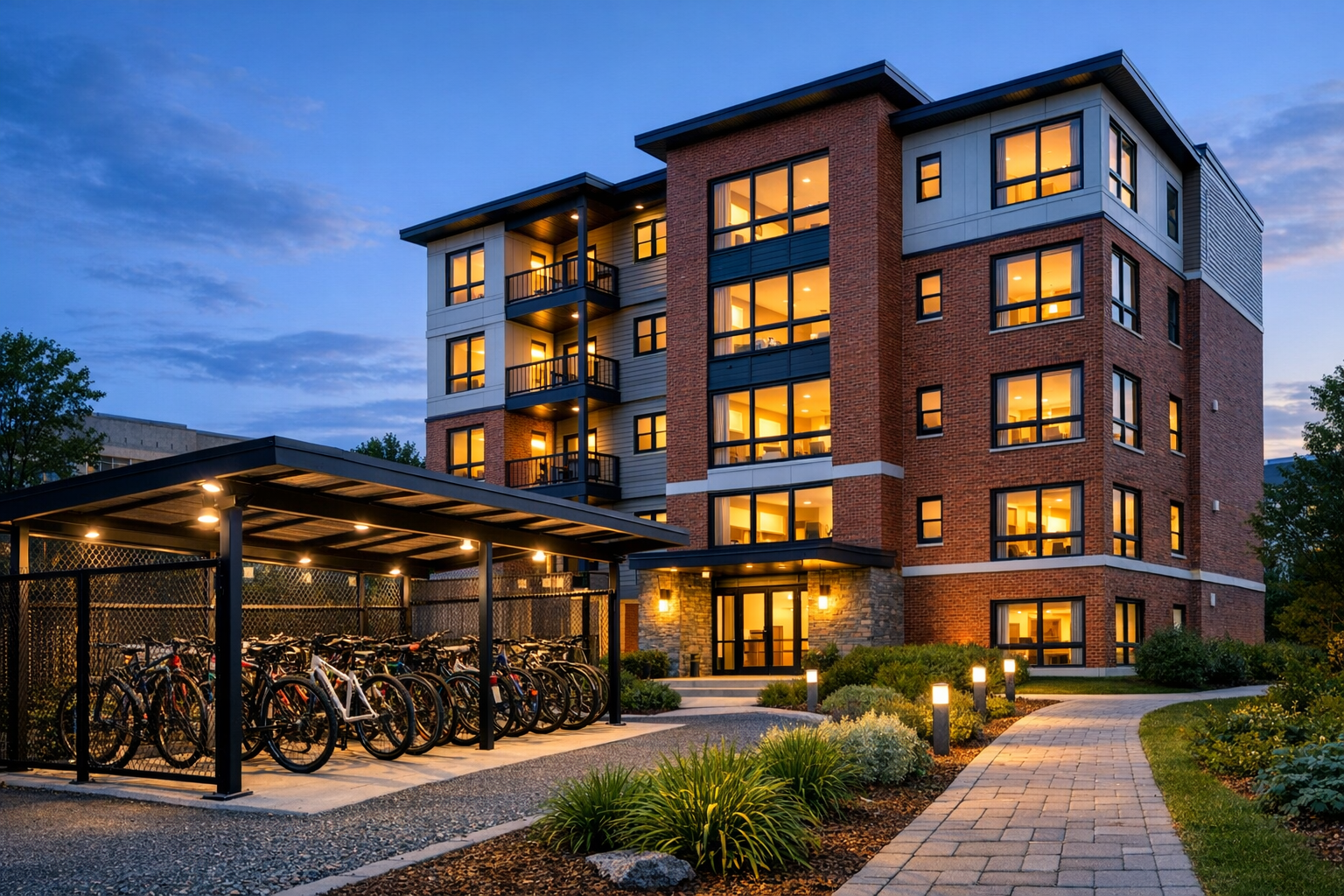
Student‑Oriented Rentals Near Universities: Quiet Hours, Bike Storage, and Layouts That Work
In Nova Scotia, student housing is increasingly challenging due to rising costs and low availability. Halifax students face rents averaging $1,628/month for a two-bedroom apartment, while Cape Breton rates are around $1,000/month. Universities like Dalhousie and NSCAD struggle with limited or no on-campus housing, leaving many students reliant on private rentals. Nearly half of students cut back on essentials like groceries to afford rent.
To meet demand, landlords can attract tenants by designing rentals with features students value most:
- Quiet hours: Policies and soundproofing to support study and rest.
- Bike storage: Secure, weather-protected spaces with modern options like e-bike charging.
- Smart layouts: Private bedrooms, functional shared spaces, and durable materials.
These features not only improve student satisfaction but also help landlords maintain full occupancy and stable rental income. Incorporating them during construction, alongside integrated design-build approaches, ensures efficient project timelines and cost control.
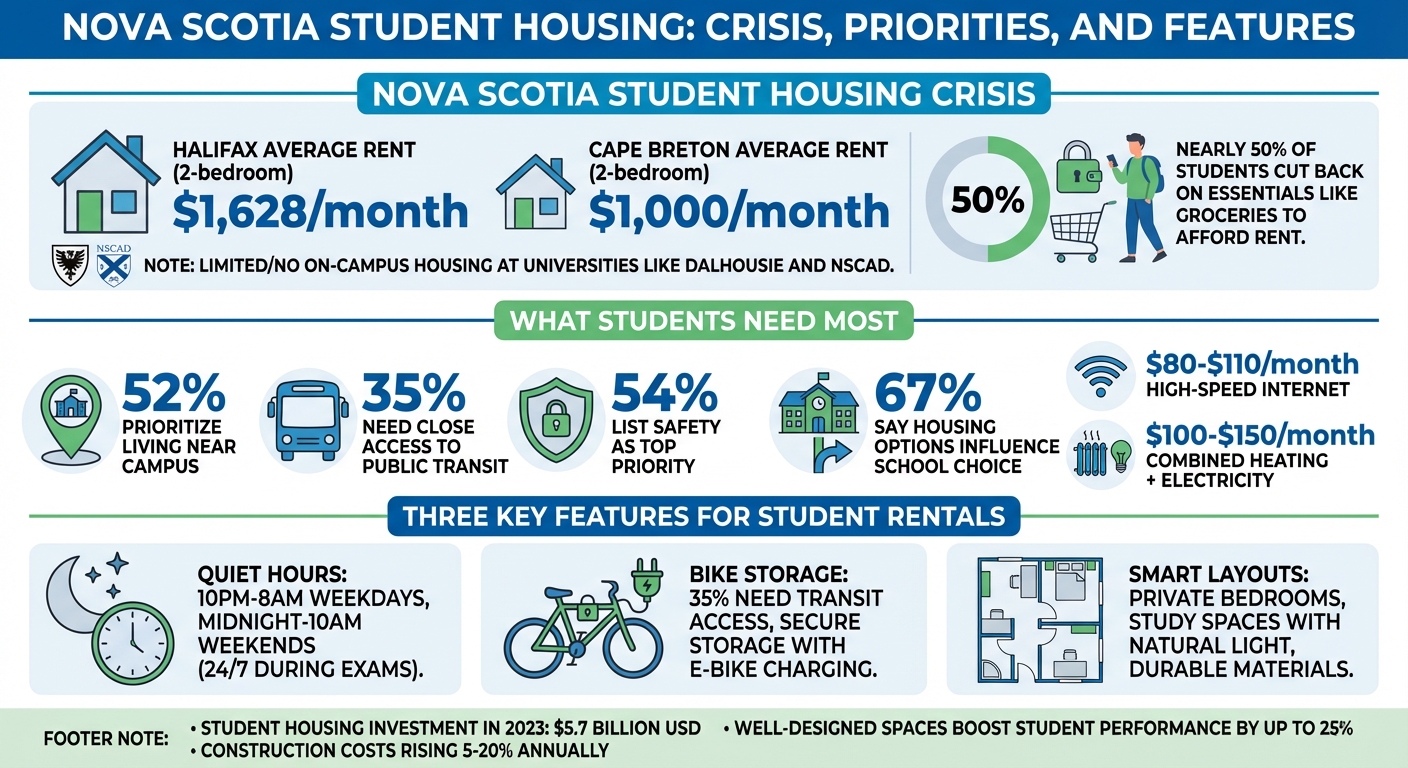
Nova Scotia Student Housing Statistics and Key Features 2025
Student Housing Unlocked: Changing the Game Through Thoughtful Design
What Students Need in Nova Scotia Rental Housing
Students in Nova Scotia have varied housing needs. A first-year undergraduate transitioning from residence life will have different priorities than a graduate student with a family or an international student arriving from abroad. Recognizing these differences allows landlords to create rental options that stay consistently occupied.
Different Types of Student Tenants
First-time renters often move from dorms and may need help understanding rental agreements or responsibilities. Many lack a credit history and depend on guarantors to secure leases [7] [11].
Seasonal tenants, typically attending classes during Fall and Winter, create a demand for summer sublets. Recent rules in Nova Scotia now require subtenants to be charged the same rent as the original leaseholder [8] [10].
International and out-of-province students often rely on online listings and trusted contacts to inspect properties before they arrive [9]. Furnished rentals are particularly appealing to this group, as setting up a first apartment can cost between $1,000 and $2,000 [2] [7].
Lifestyle-specific renters also shape housing needs. While some students seek quiet, distraction-free spaces for study [7], others prioritize social environments. Households with children may need flexible lease options to accommodate their unique situations [6].
Understanding these groups helps property owners decide which features to prioritize.
Most Requested Features in 2025
Students consistently look for high-speed internet, which costs between $80 and $110 monthly [3]. Many prefer rentals that include internet in the rent to simplify budgeting. All-inclusive pricing - covering heat, electricity, water, and internet - is especially appealing, as combined heating and electricity costs typically range from $100 to $150 per month [2] [3].
Proximity to campus or transit is another major factor. In towns like Wolfville, most students aim to live within 2 kilometres of campus, making walking or cycling feasible year-round [1] [3]. For students in nearby areas like Kentville or New Minas, reliable bus services are essential for commuting.
Other sought-after amenities include in-unit or on-site laundry, frequently cited as a must-have in student rentals [2] [4]. Secure parking also becomes a priority during winter, as municipal street-parking bans are in effect from December through March [3].
These preferences must also account for Nova Scotia’s unique climate challenges.
How Nova Scotia's Climate and Geography Affect Design
Winter conditions heavily influence rental design. With street parking prohibited from December through March, secure on-site parking is crucial for students with cars [3]. In areas with limited public transit, especially those farther from major hubs, vehicles become a necessity [1] [3]. Additionally, bike storage is important for students who rely on cycling during warmer months.
Nova Scotia’s changing weather patterns also require thoughtful planning. Annual precipitation is expected to rise by about 10% by 2100, with more frequent heavy rain events [5]. This means properties need effective drainage systems, flood-resistant landscaping, and good humidity control to prevent issues like mould and water damage. With average annual temperatures projected to increase by 2.6°C by the mid-21st century [5], improved ventilation and air quality systems will also be important.
Finally, Nova Scotia’s mandatory three-stream waste sorting makes it necessary to provide clearly marked, dedicated spaces for garbage, recycling, and composting [3].
Setting Up and Enforcing Quiet Hours
Quiet hours play a vital role in supporting academic success by ensuring students have uninterrupted time for studying and sleeping. Both Williams College and Illinois State University have shown that there is strong demand for quiet housing options among students[13].
"Quiet hours were created to support students' education by allowing them time to relax, study and sleep peacefully." – The Beacon[12]
Beyond academics, reducing noise disturbances can protect students' emotional well-being and help alleviate stress. For many, having a quiet environment at home is more appealing than relying on communal spaces like libraries or lounges for studying[13].
Creating a Quiet Hours Policy
In most student housing across Nova Scotia, quiet hours typically run from 10:00 p.m. to 8:00 a.m. on weekdays (Sunday through Thursday) and from midnight to 10:00 a.m. on weekends (Friday and Saturday)[17]. During high-stakes periods, such as final exams in December and April, many properties extend quiet hours to 24 hours a day to better support academic focus[14][15].
Policies should aim to protect students' ability to study and rest without interruptions[14][17]. Common guidelines include banning loud activities like shouting, playing amplified music, directing sound out of windows, or engaging in sports-like activities in hallways. A widely accepted standard is that noise from TVs, music, or conversations should not be audible outside a resident's room or unit[16].
To encourage a quieter community, "courtesy hours" can require residents to lower noise levels upon request, creating an expectation of reasonable behaviour at all times. Additionally, many properties enforce rules that social gatherings must end, and guests must leave, at least one hour before quiet hours begin[18].
Including these quiet hour policies in lease agreements ensures they are legally enforceable under the Nova Scotia Residential Tenancies Act[19]. Offering anonymous channels for reporting noise complaints can also make enforcement easier and more effective.
Building for Better Sound Control
Good sound control starts with thoughtful construction choices. Two key metrics are the Sound Transmission Class (STC), which measures how well walls block airborne noise like voices or music, and the Impact Insulation Class (IIC), which measures how well floors block impact sounds like footsteps[20]. While building codes usually require a minimum rating of 50, increasing wall separation to achieve STC ratings of 55 or 60 between common areas and bedrooms can significantly reduce noise complaints[20].
"The number one complaint from students at university residence halls is the sound transmission into their bedroom." – Javier Esteban, Principal at KWK Architects[20]
Several design features can help improve noise control. Solid-core doors, especially when paired with drop-down seals or door sweeps, block sound more effectively than hollow doors. Adding rubber or foam underlayments beneath flooring can reduce footfall noise for units below. For windows, using two glass layers of varying thicknesses can disrupt sound waves better than single or uniform glass panes[20][21][22].
Positioning communal spaces away from bedrooms and using isolation rails to separate drywall from framing can further reduce sound transmission[21].
Mechanical systems like HVAC units, elevators, and plumbing can also contribute to noise. Mounting these systems on isolation pads or spring hangers can dampen vibrations, while sealing gaps around windows, doors, and electrical outlets with acoustic caulk helps contain sound within rooms[20][21][22][23].
This comprehensive approach to soundproofing, when incorporated during the design phase, ensures noise control becomes an integral part of the building's functionality.
How Integrated Teams Build Quiet Features In
Integrated construction teams offer a seamless way to embed soundproofing measures into the design and building process. Unlike traditional methods, where soundproofing is often an afterthought, integrated teams coordinate these features from the start. Acoustic consultants work directly with construction crews to address details like duct placement, vent sizing, speaker locations, and material selection, ensuring consistent acoustic performance.
This collaboration prevents common issues, such as walls falling short of their intended STC rating due to overlooked details. For example, drywall fastened incorrectly through isolation rails can compromise soundproofing, but integrated teams can catch and fix such errors early.
With single-team accountability, on-site inspections verify proper installation, reducing the risk of costly mistakes. Fixed-price contracts also provide property owners with clear upfront costs for soundproofing, avoiding budget surprises later on. By streamlining planning and execution, integrated teams ensure that sound control measures are both effective and cost-efficient.
Designing Secure and Accessible Bike Storage
Just as soundproofing supports academic focus, secure bike storage meets the practical needs of daily student life.
In Nova Scotia, 35% of students need to be close to public transit, and 52% prioritize living near campus. For many, secure bike storage becomes a key factor when choosing a rental property. Safety is equally important, with 54% of student renters listing it as a top priority when selecting an apartment [24].
Well-thought-out bike storage not only protects students' property but also makes daily commutes more convenient. This combination is essential for tenant satisfaction and helps maintain the overall value of the property.
Making Bike Storage Easy to Access
Convenience starts with ground-level access. Placing bike storage near main entrances or with direct exterior access reduces the hassle of dragging bikes through hallways while keeping mud and snow out of the building. Controlled entry systems and full weather protection are essential to ensure quick access while safeguarding bikes from Nova Scotia's salt air and harsh winters.
To further protect bikes and the storage area, active ventilation helps reduce humidity and prevent corrosion. Floor drainage systems are also a must, handling water, slush, and salt runoff during winter months. These features are tailored to the region's climate, extending the lifespan of both bikes and the storage infrastructure.
Storage Options and Security Measures
For buildings with limited space, vertical racks and double-decker systems maximize storage capacity. Tamper-resistant anchors can secure bikes to fixed structures, offering another layer of protection.
Security cameras in the storage area act as theft deterrents and provide peace of mind, especially for students with expensive e-bikes. Bright lighting improves visibility and safety at night, addressing the security concerns of 54% of student renters [24]. Additionally, using corrosion-resistant materials for racks and hardware ensures durability in Nova Scotia's salty air, reducing long-term maintenance costs.
By integrating these features into the building's design, bike storage becomes a functional and valuable amenity that enhances tenant satisfaction.
Connecting Bike Storage to Building Systems
Modern bike storage often includes e-bike charging stations, which require careful planning for electrical and fire safety systems. As sustainable transportation becomes a bigger part of urban life, these charging stations are shifting from optional extras to expected features in student housing.
"As cities expand, the need for sustainable real estate integrated with technology becomes clearer." – Article Student Living [25]
When developers and construction teams collaborate early, bike storage can seamlessly connect to building systems like drainage, ventilation, and electrical infrastructure. This integrated approach ensures every detail - from duct placement to material choices - supports the long-term functionality of the storage area. A unified design process means drainage slopes are accurate, ventilation systems run efficiently, and charging stations meet all electrical codes without the need for costly retrofits. These thoughtful additions not only improve tenant satisfaction but also enhance the overall value of the property.
sbb-itb-16b8a48
Building Layouts That Work for Students
The way student housing is designed directly affects how students live, study, and thrive every day.
In 2023, the student housing market saw an impressive US$5.7 billion in investment, reflecting a shift from traditional dormitories to off-campus apartments that emphasize private bedrooms and bathrooms [27][30]. In places like Nova Scotia, where living close to campus is a top priority, smartly designed layouts give property owners a clear edge. Research even shows that well-thought-out spaces can boost student performance by up to 25% [35]. This highlights how crucial it is to make strategic decisions about room sizes, study features, and efficient use of space that meets building codes.
Sizing Bedrooms and Shared Spaces
Modern student rentals often feature five to six bedrooms grouped around shared kitchen and living areas, a layout inspired by efficient row-house designs [29]. This setup strikes a balance between privacy and community, giving students their own space while fostering social interaction in common areas.
Bedrooms should be spacious enough to comfortably fit a bed, desk, and storage. For shared spaces, durability is key. Materials like luxury vinyl tile (LVT), rubber, or carpet tile hold up well under heavy use while keeping the space inviting [28].
Kitchens also play a big role. Open-concept layouts with furniture that minimizes doors and drawers can make smaller spaces feel more open and functional [31].
"With space often at a premium in student housing, furniture that serves multiple purposes remains highly popular. This includes beds with storage; desks that can be converted into dining tables; and modular seating" – Lisa Dillon, Executive Vice President at University Furnishings [31]
Flexibility in common areas is equally important. For example, McDowell Hall at American University underwent a renovation in 2024, introducing vibrant, movable furniture that adapts to various uses like formal classes, group meals, or just relaxing [36]. This kind of adaptability resonates with students - 67% say housing options play a major role in their choice of school [37].
Adding Features That Support Studying
Creating effective study environments goes beyond just providing a desk and chair. Placing desks near windows to let in natural light can improve mood and reduce eye strain [33]. Adjustable desk lamps with options for cool light (ideal for studying) and warm light (better for relaxing) further enhance the space [33].
Built-in features like blackout shades and ergonomic furniture also make a big difference. Blackout shades or privacy blinds give students control over their environment, whether they’re sleeping or studying [28]. Meanwhile, ergonomic chairs with lumbar support, spacious desks with built-in power outlets, and monitor stands help reduce physical strain during long study sessions [32][33].
Fast, reliable WiFi tops the list of must-have amenities for students [30], so charging stations and plenty of outlets are non-negotiable. Acoustic design is another factor - quiet corners for focused work and communal tables for group projects create spaces tailored to different study styles [33][37].
A good example is the 310-bed facility at Middle Georgia State University, designed by NELSON Worldwide in 2024. It includes "student life spaces" that balance individual study needs with collaborative group work [34]. Vertical storage solutions, like floor-to-ceiling bookshelves and wall-mounted organizers, also help keep study areas tidy and efficient [32].
"We've witnessed a dramatic increase in design requests for bunk beds and lofted bed solutions, which allow for accommodating more people and amenities in a smaller space" – Andy Rosenband, CEO of Morgan Li [31]
Using Space Efficiently and Meeting Code
Maximizing every square metre while meeting updated energy codes is essential for creating appealing properties.
Nova Scotia is transitioning to the National Energy Code of Canada for Buildings (NECB) 2020, with Tier 1 set to take effect on April 1, 2025 [38]. This change means that planning must account for insulation and mechanical systems without sacrificing usable space. For example, energy recovery systems are now mandatory for continuously operating ventilation, requiring careful integration of ductwork to maintain storage areas [38].
"Under Tier 3, energy efficiency will become a major design driver for new buildings. This will require a shift from traditional linear design processes, ideally leading to improved design team collaboration in an integrated design environment" – Anne Lombardi, Vice President at Integral Energy Performance [38]
Winter gear storage also needs attention. Properly installed air and vapour barriers (like house wrap and polyethylene sheets) prevent condensation and mould in areas exposed to wet coats and boots [40]. Accessibility features, such as wider doorways, barrier-free entrances, and adjustable-height counters, must be factored in from the start to meet Nova Scotia’s building code requirements [41].
Other details include sealing rim joists with rigid or spray foam to stop drafts and moisture issues [40]. Achieving air sealing values that exceed targets by 10–20% can even qualify properties for energy efficiency grants [39]. Lastly, modular wall systems and reconfigurable furniture offer long-term versatility, making the most of available space while staying compliant with building codes.
How Integrated Design-Build Improves ROI
When it comes to student housing, tight academic deadlines and high demand leave little room for delays or budget overruns. Missing critical deadlines, like the fall move-in period, can cost property owners millions in lost revenue [43]. That’s where the integrated design-build approach comes into play, offering a streamlined solution that boosts project ROI.
The Challenges of Traditional Construction
Traditional construction methods often create more problems than they solve. With architects, engineers, and contractors working under separate contracts, coordination becomes chaotic. The property owner is left mediating between disconnected teams, leading to delays and finger-pointing instead of quick resolutions.
Budget overruns are another common issue, with costs often exceeding initial estimates by 30–60%. Hard costs for student housing projects climb 5–20% annually [26], making cost predictability a must. On top of that, timeline delays can stretch an 8-month project into an 18-month ordeal, potentially forcing property owners to miss an entire academic year of rental income.
Why a Unified Team Makes the Difference
The design-build delivery method simplifies the process by bringing architects, engineers, and contractors together under a single contract. This eliminates the need for the property owner to act as a go-between. A great example is the 2024 Norfolk State University project, where a 740-bed residence hall team addressed poor soil conditions early. By working together to raise the building pad with compacted sand, the team avoided delays and stayed on budget [43].
"Design-build contracts are gaining in popularity because the method is better for client dollars, saves time on delivery and it's practical." – Ben Perrone, Project Director, Sundt [42]
Fixed-price contracts are another major advantage. Unlike cost-plus pricing, fixed-price agreements give property owners a clear picture of construction costs before breaking ground. This means no surprises down the road. Plus, having a single team ensures accountability - when issues arise, there’s no question about who’s responsible.
Collaborative planning also leads to smarter designs and fewer costly changes. For instance, during the University of Arizona’s Student Success District project, completed in 2021, design-build meetings led to shared departmental spaces, cutting the requested program space by nearly 50% and delivering major savings [42]. With everyone on the same page from the start, the team developed more accurate plans, reducing the need for change orders.
On-time completion is another hallmark of the design-build approach. San Diego State University��s "Evolve" project is a standout example. Delivered in August 2025, the 3,600-unit housing project used a fast-track approach with phased occupancy, saving $80 million and cutting total design and construction time in half [44]. This efficient process not only reduces disruptions but also ensures financial predictability.
How It Pays Off for Property Owners
Predictable costs and timelines are key to hitting ROI targets. Faster project delivery reduces financing costs and ensures revenue starts flowing sooner [44]. For student housing, this means properties are ready to lease when students arrive, avoiding the costly mistake of sitting empty for an extra academic year.
Take Virginia State University’s 2024 project as an example. By using a design-build team that combined on-site work with off-site precast fabrication, they shaved 4–5 months off the schedule. This ensured the residence hall would open by Fall 2025, just in time for the university’s largest freshman class in 30 years [43].
"Speed to market is a key tool, as construction cost escalation and financing costs are reduced, and new units produce revenue more quickly." – Sandy Mendler, Education Practice Area Leader, Gensler [44]
Phased occupancy also offers property owners an early revenue stream to fund later phases. This is particularly valuable in places like Nova Scotia, where demand for student housing remains high. With an estimated need for 400,000 purpose-built student beds across Canada over the next six years [26], delivering projects on time and within budget gives property owners a strong competitive edge.
Conclusion
Rentals aimed at students near universities in Nova Scotia need to offer more than just the basics. Features like quiet hours, secure bike storage, and smartly designed layouts not only keep students happy but also improve rental income and reduce vacancy rates. Students value living spaces that help them focus on their studies, and properties that meet these needs typically see higher demand [45][46].
Relying on traditional construction methods can lead to setbacks, with fragmented contracts and fluctuating costs often causing delays. In the student rental market, a delay could mean losing out on an entire academic year's worth of income. With construction costs for student housing rising 5–20% annually [26], keeping expenses predictable is a must.
The design-build approach offers a practical solution to these challenges. By uniting all teams under one contract with fixed pricing, it ensures that features like soundproofing, accessible bike storage, and efficient study spaces are part of the initial plans - not expensive afterthoughts. Plus, when problems arise, there’s a single team responsible for resolving them, eliminating the blame game between contractors. This streamlined process ensures the property is designed and built to deliver real value from the start.
FAQs
What are the advantages of using an integrated design-build approach for student housing projects?
An integrated design-build approach simplifies the construction process by bringing design and construction together under a single contract. This approach leads to clearer communication, shorter project timelines, and greater accountability. For property owners, it means predictable costs and fewer unexpected issues, as budgets and schedules are established right from the beginning.
This collaborative method also fosters a strong partnership between designers, builders, and property owners, ensuring the creation of well-designed, practical housing that meets the specific needs of students. Features such as quiet study spaces, secure bike storage, and efficient layouts can be seamlessly included, enhancing tenant satisfaction and adding long-term value to the property.
How do designated quiet hours benefit students in rental properties?
Designated quiet hours play a key role in creating a space where students can concentrate on their studies, get a good night's sleep, and recharge for the challenges ahead. By keeping noise levels down during set times, these policies help build a more supportive and focused living environment. This, in turn, can boost academic performance and improve the overall experience for tenants.
For property owners, quiet hours are more than just a courtesy - they can attract tenants who value responsibility and mutual respect. This not only enhances the rental experience but also increases the property's appeal, contributing to its long-term success.
Why is having secure bike storage a key feature for student rentals?
Secure bike storage plays a key role in student rentals. It not only helps protect bikes from theft but also shields them from harsh weather, ensuring they stay in good condition. By providing a safe space for bikes, students are encouraged to embrace cycling as a practical and eco-friendly commuting option. Plus, it keeps living areas tidy by reducing bike clutter, making shared spaces more comfortable and organized. For property owners, offering secure bike storage can boost tenant satisfaction and appeal to renters who prioritize both convenience and security.