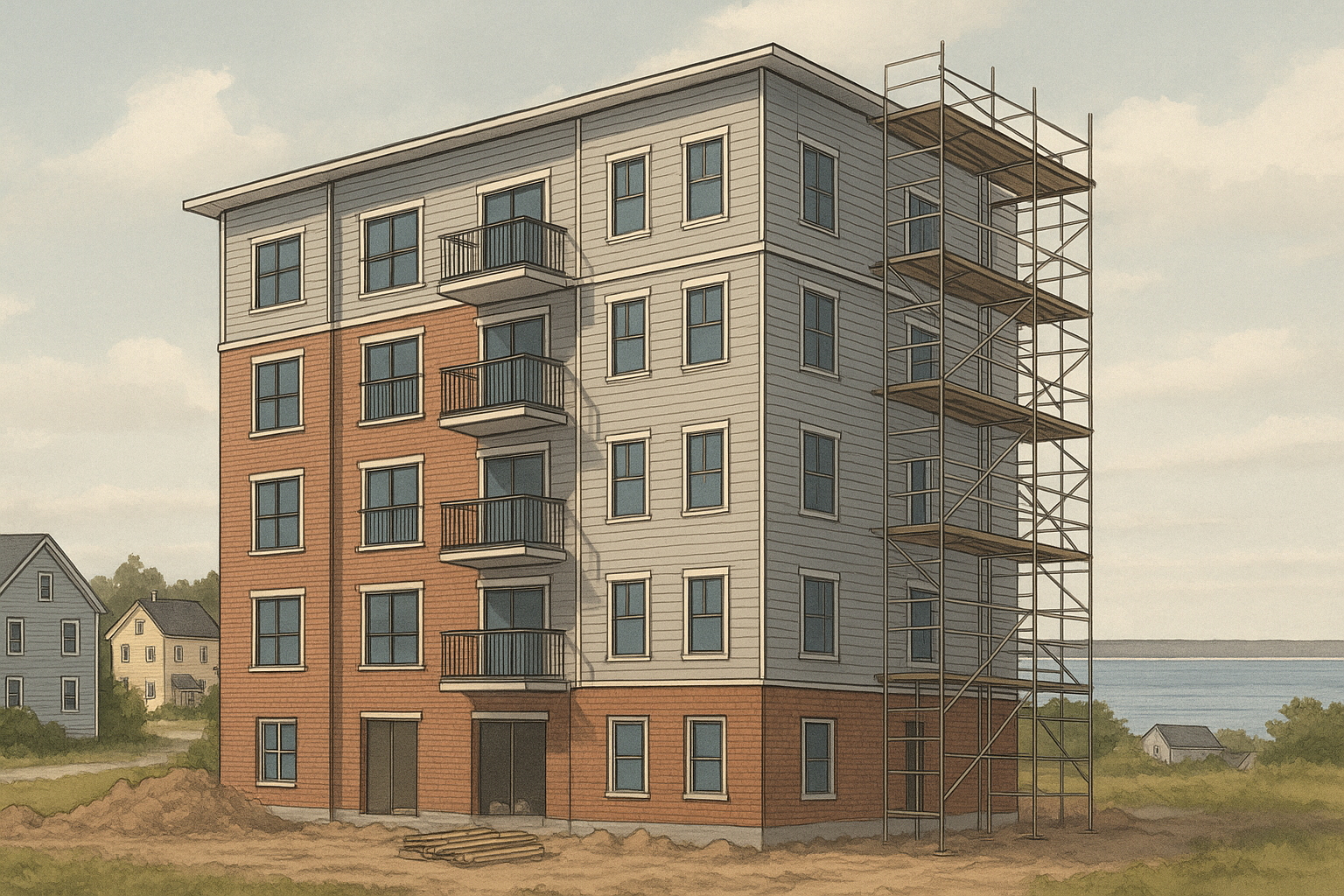
Rent Control and New Construction: How Policy Impacts Developers in Nova Scotia
Rent control in Nova Scotia limits rent increases to protect tenants but creates challenges for developers. Rising construction costs, capped rental income, and project delays make it harder to build new rental units, especially for 4–24 unit properties. Developers face shrinking profit margins as expenses outpace revenue potential, leading many to reconsider projects.
Key takeaways:
- Profitability issues: Rent caps reduce returns, making some projects unattractive.
- Rising costs: Labour, materials, and regulatory expenses continue to climb.
- Delays: Longer timelines increase financing costs and delay rental income.
- Solutions: Fixed-price contracts, integrated design-build approaches, and CMHC MLI Select financing help reduce risks and improve cash flow.
Developers can still succeed by focusing on cost-efficient construction, guaranteed timelines, and financing programs tailored to regulated markets.
Rent caps can be controversial. How does Nova Scotia’s measure up?
How Rent Control Hurts New Construction Projects
Rent control in Nova Scotia presents a tough challenge for property developers planning multi-unit rental buildings. While aimed at protecting tenants, these policies drastically alter the financial dynamics of new construction projects.
Lower Returns on Investment
Rent control directly impacts the profitability of new developments. By capping rental increases while construction costs continue to climb, property owners see their expected returns shrink. For instance, developers aiming for annual returns of 12–20% often find those projections significantly reduced under rent control.
Take a typical fourplex project with a construction cost of about $640,000. Even as operating expenses - like property taxes, maintenance, and utilities - rise, rent control limits the ability to adjust rental rates accordingly. This mismatch between growing costs and fixed income potential creates a financial strain, leaving many developers questioning whether such projects are worth pursuing when other investments offer better returns.
Rising Costs and Limited Income Growth
Construction costs in Nova Scotia have surged due to higher prices for labour, materials, and compliance with regulations. At the same time, rent control policies restrict how much rental rates can increase, making it difficult for property owners to keep up with rising expenses. For example, a developer planning to charge $1,950–$2,100 per unit might find their income projections falling short as costs outpace the capped rent increases.
This creates a double bind: expenses climb faster than expected, while revenue growth is artificially limited. For many developers, this financial squeeze leads to cancelled projects, further straining the already limited housing supply. Unexpected costs, such as delays or additional foundation work, only add to the pressure. With no way to offset these extra expenses through higher rents, the feasibility of new projects becomes even more tenuous.
Delays, Overruns, and Coordination Issues
Traditional construction methods often exacerbate the financial challenges developers face. When separate teams handle design, engineering, and construction, delays and miscommunication are common. An eight-month project can easily stretch to 18 months or more, increasing financing costs while delaying rental income.
Cost-plus contracts, where contractors bill actual costs plus a markup, add another layer of uncertainty. A project initially budgeted at $160,000 per unit can quickly balloon due to rising material costs, change orders, or extended timelines. For developers operating under rent control, every unexpected cost eats further into already slim margins, creating a high-risk scenario.
Disputes between multiple contractors over delays or quality issues add to the headaches, forcing property owners to spend valuable time resolving problems instead of focusing on generating revenue. Developers who have faced cost overruns of 30–60% on traditional projects find these challenges even more pronounced under rent control. Without the ability to adjust rents to reflect rising costs, many are forced to reconsider whether new developments are financially viable.
These mounting difficulties highlight the importance of streamlined construction approaches, such as integrated design-build solutions, that can help lock in costs and timelines to reduce financial uncertainty.
Ways to Reduce Rent Control's Impact on Construction
With rent increases capped while costs continue to rise, property owners need smart strategies to maintain profitability. These strategies include securing favourable financing, improving project management, and designing cost-effective, efficient buildings.
Leveraging CMHC MLI Select Financing
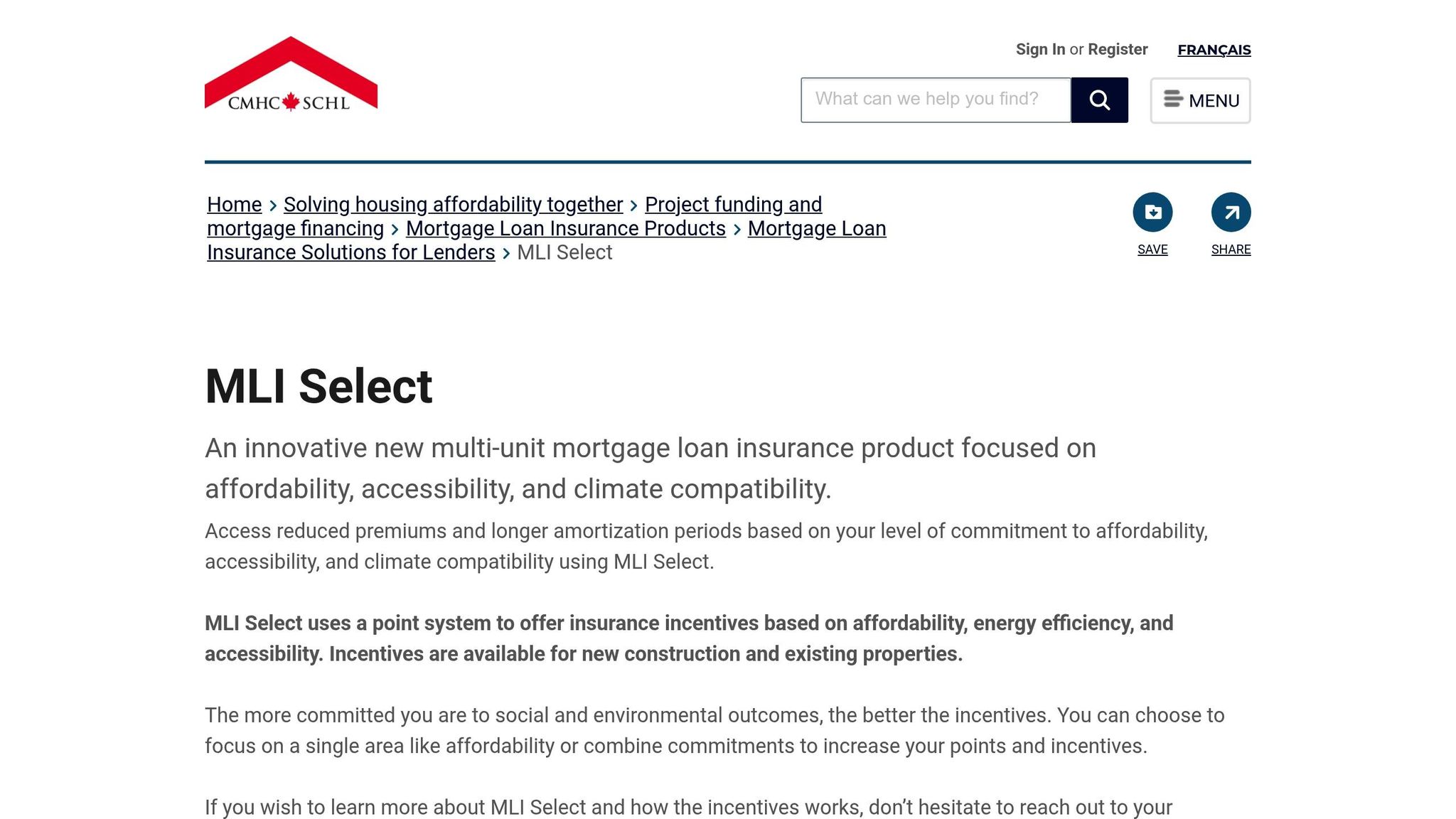
The CMHC MLI Select program is a game-changer for property owners, offering high loan-to-value ratios of up to 95%. For example, on a $640,000 fourplex, this reduces the upfront capital required from $128,000–$160,000 down to just $32,000 [1][4].
The program also allows for extended amortization periods of up to 50 years, which significantly lowers monthly mortgage payments and improves cash flow [1][4]. This is especially helpful under rent control, where annual rent increases are capped at 5% until December 31, 2025 [5]. With these terms, property owners can achieve positive cash flow from the start, even with higher construction costs.
Another advantage is the reduced debt service coverage ratio, set at 1.1x, making it easier for projects to qualify for financing [1][4]. Projects that meet criteria for affordability, energy efficiency, or accessibility can also benefit from reduced mortgage insurance premiums and potentially lower interest rates, cutting overall costs further.
For property owners willing to commit to affordability targets - such as renting units at or below 30% of the local median renter income - these financing perks align with broader social housing goals [1][2]. However, rent increases for these affordable units must follow provincial rules, including Nova Scotia’s current 5% cap [3].
Partnering with Integrated Design-Build Companies
Integrated design-build companies simplify construction by combining all professionals under one roof. This approach offers fixed-price contracts, locking in costs before construction begins and avoiding the budget overruns that often range from 30-60% with traditional methods.
These companies also ensure guaranteed timelines. Instead of juggling multiple contractors, property owners work with a single accountable partner. Some firms even offer financial penalties - up to $1,000 per day - for missed deadlines, providing both predictability and compensation for delays.
This level of coordination is especially valuable under rent control. Delays mean lost rental income, which cannot be recovered through higher rents. For property owners aiming for monthly rents of $1,950–$2,100 per unit, meeting deadlines is critical to achieving projected annual returns of 12-20%.
By combining streamlined project delivery with efficient design, property owners can further control costs and stay profitable.
Designing Efficient and Cost-Effective Buildings
Energy-efficient construction isn't just good for the environment - it’s also a smart financial move. Buildings that exceed provincial energy codes by 40% or more can qualify for CMHC MLI Select’s top financing terms, including 95% loan-to-value ratios and extended amortization [1][4].
Value-engineered designs can also help maximize rental income while keeping costs in check. Features like ductless heat pumps, triple-pane windows, and efficient layouts lower utility expenses for both property owners and tenants. Under rent control, where passing on rising costs to tenants is limited, these savings are crucial.
Smart design choices also make properties more attractive to tenants. Amenities like in-unit laundry, modern appliances, and energy-efficient heating systems allow owners to charge premium rents for new leases, which aren’t subject to rent control caps. This means market-rate rents of $1,950–$2,100 per unit remain achievable for new tenants, even if increases for existing ones are restricted.
Additionally, buildings qualifying for Energy Star certification or similar programs can access rebates and incentives, further reducing construction costs. These savings help offset the financial challenges posed by rent control, making new projects more feasible for property owners.
sbb-itb-16b8a48
Case Studies: How Rent Control Affected Nova Scotia Projects
Rent control policies can significantly influence how construction projects are planned and executed, with the choice of construction method playing a key role in determining outcomes.
Challenges with Traditional Multiple-Contractor Projects
When projects rely on separate architects, engineers, and subcontractors, property owners often face a maze of coordination issues. This fragmented approach can lead to delays and unexpected expenses - problems that are magnified under rent control, where rental increases are capped. Even brief disruptions can jeopardize a project's financial viability, shrinking returns on investment. These challenges highlight the risks property owners face when using traditional construction methods in a tightly regulated rental market.
Advantages of an Integrated Design-Build Approach
A more cohesive solution lies in the integrated design-build approach. This method unites design, engineering, and construction under a single, accountable team. By streamlining communication and decision-making, integrated design-build firms can identify potential issues early, minimizing the chances of delays and budget overruns. For property owners navigating rent control, this approach offers stability through fixed-price contracts, guaranteed timelines, and access to financing programs like CMHC MLI Select. These features provide the predictability needed to ensure projects remain viable despite regulatory constraints.
These case studies illustrate a clear takeaway: while traditional, fragmented methods increase the risk of delays and cost escalations, an integrated design-build strategy offers a more dependable way to develop rental properties in Nova Scotia's regulated market.
Choosing Construction Methods: Multiple Contractors vs Integrated
When building rental units under Nova Scotia's rent control, the choice of construction method is a pivotal decision that directly influences your project's financial success. With rental income increases limited by regulation, keeping your budget and timeline on track becomes even more critical. The approach you take to construction can determine whether your project thrives or struggles.
The traditional method involves hiring separate professionals for each stage of the project - architects for design, engineers for structural planning, and various contractors for construction. While this might seem straightforward, it often leads to delays and cost overruns. Under rent control, these setbacks are particularly damaging since you can't simply increase rents to offset unexpected expenses.
An alternative is the integrated design-build model, which combines planners, architects, engineers, and construction crews into one cohesive team. This streamlined approach eliminates the coordination headaches that typically plague traditional methods. Integrated firms often promise completion in six months - a stark contrast to the 12 to 18 months common with fragmented contracting.
The financial impact of delays is significant. For a typical four-unit rental property, construction delays can cost approximately $8,800 per month in lost rental income. Additionally, traditional projects often see budget overruns ranging from 30% to 60%. In contrast, integrated firms provide fixed pricing and contractual guarantees, with penalties of up to $1,000 per day for missed deadlines.
Here’s a side-by-side comparison of the two approaches:
Comparison Table: Multiple Contractors vs Integrated Models
| Aspect | Multiple Contractors Model | Integrated Design-Build |
|---|---|---|
| Budget Control | Cost-plus contracts with overruns of 30-60% | Fixed pricing at $160,000/unit with no overruns |
| Project Timeline | 12-18 months with frequent delays | Guaranteed 6-month completion |
| Coordination | Disorganized management of multiple teams | Single point of accountability |
| Financial Risk | Owner absorbs all cost increases and delays | Builder assumes penalties for delays |
| Quality Assurance | Multiple warranties from different contractors | Unified 2-year warranty with thorough checks |
| Communication | Fragmented updates from various sources | Daily photo updates via a single portal |
Under the constraints of rent control, the integrated design-build model provides a level of predictability that traditional methods simply can't match. By controlling costs and timelines, this approach ensures property owners can maintain healthy returns on their investment, even when rental income growth is restricted. Choosing the right construction strategy is not just about efficiency - it's about protecting your bottom line.
Conclusion: Building Smarter Under Rent Control
Nova Scotia's rent control policies have reshaped the way rental properties are developed. With rental increases capped and construction costs climbing, property owners can no longer rely on fragmented approaches. Instead, they need strategies that minimize risk and deliver results efficiently.
Fragmented projects often lead to delays and budget overruns, putting returns at risk. This makes coordinated, fixed-price contracts more critical than ever. The integrated design-build model stands out as a solution. By offering fixed pricing, a six-month timeline, and penalties for delays, this approach provides the cost control and schedule reliability that rent-controlled projects require. With a single point of accountability, coordination becomes simpler, and profitability is better protected.
In this environment, integrated construction methods provide the structure and clarity needed to succeed. By embracing systematic solutions, leveraging CMHC MLI Select financing to improve cash flow, and focusing on efficient designs, property owners can navigate the constraints of rent control and still achieve profitable outcomes. One Nova Scotia-based design-build specialist demonstrates how fixed pricing and guaranteed timelines can secure investments in this challenging market.
Although the region continues to face a rental housing shortage, property owners who adapt their construction strategies to align with rent control realities can still find success. The key is working with experts who prioritize predictability, turning challenges into opportunities for smart and profitable development.
FAQs
How do rent control policies affect the financial feasibility of building new rental properties in Nova Scotia?
Rent control policies in Nova Scotia, which limit annual rent increases to 5% until 31 December 2027, play a major role in shaping the financial landscape for rental projects. These regulations apply to current tenants and lease renewals, effectively capping revenue growth and, in turn, reducing the return on investment (ROI) for developers.
To navigate these restrictions, developers can explore cost-effective strategies. For instance, adopting efficient design-build models can help streamline construction, while financing tools like the CMHC's MLI Select program can provide additional financial flexibility. Although rent control poses certain challenges, thoughtful planning and strategic upgrades can help developers maintain profitability and achieve long-term stability in their projects.
How does an integrated design-build approach help developers manage challenges under rent control in Nova Scotia?
An integrated design-build method can be a game-changer for developers navigating rent control challenges in Nova Scotia. By merging design and construction into one contract, this approach simplifies communication and ensures one-point accountability, cutting down on delays and unexpected costs that often arise with separate contractors.
This method also offers better control over project timelines and budgets - critical factors when rent control policies cap potential income. Developers gain the advantage of efficient planning and execution, helping to manage financial pressures from reduced returns while keeping projects on schedule and within budget.
How can property owners in Nova Scotia use CMHC MLI Select financing to address the challenges of rent control?
Property owners in Nova Scotia have a great opportunity with CMHC MLI Select financing, especially if they prioritize affordability, energy efficiency, and accessibility in their rental projects. This program provides valuable perks like longer amortization periods, lower interest rates, and reduced insurance premiums. These benefits can help ease some of the financial challenges that come with rent control policies.
By meeting the program's criteria, property owners can boost cash flow, strengthen long-term profitability, and make their developments more financially sustainable, even under rent control constraints. Plus, this approach contributes to creating housing that is both inclusive and better for the environment - key factors in today's competitive market.